This site is being archived soon. Visit wesnet.org.au for more information.

Intervention of child protection services in cases where children are living with domestic and family violence

In 2018, AWAVA hosted an intern, Tatiana Zhdanova, from the Australian National Internship Program. Drawing on expert interviews with women’s legal and court advocacy services, Tatiana prepared a report on common patterns and outcomes for children and their parents in cases where children are exposed to domestic and family violence. The report also proposes recommendations to improve outcomes for children and mothers who are victims/survivors.

Download the report here  

Path to Nowhere Report: Women on Temporary Visas Experiencing Violence and their Children

The National Advocacy Group on Women on Temporary Visas Experiencing Violence has released the report “Path to Nowhere”. The report draws from data collected by an online survey which was developed for service providers to submit data on women with worked with or who sought assistance from them during the month of August 2018.


In summary the survey process found that during the month of August:

  • It appears there were at least 387 women on temporary visas experiencing violence accessing support
    services in Australia;
  • These women had more than 351 children or dependants
  • Around a quarter (24%) of these women were living in crisis accommodation and around one in ten
    (11%) were living in temporary accommodation;
  • One in ten of these women were living at home with the partner, which may increase their risk of
    experiencing further violence;
  • Crisis and long-term housing was the service most needed by clients that organisations were unable
    to provide, followed by financial assistance.

You can download the report here:


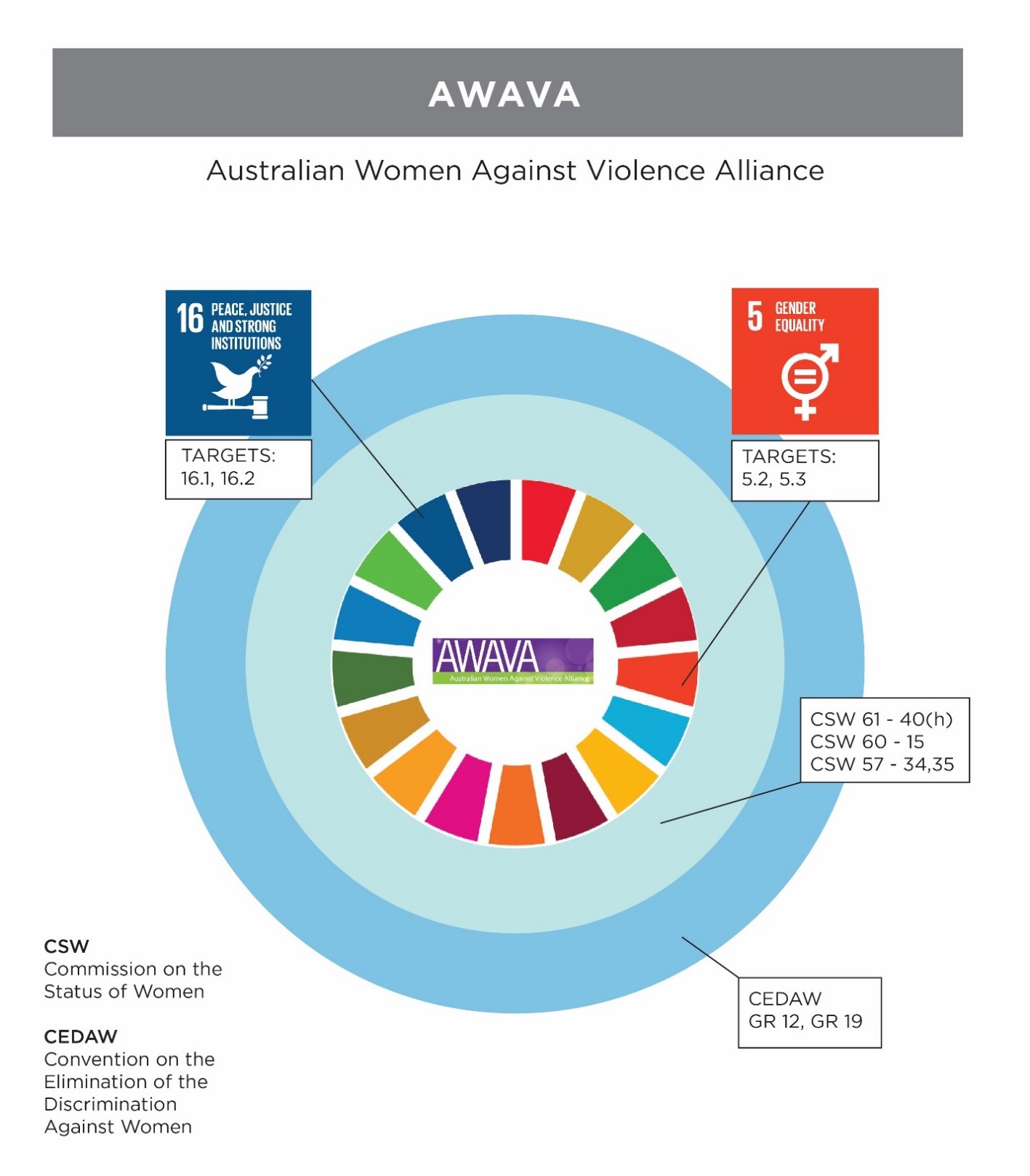
Mapping Domestic Priorities and International Commitments

This document outlines AWAVA’s domestic advocacy priorities against international frameworks and
commitments on gender equality and women’s rights.

AWAVA Advocacy Priorities

  1. Australian governments must fund and support effective, accessible and competent services for the diverse
    groups of women subjected to different forms of violence.
  2. Women’s and children’s safety must be placed at the centre of the family law system, as outlined in Women’s
    Legal Services Australia’s Five Step Plan for Safety First in Family Law.
  3. The National Plan to Reduce Violence Against Women and their Children needs to include a national consultative mechanism for civil society to be involved in oversight and guidance, as well as appropriate mechanisms for monitoring and evaluation.


Download the document here 

Submission on the development of the Fourth Action Plan

This submission draws on the survey conducted by AWAVA in May-June 2018, as well as AWAVA’s policy positions established in consultation with our members and networks including peak bodies and other diverse organisations from every State and Territory in Australia working in areas such as domestic and family violence, sexual assault, legal assistance, and education.


The Fourth Action Plan is a milestone in the efforts to respond to violence against women in Australia. Being the last four-year plan of the 12-year timeframe, it represents a crucial opportunity for honest evaluation and thoughtful planning towards ongoing, consistent and well-resourced efforts to reduce and ultimately end violence against women.

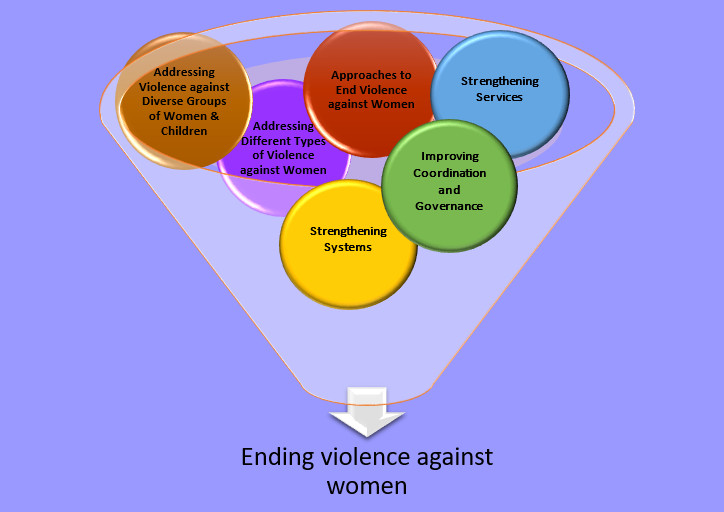
AWAVA offers a comprehensive structure that policy-makers might find useful in conceptualising the priority areas for the Fourth Action Plan, and working towards a second National Plan. We offer a framework for addressing violence against women and their children holistically by taking intersectional approaches to end violence against women, addressing violence against diverse groups of women and their children, addressing different types of violence against women, strengthening systems and services, and improving coordination and governance. For all the efforts to be sustainable and successful, long-term funding is required.
 

Download the full Position Paper here 


Download the Executive Summary here  

AWAVA Fourth Action Plan Survey Report

The National Plan to Reduce Violence Against Women and Their Children 2010-2022 (the National Plan) is a major policy framework that has the potential to help achieve gender equality and end violence against women. The National Plan acts as the primary Australian policy on reducing sexual assault and domestic and family violence.


Support for the National Plan has been an important part of AWAVA’s work since the inception of the Plan. We have provided advice on the development of the three Action Plans so far, and have provided feedback on their implementation.


This survey is a part of AWAVA’s work to contribute to evaluations of the Third Action Plan (3AP) and consult on the development of the Fourth Action Plan (4AP). The survey aims to identify gaps, issues and positive steps that can inform the creation of the Fourth Action Plan.


The survey was structured to collect separate data from individuals (people speaking on their own behalf only, and not on behalf of any organisation), and representatives of service providers and peak bodies. Part 1 of this report combines responses from service providers and peak bodies. Part 2 summarises responses received from individuals. Part 3 combines diversity data.


The survey ran from May to June 2018. In total, 243 people responded to the survey. Among them there were 79 service providers (48 full and 31 partial responses), 7 peak bodies (4 full and 3 partial responses) and 157 individual responses. Partial responses were used in the analysis to the extent possible. Where appropriate we indicate the total number of responses received to a given question. We would like to thank everyone who completed the survey, and all the individuals and organisations who circulated it within their networks.


Download the report here

AWAVA’s 2018-19 Federal Budget Analysis

We have completed our analysis of how the 2018-19 Federal Budget addresses violence against women. While there is some good news in the Budget, other areas need significant improvement. Download our full analysis: 


Have a look at our video summary here:


Women’s Refuges as Part of Feminism: A View from a Different Angle

AWAVA was one of the sponsor partners for the March 2018 issues of the Parity Magazine titled The Future of Women’s Refugees.


Dr Merrindahl Andrew, AWAVA’s Program Manager is writing on women’s refuges as part of feminism:

While refuges are clearly part of the homelessness services sector,

[…] what is sometimes less clear in policy discussion and development is the simultaneous position that refuges occupy within an evolving set of feminist (or feminist-informed) institutions and, more broadly, an evolving women’s movement.

Continue reading here.

Brochure: The Unique Role of Specialist Women’s Services in Ending Violence against Women

With a variety of different organisations in Australia providing services to survivors / victims of violence, it is important to recognise the proven efficacy of the established specialist women’s services sector. These services are at the forefront of ending violence against women. The impact and effectiveness of these specialist services is underpinned by a set of  good practice principles that are supported by international research and evidence-based practice

[1].


Comprehensive and integrated good-practice response of these services is underpinned by (1) a rights-based approach that enables understanding of the gendered nature of the violence, its causes and consequences and (2) empowers survivors / victims by enabling self-determination, control over processes and choice. Good- practice service provision, taking (3) a client-centred approach, remains accountable to victims / survivors and (4) places their safety, needs and interests at the centre of all decisions. It also works to ensure that (5) perpetrators are held accountable for their use of violence. Good-practice service provision delivers (6) culturally-sensitive, holistic and accessible services to diverse groups of women.


Using these principles as a framework, specialist women’s services are working to ensure the efficacy of the support they provide and to create the conditions for survivors / victims to access justice. These principles should underpin the delivery and coordination of all essential services responding to women and children subjected to violence.


Download the pdf version of the brochure here 

Download the word version of the brochure here 


For a printed copy, please email [email protected]


[1] AWAVA 2016:  The role of specialist women’s services in Australia’s response to violence against women and their children https://awava.org.au/2016/04/07/research/role-specialist-womens-services-australias-response-violence-women-children

Family Violence, Child Protection and Family Law Resource

Children and families are entering the child protection system with increasingly complex family circumstances, including domestic and family violence. Victims/survivors of domestic and family violence often do not receive the support they need to maintain or re-establish their caring roles while building lives that are safe from violence. The aim of this page is to provide a guide to some available policy reports, information and links on the intersection of domestic and family violence, child protection and family law. This resource does not compile existing recommendations or make new ones, although many of the reports referred to do contain proposals for reform. The content is relevant for June 2017.


If you have any feedback or wish to comment on the material listed here, please contact [email protected]


Relevant legislation and jurisdictions


Work in the intersection of domestic and family violence, child protection and family law is complicated by overlapping jurisdictions, e.g. there may be State/Territory interventions (child protection) at the same time as interventions at the Federal level (family law).


These overlapping jurisdictions and services are outlined in a report on Collaborative work across the child protection and specialist domestic and family violence interface  by Cathy Humphries and Lucy Healey for ANROWS’s PAThways and Research Into Collaborative Inter-Agency practice – PATRICIA project


The relevant pieces of legislation in Australian jurisdictions are outlined in the table below:


Jurisdiction Legislation
Federal Family Law Act 1975Family Law (Child Protection Convention) Regulations 2003
NSW Children and Young Persons (Care and Protection) Act 1998Children and Young Persons (Care and Protection) Amendment Bill 2009

Children and Young Persons (Care and Protection) Amendment (Parental Responsibility Contracts) Act 2006

Child Protection (Offenders Registration) Act 2000

Crimes Act 1900

Commission for Children and Young People Act 1998

The Ombudsman Act 1974

ACT Children and Young People Act 2008Adoption Act 1993

Human Rights Act 2004

Human Rights Commission Act 2005

Public Advocate Act 2005

NT Care and Protection of Children Act 2007Information Act 2006

Disability Services Act 2004

Criminal Code Act 2006

QLD Child Protection Act 1999Child Protection Reform Amendment Act 2014

Public Guardian Act 2014

Family Child and Commission Act 2014

Education (General Provisions) Act 2006

Public Health Act 2005

Commission for Children and Young People and Child Guardian Act 2000

Adoption of Children Act 1964

SA Children’s Protection Act 1993Children’s Protection Regulations 2006

Young Offenders Act 1994

Adoption Act 1988

Family and Community Services Act 1972

TAS Children, Young Persons and their Families Act 1997Children, Young Persons and their Families Amendment Act 2009

The Family Violence Act 2004

VIC Children, Youth and Families Act 2005Working with Children Act 2005

Child Wellbeing and Safety Act 2005

The Charter of Human Rights and Responsibilities Act 2006

The Commission for Children and Young People Act 2012

WA Children and Community Services Act 2004Working with Children (Criminal Record Checking) Act 2004

Family Court Act 1997

Adoption Act 1994

Child Care Services Act 2007


National Policy Context


The two key national policy frameworks are:

The National Framework for Protecting Australia’s Children 2009–2020


AND


The National Plan to Reduce Violence Against Women and their Children 2010-2022


Also relevant is the Royal Commission into Institutional Responses to Child Sexual Abuse


Key reports, inquiries and submissions


Australian Human Rights Commission Children’s Rights Report (2016)


Australian Institute of Family Studies (2016) Child Abuse and Neglect Statistics


Australian Institute of Family Studies (2015) What is child abuse and neglect? CFCA Resource Sheet


Australian Institute of Family Studies (2011) Joining the dots: Child protection systems in Australia 


Australian Institute of Health and Welfare.  List of child protection agencies by states and territories


Australian Law Reform Commission (2010) Final Report Family Violence—A National Legal Response Chapter 19 The Intersection of Child Protection and Family Laws and Chapter 4 Purposes of Laws Relevant to Family Violence. Child protection law


Department of Families, Housing, Community Services and Indigenous Affairs together with the National Framework Implementation Working Group (2011) An outline of National Standards for Out‐of‐home Care A Priority Project under the National Framework for Protecting Australia’s Children 2009 – 2020


Domestic Violence NSW (2016) Submission to the NSW Parliamentary Inquiry into Child Protection 


Family Court of Australia (2016) Child abuse allegations: Magellan Case Management 


Family Law Council (2016) Families with Complex Needs and the Intersection of the Family Law and Child Protection Systems. The Final Report 


Family Law Council (2016) Families with Complex Needs and the Intersection of the Family Law and Child Protection Systems. The Interim Report


Federal Circuit Court (2013) Exposure to family violence and its effect on children 


Senate Community Affairs Committee report on Out-of-Home Care (2015)


Women’s Legal Service NSW (2016) Submission to the NSW Parliamentary Inquiry into Child Protection 


Women’s Legal Services Australia (2017) Submission to House of Representatives Standing Committee on Social Policy and Legal Affairs Submission to the parliamentary inquiry into a better family law system to support and protect those affected by family violence


Child protection and Aboriginal and Torres Strait Islander Children


Aboriginal and Torres Strait Islander children are overrepresented in child protection, with a recent inquiry report noting: “In 2013, peak Aboriginal and community service organisations warned the Victorian government that the rate of Aboriginal child removal in Victoria was exceeding levels seen at any time since white invasion”

[1]. A Family Law Council report[2] states that from 1999-2000 to 2009-2010, the substantiation rate of notifications in relation to Aboriginal and Torres Strait Islander children increased from 15 to 37 per 1000 children, compared with four to five per 1000 children for non-Indigenous children.  At 30 June 2015, the rate of Aboriginal and Torres Strait Islander children on orders was 9 times that for non-Indigenous children.[3]


Some relevant resources:


Aboriginal and Torres Strait Islander Healing Foundation, Bringing Them Home 20 years on: an action plan for healing


Australian Human Rights Commission 1997 Bringing Them Home: “The Stolen Children” Report


Australian Institute of Family Studies 2016, Child Protection and Aboriginal and Torres Strait Islander Children


Commissioner for Children and Young People, Victoria (2016) Always Was, Always Will Be Koori Children Systemic inquiry into services provided to Aboriginal children and young people in out-of-home care in Victoria (2016) 


Family Law Council 2012 Improving The Family Law System For Aboriginal And Torres Strait Islander Clients A report to the Attorney-General 


Judicial Council on Cultural Diversity (2016) The Path to Justice: Aboriginal and Torres Strait Islander Women’s Experience of the Courts


Little Children are Sacred: Report of the Northern Territory Board of Inquiry into the Protection of Aboriginal Children from Sexual Abuse (2007)


Children from culturally and linguistically diverse backgrounds


Unique challenges experienced by families from culturally and linguistically diverse backgrounds are migration and acculturation stress, displaced sense of belonging and cultural identity, perceived or actual racism and discrimination, intergenerational conflict, low English proficiency, insufficient awareness of institutional systems and local services available, lack of extended family/community support, poor settlement experience in the period after arrival and socio-economic disadvantage.


Some relevant reports surveying the issues include:


Australian Churches Refugee Taskforce (2014) Protecting the Lonely Children


Ethnic Communities Council QLD (2011) Resources for Culturally and Linguistically Diverse (CALD) Clients and Child Protection 


Judicial Council on Cultural Diversity 2016, Migrant and Refugee Women’s Experience of the Courts 


Kaur, J (2012), Cultural Diversity and Child Protection: Australian research review on the needs of culturally and linguistically diverse (CALD) and refugee children and families. Queensland, Australia


Losoncz, I. (2015) Building safety around children in families from refugee backgrounds: Ensuring children’s safety requires working in partnership with families and communities. Australian National University 


Saunders, V., Roche, S., Prof. McArthur, M., Prof. Arney, F., Dr Ziaian, T. (2015) Refugee Communities Intercultural Dialogue: Building Relationships, Building Communities. Institute of Child Protection Studies, Australian Catholic University, University of South Australia 


Sawrikar, P, (2009) Culturally appropriate service provision for culturally and linguistically diverse (CALD) children and families in the New South Wales (NSW) child protection system (CPS). Social Policy Research Centre, University of New South Wales 


Sawrikar, Pooja and Katz, Ilan Barry (2014) Recommendations for Improving Cultural Competency When Working with Ethnic Minority Families in Child Protection Systems in Australia, Child and Adolescent Social Work Journal, 2014, 31, 5, 393 


Victorian Royal Commission into Family Violence: Summary and recommendations, Parl Paper No 132 (2014–16)


Williams, Charlotte RMIT University Enhancing service delivery for culturally and linguistically diverse children and families 


Children raised by same-sex or transgender parents


Policies and practices to support same-sex parented families in the Australian health, education, child protection and foster care systems have been assessed in the following reports:


* Note: Resources suggested below does not take into account the most recent (2017) legislative change, that adoption by same-sex couples is legally available in all jurisdictions of Australia – except for the Northern Territory.


Dempsey, D. (2013) Same-sex parented families in Australia. CFCA PAPER NO. 18. Australian Institute of Family Studies 


Hayes, A., & Higgins, D. (Eds.). (2014). Families, policy and the law: Selected essays on contemporary issues for Australia. Melbourne: Australian Institute of Family Studies p.89-99 


Riggs, D.W. (2011). Australian lesbian and gay foster carers negotiating the child protection system: Strengths and challenges. Sexuality Research & Social Policy, 8(3), 215-226.


Children with disabilities and child protection


Submissions by leading disability advocacy organisations to the Senate Community Affairs inquiry into Out-of-Home Care have argued that child protection systems do not provide adequate support for families with disability or families of children with disability to maintain care of their children. [4] The following reports outline some of the issues involved:


Breckenridge, J and Flax, G (2016) Service and support needs of specific population groups that have experienced child sexual abuse, Royal Commission into Institutional Responses to Child Sexual Abuse, Sydney.


Child Protection Systems Royal Commission, The life they deserve: Child Protection Systems Royal Commission Report, Volume 1: Summary and Report, Government of South Australia, 2016. 


Llewellyn, G, Wayland, S, Hindmarsh, G (2016) Disability and child sexual abuse in institutional contests, Royal Commission into Institutional Responses to Child Sexual Abuse, Sydney 


McConnell, D, Llewellyn, G, Ferronato, L. (2000) Parents with a disability and The NSW Children’s Court, University of Sydney 


Robinson, S (2016) Feeling safe, being safe: What is important to children and young people with disability and high support needs about safety in institutional settings?, Royal Commission into Institutional Responses to Child Sexual Abuse, Sydney, 2016. 


Download the word version of the resource here 


[1] ALWAYS WAS, ALWAYS WILL BE KOORI CHILDREN. Systemic inquiry into services provided to Aboriginal children and young people in out-of-home care in Victoria http://www.ccyp.vic.gov.au/downloads/always-was-always-will-be-koori-children-inquiry-report-oct16.pdf

[2] Improving the family law system for Aboriginal and Torres Strait Islander clients. A report to the Attorney-General prepared by the Family Law Council 2012

[3] Children Protection 2014-2015 AIHW

[4] Intellectual Disability Rights Service, Submission 21; Endeavour Foundation, Submission 43; National Disability Services, Submission 54; ACT Disability, Aged and Carer Advocacy Service (ADACAS), Submission 71; People with Disability Australia (PWDA), Submission 74; Children with Disability Australia (CDA), Submission 80. All submissions are made into the Out-of-Home Care Inquiry by the Senate Community Affairs Committee Secretariat.

10 steps you can take to help end violence against women

*Download a glossy version of the brochure here 


Violence against women is endemic, and it affects women of every class, age, sexuality, race, ability/disability, religion or other background. The main driver of violence against women is gender inequality, which operates on many levels from social and cultural norms to economic and structural injustices.


In Australia, we live in a society where one in three women has experienced physical violence since the age of 15 and one in five women has experienced sexual violence[1]. This makes the commitment to end violence against women a responsibility for everyone.


Whether you are female or male, young or senior, a parent or a person who has friends with kids, simply a colleague or a boss, if you work professionally in the area of ending violence against women or are just a concerned individual ready to act, we all can take steps that will help to eliminate violence against women.


The aim of this fact sheet is to equip you with some practical steps and knowledge so your actions to eliminate violence against women will make a positive difference.


1.                  Seek help immediately

If you are feeling in danger, you should ring the Police on 000 immediately. If you are not in immediate danger but need support, call 1800 RESPECT for counselling, referral and information (ph: 1800 737 732). 1800 RESPECT also provides support to friends and families of a woman experiencing violence.


If you hear or see a violent or abusive situation happening, don’t turn your back. If it is safe you could try to defuse the situation by intervening. But if you feel that may be dangerous, or if you think a person is being hurt or about to be hurt, you should ring the Police on 000 immediately.


2.                  Stay informed & educate yourself

Educate yourself about the causes, drivers and consequences of violence against women. Learn more about domestic and family violence and sexual violence and help spread that knowledge.


It is important to understand violence against women in terms of power dynamics and social structures, rather than just as purely individual experiences.


Violence against women and children occurs within a patriarchal society where male dominance and privilege are normalised. Violence is used as a means of coercion and control over a woman or a partner and has nothing to do with one’s personal traits.


Sexual violence is an abuse of power too. Men rape women because they believe women are possessions, not equals, and that they have a right to women’s bodies. Myths like this place responsibility on women and encourage more victim-blaming.


Violence is more common in families and relationships in which men control decision making, and less so in those relationships where women have a greater degree of independence[2].


But violence can occur even in the relationship of same-sex attracted people or people who do not identify as gender-binary. It is all about abuse and control. We should not let this be Another Closet for people to be confined in, so let’s bust our myths about that.


Learn more:


In our technology-saturated world, women are subjected to violence through their phone and online too. This includes stalking, control, threats, bullying and image-based abuse both in the context of domestic and family violence and more generally. It is important to know how to use technology carefully to help find safety for yourself and other people who may be subjected to technology-facilitated abuse. Learn more from the toolkit prepared by WESNET’s Safety Net Australia project or on the website of the e-Safety Commissioner.


3.                  Use empowering language

Language matters. We perceive the world around us through words but words can have different meanings and interpretations.  Language frames not only how we understand the problem but also how effectively we will respond to it.


Whether you are speaking in a group about the problem of violence against women in the community, talking to a friend or with someone who’s been affected by violence, language can do justice or cause harm.


If you are a supporter speaking in public or at a community event, avoid referring to women who had violence inflicted on them as ‘victims’ as that term may not reflect a woman’s full identity, but instead define her in terms of something that is only part of her experience. A better choice would be using ’victim / survivor’ terminology as it acknowledges the crime committed against a woman while at the same time recognising her agency and life beyond violence.


Women’s Health West has produced a comprehensive resource about Speaking publicly about preventing men’s violence against women: Curly questions and language considerations.


Our Watch has produced a comprehensive resource for journalists writing about women who have survived violence.


4.             Respond to someone disclosing violence appropriately

If you need to support someone who has disclosed to you the violence inflicted on them, or who has asked you for help, language matters immensely.


Whoever it may be, your friend, colleague or family member, respond appropriately and make sure that she feels supported and encouraged to talk to you and seek help. Listen and believe. Never dismiss family violence as a just “a domestic”[3] or suggest that sexual violence might have been a “misunderstanding”. Provide support. Sometimes practical assistance such as assisting with shopping or picking children up from school (with proper authorisation) can be of great help. Never judge or blame a woman about the violence, regardless of the circumstances or her background.


Domestic Violence Resource Centre Victoria has developed a great resource for family and community members on how your support can make a difference.


Continuously reflect on the language you are using, information that you are spreading and support you are offering. Encourage others to do the same. Reflection helps learning and enables improvement.


Get more tips on learning through reflective practice with this resource developed by Domestic Violence Resource Centre Victoria.


5.                  Ethical representation of victim / survivors

No matter what you do, you should always treat a woman who has experienced violence in a dignified, respectful and ethical way. In practice this means accepting an experience without judgement and treating a woman as an individual and not through the prism of your stereotypes about her cultural, religious, economic or social background or affiliations. This encompasses both the language you are using and the kinds of support you are offering.


Be aware that if you make inappropriate comments about a woman’s social position, this may reinforce the power dynamics that contribute to the violence and result in victim-blaming.


6.                  Speak up

Violence is never okay. Challenge practices that condone  violence against women and encourage others to speak up. Sexist jokes are never okay no matter the circumstances they are told in or the position of a teller.


As a  ‘bystander’[4], someone who observes an act of violence, discrimination or other unacceptable or offensive behaviour, you can play a powerful role in preventing and responding to violence against women. Speak out about or seek to engage others in responding to specific incidents of sexism, discrimination or violence against women. It’s okay to criticise afriend if he continually makes sexist jokes. After all, part of being a friend is being able to tell you the truth if you behave inappropriately. If you can, confront colleagues whose comments are sexist, blame the victim or minimise issues of violence.


If you are a manager, make sure that everyone in the office is treated fairly and has the chance to reach their potential. Don’t let your perception of their gender distort your decisions. Check out Equal Footing, a toolkit for workplaces to promote gender equality and respectful relationships, or get your workplace accredited by White Ribbon as one taking active steps to stop violence against women.


If you are a graphic designer or working in advertising, avoid using women’s bodies to advertise unrelated products. Women’s bodies of all shapes and colours are beautiful, but women are people first, not decorations.


If you are involved in sport as a player, coach or official, challenge others who use sexist sledging on the sports field, and work to increase women’s and girls’ access to your sport. Sport is about playing according to the rules, and this should be one of them. If you are coach of boys, get a Coaching Boys into Men toolkit, which is focused on building respect, integrity and non-violence.


Read more about other things you can do  at your workplace, as a friend or a community member in this resource prepared by the ACT Domestic Violence Prevention Council, the Women’s Centre for Health Matters, Domestic Violence Crisis Service, Canberra Rape Crisis Centre and the Women’s Legal Centre (ACT and Region).


Get other useful resources on essential and supporting actions from the resource Putting the Prevention of Violence against Women into Practice: How to Change the Story by Our Watch (pages 81-93).


If you don’t know what to say in instances of sexual violence, http://www.whattosay.org.au can provide you with helpful tips. What To Say gives information about safe ways to intervene when you witness sexual violence, and also provides advice on how to support someone who tells you they’ve been subjected to sexual violence.


7.                  Be limitless[5].

Promote and normalise gender equality in public and private life. If you are a parent, bring your kids up with the idea that they are limitless in their potential. Their gender should not determine their future.  If you have friends with kids, buy them books that challenge rigid, imposed gender roles and stereotypes. Learn more about the issues by reading the Power of Parents snapshot report by Our Watch. As a relative or friend, re-think whether children’s toys need to be divided into ‘boys’ toys’ and ‘girls’ toys’. More flexible ideas of gender, instead of rigid stereotypes, will help to create better foundations for safety and respect.


Speak about equal and respectful relations between and among women and men, girls and boys, women and women, men and men, whatever the consenting combinations are. Be the role model yourself.


Promote women’s independence and decision-making in public life and relationships.


Think about how you treat other people. Are you dealing with them through the prism of strict, stereotypical gender roles or do you let people express themselves to their full potential?


8.                  Donate & Fundraise

As an individual, donate money to organisations working with victims / survivors of family, domestic or sexual violence. Look at the list of AWAVA’s Advisory Group members to find contact details for peak bodies in different States and Territories, as well as other organisations working in this area. Consider also supporting organisations working to advance gender equality, economic and political participation of women or providing free legal advice or health-related services and representation to women.


If you are a business owner, donate your money and/or your services or provide other in-kind support to organisations working to eliminate violence against women.


You can also attend public awareness events in your community or organise one. Get your friends and colleagues to do the same. Just make sure that if you are organising an event, you are speaking appropriately and proving the support that is needed. Check with your local organisations about what kind of support they really need.


Putting the Prevention of Violence against Women into Practice: How to Change the Story by Our Watch (pages 130-138) outlines key considerations and tips in developing communications and organising events.


9.                  Advocate for a systemic change

To achieve systemic and long-lasting change, become a member of your local, state or national organisation working to end violence against women. Become a Friend and Supporter of AWAVA to receive regular updates about policy and service delivery relating to violence against women, as well as to hear about opportunities to support efforts to prevent gender-based violence. Learn more and get involved with other organisations across Australia that are striving to end violence against women. Sign their petitions, respond to their surveys, endorse their submissions.


You can write your own letter to your local members asking them to lobby for appropriate reforms and to increase funding for specialist women’s services and community legal centres. Some tips to help get your voices heard by your local MP include: make it relevant to the local context, handwritten letters gain more attention, ask them to do something specific and keep following up on their progress.


If you are thinking of setting up a new initiative, think strategically, check who else might already be doing what you plan to do, and consider teaming up with them. It’s always a good idea to check your idea with your local specialist women’s service.  Remember, all efforts count, but to bring real change to the lives of all women, we must advocate for systemic change.


10.              Don’t forget to care about yourself

For some people, ending violence against women starts from a personal survival story, or the story of a loved one.  For others, it’s more a matter of justice and equality. As you get more involved in helping others or yourself, do not forget to care for your own mental health and wellbeing. You might find it useful to look at some of the resources collected by VAWNet on self-care and vicarious trauma.


Download a glossy version of the brochure here 


[1] Cox, P. (2015) Violence against women: Additional analysis of the Australian Bureau of Statistics’ Personal Safety Survey 2012, Horizons Research Report, Issue 1, Australia’s National Research Organisation for Women’s Safety (ANROWS), Sydney; and Woodlock, D., Healey, L., Howe, K., McGuire, M., Geddes, V. and Granek, S. (2014) Voices against violence paper one: Summary report and recommendations, Women with Disabilities Victoria, Office of the Public Advocate and Domestic Violence Resource Centre Victoria.

[2] For more Myth and Facts about Violence against Women visit Our Watch https://www.ourwatch.org.au/Understanding-Violence/Myths-about-violence

[3] For more information visit http://www.helpstopdv.org.au/what-can-you-do

[4]More resources on the role of bystanders are available from VicHealth https://www.vichealth.vic.gov.au/media-and-resources/publications/bystander-research-project

[5] Our Watch Practical How-to Guide for Preventing Violence against Women

Go to Top