This site is being archived soon. Visit wesnet.org.au for more information.

Blueprint for Reform 2022

***Webinar recording out now***

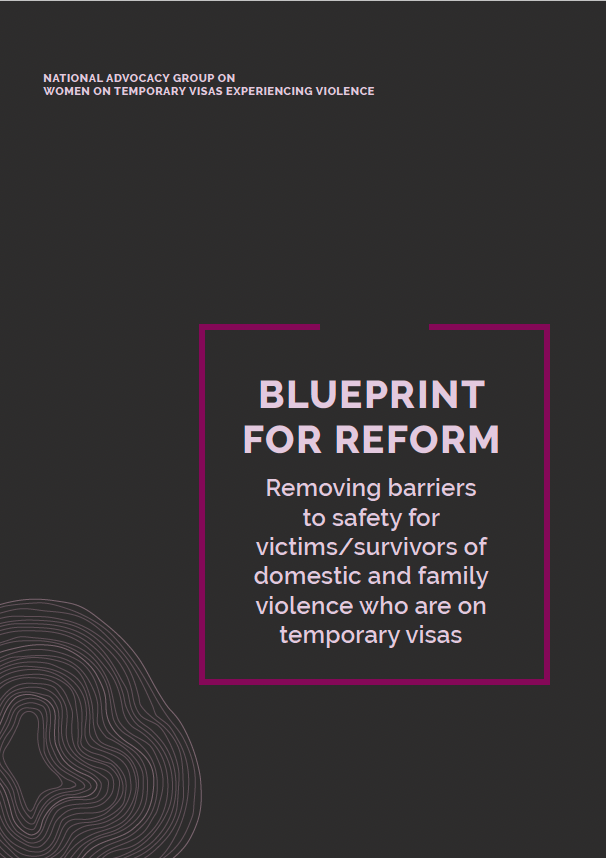
Blueprint for Reform: Removing Barriers to Safety for Victims/Survivors of Domestic and Family Violence Who Are on Temporary Visas

The Blueprint for Reform: Removing Barriers to Safety for Victims/Survivors of Domestic and Family Violence Who Are on Temporary Visas is the culmination of work by the National Advocacy Group on Women on Temporary Visas Experiencing Violence, aimed at ensuring safety and justice to victims/survivors of family violence, regardless of visa status and type.

We know that temporary visa holders experiencing family violence in Australia face multiple barriers to accessing safety, support, and justice. These barriers can cause women to remain in situations that are harmful and dangerous.

As the Australian Government moves towards implementing the National Plan to End Violence Against Women and Children 2022-2032, it is imperative that all women and children are given access to safety and stability.

The Blueprint for Reform recognises and responds to a range of barriers for women on temporary visas. The services system is too complex and often inaccessible. When a temporary visa holder experiences family violence in Australia, her visa status determines whether she can access social security, working rights, childcare, free public health, and housing support.

These barriers are used frequently by perpetrators of family violence to further coerce and control victims/survivors.

This Blueprint includes recommendations to ensure victims/survivors access the safety and support they need in four key steps:

  1. Improve the migration system so that all women on temporary visas who experience domestic, family and sexual violence and their dependants can access protections, services and justice.
  2. Expand eligibility and access to social security (including Medicare) for women on temporary visas who are experiencing domestic and family violence.
  3. Expand eligibility and access to social and public housing for women on temporary visas who are experiencing domestic and family violence.
  4. Ensure long-term and sustainable funding for specialist and legal services that support women on temporary visas who are experiencing or are at risk of domestic, family and sexual violence.

The National Advocacy Group are experts from across Australia who are calling on the Australian Government to adopt the recommendations.

Adopting and implementing the recommendations in the Blueprint will help to ensure the safety of all victims/survivors of family violence.

Queries should be directed to the Executive of the National Advocacy Group, [email protected].

—
Download the report:

Download the one-pager:

Blueprint for Reform 2022 Cover

Watch the Webinar of the Launch from June 2023
Call to improve support for women on temporary visas experiencing violence

As part of the National Advocacy Group on Women on Temporary Visas Experiencing Violence, AWAVA has joined over 60 state and national peak bodies, service providers, researchers and other organisations across Australia to call for increased action to ensure that all women experiencing violence in Australia are able to access the help they and their children need to be safe, regardless of migration status.

In an open letter to parliamentarians and politicians, the National Advocacy Group details four key areas of reform needed to better support women on temporary visas experiencing violence, including in relation to the migration system, eligibility for social security and Medicare, funding for specialist services, and access to social housing.

Download the letter here.

AWAVA Election Card Report 2022


AWAVA has produced an election report card comparing and contrasting major parties’ positions on ten key policy areas, including women’s specialist services, housing, the NDIS, the caring workforce and the just use of power. While AWAVA does not endorse candidates or parties, it does encourage friends and supporters to consider party policies and the impact these might have on the various dimensions of equality and on the safety of women, children and non-binary people.


You can download the Election Report Card here.

How to participate in parliamentary processes: an advocacy guide

Advocacy has long been used as a feminist tool to challenge and disassemble sexist attitudes, policies and practices. By looking first at parliamentary inquiries, followed by the process of lobbying, this blog outlines how to effectively engage with politicians and take advantage of parliamentary processes to support the rights and freedoms of women and girls in Australia.


1. Parliamentary Inquiries


Parliamentary inquiries provide a vital avenue for community members and organisations to examine government departments, interrogate and develop policy and review legislation before it’s enacted.


Most parliamentary inquiries will provide a terms of reference that highlight the key focus areas of the inquiry and questions it hopes to answer. For your submission to be regarded, you need to respond to at least one of these terms of reference, drawing on facts, opinions, arguments and recommendations for action to strengthen your advocacy position. Whilst written submissions are a commonly requested format, parliamentary committees can also request your expertise through online surveys and questionnaires.


Submission checklist (Parliament of Australia, 2020):

  • Has my submission been written for the purposes of the inquiry?
  • Have I checked that this is not material that has been published previously?
  • Have I commented on some or all of the terms of reference?
  • Have I provided a summary of the submission at the front and numbered the pages (for lengthy submissions).
  • Have I provided my return postal or email address and contact details with the submission?
  • Have I ensured that my personal details are excluded from the body of the submission?
  • If the submissions contain confidential information, have I made this clear on the front of the submission and included reasons for requesting confidentiality?


For more information on dealing with parliamentary committees please see here.


After making a submission to a parliamentary inquiry you may be invited to appear as a witness at a Committee Public Hearing. Public hearings provide committees with the opportunity to ask witnesses to clarify and expand on their written submissions. These can take a number of forms, including roundtables, workshops and community statement sessions. Generally, these committee hearings are conducted in public, with the media present, and are often broadcasted, with transcripts being made available later on the Australian Parliament website.  Witnesses are always given “reasonable opportunity”, before appearing, to object to the broadcasting of proceedings (Parliament of Australia, 2020).


More information on the procedure of parliamentary inquiries and your rights as an attendee are available here.


2. Lobbying


If you have identified a feminist issue that is not currently being addressed by a Parliamentary Inquiry, you may wish to engage in lobbying to bring the attention to it. Lobbying is a type of advocacy that seeks to influence the actions, policies or decisions of government through engaging directly with politicians.


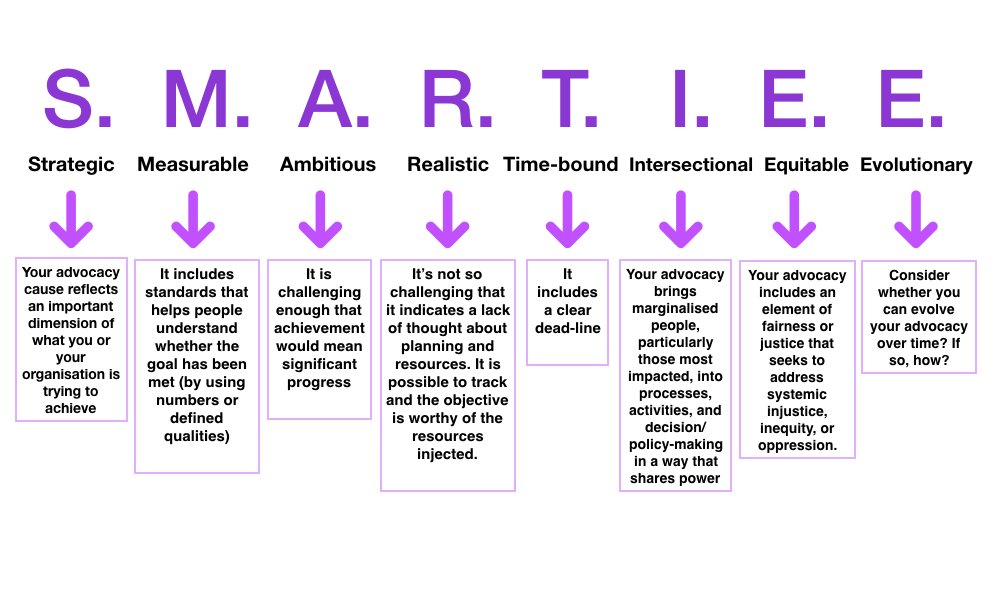
Step one: Identifying and designing an advocacy issue (SMARTIEE).


S.M.A.R.T.I.E.E. is a good framework to keep in mind when designing an advocacy case that will be effective at driving sustainable, structural change (YWCA 2020):


(SMARTIEE) Strategic: Your advocacy cause reflects an important dimension of what you or your organisation is trying to achieve Measurable: It includes standards that helps people understand whether the goal has been met (by using numbers or defined qualities) Ambitious: It is challenging enough that achievement would mean significant progress Realistic: It’s not so challenging that it indicates a lack of thought about planning and resources. It is possible to track and the objective is worthy of the resources injected. Time-bound: It includes a clear deadline. Intersectional: Your advocacy brings marginalised people, particularly those most impacted, into processes, activities, and decision/policymaking in a way that shares power. Equitable: Your advocacy includes an element of fairness or justice that seeks to address systemic injustice, inequity, or oppression. Evolutionary: Consider whether you can evolve your advocacy over time? If so, how?

A note on intersectionality:

In terms of gender, intersectionality highlights that there is no one homogenous experience of gender discrimination. Instead, it highlights that oppression and privilege are impacted by different “social relations, historical experiences and forms of discrimination”, including racism, ableism, homophobia, transphobia, classism and many others (The Opportunity Agenda, 2017). Ensuring your issue is both feminist and intersectional is essential for your advocacy to lead to a positive and sustainable change for all women. Here is how you can do it in 6 steps (YWCA, 2020):


Intersectionality Step 1: Identify who or what cause you are advocating for Step 2: Consider the power structures within which your issue operates Step 3: Consider what privileges or oppressions you bring to the table because of your identity/ies and lived experience Step 4: Consider who is most impacted by the issue Step 5: Ask yourself what you know about the issue, and what else u need to know—challenge your assumptions Step 6: Ensure your advocacy includes marginalised voices, and the people who are the most impacted

More information on intersectionality and its relationship to power, privilege, identity, oppression can be found in the YWCA’s Advocacy Toolkit.


Step 2: Appealing directly to politicians   


a) WHO should you target?


a green woman icon

Local Representatives

Local representatives have made a commitment to representing their local community members. As a result, they are the typically the first point of contact and can be helpful for gaining access to advisors, ministers and relevant committees.


a green woman icon

Advisors

Advisors prepare briefs on bills going through parliament and help the Minister and their department engage with stakeholders. They play a role in ensuring policy decisions are made on behalf of the community. Convincing advisors of the importance of your issue is a key first step in gaining the approval of Ministers/Shadow Ministers.


a green woman icon

Ministers/Shadow Ministers

Ministers and/or Shadow Ministers are best positioned for producing structural policy change at state and federal levels. A list of the current ministers and shadow ministers can be found on the Parliament House Website.


These resources can be used to understand what issues are important to politicians and their constituency. This research will help you to target politicians who will be sympathetic to your cause and frame your advocacy issue in a way that appeals to their interests and values:

a) Parliamentarians first speeches. These speeches are found on the parliamentarian’s profile pages that can be found on the parliament house website.

b) Voting History: Found on the TheyVoteForYou and OpenAustralia

c) The Hansard: Provides an online written record of parliamentary proceedings

d) Social media and media reports

e) Committee membership: Found on the Parliamentary Profile Page.

f) Party Platform


b) WHAT can parliamentarians do to help your advocacy?


In the following ways, members of parliament can increase recognition of your cause, spark debate and challenge government to recognise the presence of dissenting voices (Richards, 2019).


What parliamentarians can do to support your advocacy: 1) Raise Awareness through public platforms including social media, attending your events, and/or writing letters and signing their name in support 2) Direct a question at the responsible minister in the House of Reps or Senate that scrutinises the consequences of a proposed bill or amendment 3) Give speeches on behalf of your case to the House of Reps or Senate 4) Support your issue in a parliamentary vote. (Make sure to look at the make-up of the cross bench in the House and Senate - the positions of cross-benchers can determine the success or failure of policy)


c) HOW can you advocate to parliamentarians?


a green image of three human figure and a graph arrow pointing up

Data Collection and Ethical Story Telling:

Whilst storytelling humanises your advocacy, data provides politicians with measurable and accessible evidence that supports your claims. It is essential that you gain the explicit permission of any person/group/organisation whose story you wish to include and provide them with the opportunity to be involved throughout the lobbying process. Data must be reliable (drawn from reputable sources), honest and straightforward (Richards, 2019).


a green image of two text bubbles

Messaging and Framing:

It’s a good idea to design a short and simple advocacy message that reflects your objectives, targets and strategy. Your message should be framed according to the values and interests of your target parliamentarians and their electorate, however it’s important to ensure community voices are not compromised in an effort to appeal to parliamentarians (Richards, 2019).


a green image of a watch displaying the time

Timing:

Unlike parliamentary inquiries that provide an agenda and due date for submissions, lobbying can be done at any point of the political cycle. In saying this, some times are better than others, including:

  • When a party is settling its platform. Prior to an election campaign, politicians have the most flexibility to work with advocates on policy change.
  • During sitting week (this requires travel to Canberra):
    • Monday and Tuesday of sitting weeks are the days parties hold most of their policy committee and party room meetings
    • parliamentarians are also required to attend question time from 2.00 pm to 3.10 pm every day during sitting weeks.
    • The House of Representatives and the Senate usually operate between 9.30 am and 8.00 pm.
  • On a significant date. E.g., when a new bill is up for debate, when an issue is topical in the news (e.g., sexual violence in Federal Parliament) or on a noteworthy date such as International Women’s Day.


Inappropriate times for advocacy include:

  • During an election campaign (this is too late to engage politicians).
  • The weeks prior to a long break is a difficult time for politicians to gain any momentum on your issue before parliament goes into recess.
  • Budget week. This is a busy time, where politicians have little extra capacity to engage with advocates (YWCA, 2020).


Preparing for an Interaction

Who should I take?

Limit your group to three. Assigning roles and tasks to each member can help to ensure your meeting flows smoothly.


What should I take?

It is recommended to bring (and leave behind) a one-to-two-page support document. This should include evidence and data supporting your advocacy case.


What should I say?

Begin your meeting by briefly explaining who you are, who you represent, what work you do, and why you have asked to meet with them. Make sure you use a mix of evidence. It’s important that you illustrate that your issue exists (by using data) and that it matters (by using case studies).


What if I get a bad response?

Following the meeting, send any requested evidence or information to the politician’s office. Also re-examine any notes and/or feedback to make sure there were no misunderstandings during your meeting.


Advocacy is often the most successful when it reflects the concerns of the broader sector and community. Remaining intersectional, developing strong relationships, acknowledging political contexts and framing problems and solutions in a way that centres politics are therefore all vital components for driving sustainable policy change that benefits the lives of all women in Australia.


For more information on feminist advocacy please see the following sources:


For more information on intersectionality and how to be an ally please see the following sources:


Highlights from AWAVA’s 16 Days of Activism against Gender-Based Violence Campaign

About 16 Days of Activism against Gender-Based Violence Campaign


Led by women’s rights defenders, the 16 Days of Activism against Gender-Based Violence is an annual international campaign that begins on 25 November, the International Day for the Elimination of Violence against Women, and runs until 10 December, Human Rights Day. It was initiated by activists at the inaugural Women’s Global Leadership Institute in 1991 and continues to be coordinated each year by the Center for Women’s Global Leadership. It galvanizes the advocacy and actions by individuals, communities and institutions around the world to eliminate violence against women and girls.


AWAVA’s 2020 16 Days theme: Communities Driving Change


The Australian Women Against Violence Alliance community is comprised of 25 specialist women’s services and over 500 individual friends and supporters from across all states and territories. We wanted to use the opportunity during our 16 Days Campaign to provide a platform and amplify the voices of our community, made up of diverse leaders, frontline workers and advocates, many with lived experience of violence. This is how Communities Driving Change was selected as AWAVA’s theme for 16 Days campaign, with the accompanying hashtag #AllVoicesForSafety and #16days.


AWAVA invited members of our community to share what they are doing to drive change and what their priorities are for safety. Throughout the period of the 16 Days Campaign, we featured our diverse community members on AWAVA’s Facebook and Twitter, including interviews with Harmony Alliance who work with migrants and refugee women, Women With Disabilities Australia (WWDA), Project Respect who work with sex works and who are victims/survivors of trafficking, National Council for Sing Mothers and Their Children, Older women NSW, the National Rural Women’s Coalition and many other organisations working to end gender-based violence across Australia.


Spotlight on Aboriginal and Torres Strait Islander Women


Spotlight on Rural, Regional and Remote Women


Spotlight on Trafficked Women and Women Working in Sex Industry 


AWAVA also spoke with two survivor advocates working with Domestic Violence NSW, Jane Matts and Rachael Natoli.


In this space, Jane is “working with women in Queensland and NSW who have had their voices ignored in Family Court/Federal Circuit Court (FCC). Many have had their children removed as a result of poor management of DV/child sex abuse.”


Read the full post here.


Thank you to all the Friends and Supporters who submitted your responses and those who have liked and shared these important messages. We created a digital clip featuring submissions from Marie Stopes Australia, Children by Choice Association Inc, Central Coast Community Women’s Health Centre and more.


Visit AWAVA’s Facebook and Twitter to see all the posts.


Collectively, our community called for programs and services that tailor to the diversity of victims/survivor’s and that are trauma-informed, along with many other good practices principles that can be found in the revised Good practice principles in addressing sexual and gender-based violence: Drawing on the unique practice model of specialist women’s services brochure, which was launched during the 16 Days Campaign period. Building on over 40 years of feminist and social justice approaches, the impact and effectiveness of specialist women’s services is underpinned by a set of good practice principles that are supported by international research and evidence-based practice. These principles should inform the delivery and coordination of all essential services responding to women and children subjected to violence.


In marking the launch of the Good Practice Principles brochure, we also hosted a webinar with representatives from our organisational members who contributed to this important work.


Moderated by Tina Dixson, Acting Program Manager, AWAVA, the panel was made up of:

  • Bonney Corbin, Australian Women’s Health Network, Marie Stopes Australia
  • Kedy Kristal, Centre for Women’s Safety and Wellbeing
  • Yvette Cehtel, Women’s Legal Services Tasmania
  • Karen Bentley, WESNET

A recording of the webinar will be uploaded shortly.


Thank you everyone, for your engagement in building our community to end violence against women, wherever you are. We look forward to working together in the 2021 16 Days Campaign and beyond!


Checkout other organisations’ 16 Days Campaign


DVNSW

YWCA Australia

UN Women


Equipped to act

Many people behave in ways that are disrespectful or discriminatory towards women, girls and non-binary people. These actions often target people for their gender identity or expression, and they may also target people’s Aboriginality, disability, sexuality, race, migration status or other identity. When people behave in a way that is disrespectful or discriminatory, it can escalate to them using violence, abuse and harassment. Even where that person does not escalate their behaviour, it still makes it more likely for that kind of disrespect and discrimination to continue in their family or community. In turn that helps create the conditions for someone else to use violence, abuse and harassment, and to get away with it.


Because this behaviour is widespread, everyone, regardless of their age, gender or background, will witness some form of disrespect or violence at some point, and we are all in a position to respond in ways that either reinforce the likelihood of escalating violence, or help to prevent it.


This blog post lists some resources that can help individuals and organisations equip themselves to intervene safely, and help prevent and stop violence, abuse and harassment.


If you have suggestions about other resources, or other feedback, please email [email protected]


AWAVA’s brochure: 10 steps you can take to help end violence against women
This brochure includes resources to seek help, educate yourself, use empowering language and respond appropriately if someone discloses violence


ACON’s Domestic and Family Violence Bystander Intervention Toolkit
This toolkit is designed to help you, the bystander, overcome some of the barriers to intervening and support you to intervene in a helpful way when you know or suspect that someone is in an abusive relationship. This toolkit is applicable generally, in a way that is inclusive of LGBTIQ+ people and relationships.


Our Site: Information to help friends, family, carers and violence response services to support women and girls with disability to be safe
Women with Disabilities Australia’s Our Site resource for women and girls with disability also includes information for people and organisations seeking to support the safety of women and girls with disability. This page includes information about the right to freedom from all forms of violence, the situation for women and girls with disability, and how to respond if you see someone being violent or become aware that a woman or girl with disability is being abused.


DVRCV’s tips – For families, friends & neighbours concerned about domestic violence
It can be really worrying when someone you care about is being hurt or abused by their partner. This guide from Domestic Violence Resource Centre Victoria contains help for people supporting victims of abuse.


For families, friends & neighbours – during COVID-19
During the COVID-19 pandemic, there are additional barriers for victims/survivors. Family, friends and neighbours can play an especially important role when people may have less privacy than usual and less time away from an abusive family member. This resource from Domestic Violence Resource Centre Victoria contains guidance for people supporting victims/survivors of abuse during the pandemic.


Gender Equity Victoria’s Active Online Bystander Project

The toolkit aims to help get you inspired to stand up for what you think is right online and step in when you see someone participating in or encouraging discrimination. An active bystander is someone who says or does something when they see harassment and discrimination. You can be an active bystander online by using the suggestions in the toolkit and video.


Respect Victoria’s campaign: Tools to help end sexual harassment on public transport
This campaign is designed to bring all Victorians into the conversation around sexual harassment on public transport by providing the tools to call out inappropriate behaviours. Also applicable to people in other States and Territories and other settings.


Australian Muslim Women’s Centre for Human Rights: Islam and Muslims oppose violence against women
A guide for Muslim women who have experienced family violence and Muslims who seek to inform themselves and their community about a socially responsible understanding of family violence. Available in Arabic, Dari, Turkish and English.


SAFER: A resource to help Australian churches understand, identify, and respond to domestic and family violence
An online tool designed by Common Grace to help the Australian Christian community keep victims of domestic and family violence safe.


VicHealth’s resource to help organisations set up bystander initiatives
This resource has been developed to help organisations introduce bystander initiatives as part of their work to reduce sexist and sexually harassing behaviours.


Learning from bystander interventions at universities (VicHealth study)
This document provides an overview of two bystander interventions trialled at two universities in Victoria. Both interventions were focused on strengthening the capacity of individuals to become active bystanders.


VicHealth’s ‘Stepping in’ bystander action toolkit for sporting associations

This toolkit has been designed to support sporting associations as workplace role models, recognising that a key aspect of creating a safe and inclusive workplace is to equip all staff to step in when they see or hear about sexist language, sex discrimination or sexual harassment taking place at work.


COVID-19 and violence against women – Federal Government support needed

Following are the requests for Federal Government support that our members have developed over the last week in light of the risks to women’s and children’s safety during the COVID-19 pandemic. Our understanding of what is needed is evolving with the progress of the pandemic and the adaptions required, but this is our starting point for advocacy and planning.


For more information on the impact of the pandemic on women’s and children’s safety, with particular reference to domestic and family violence (DFV) and sexual violence (SV) see our opinion piece here.


We request that the Federal Government provide the following support:
  • TV and social media campaign- “Everyone has the right to be safe in their own home – services are here to support you”, targeting both victims/survivors and people using violence and giving avenue to seek help/change behaviour. Must be part of a package together with funding for services as below. 
  • Increased funding for ads and service capacity for: 
    • 1800RESPECT
    • Men’s Referral Service
    • Kids Helpline
    • Mensline
    • Safety Net Australia
  • Courts and policing to prioritise women’s and children’s safety
    • Victims/survivors need to be able to rely on civil protection orders 
    • Exclusions orders should be encouraged at this time
    • Coordination with States and Territories
  • Increased investment in safe at home programs (Federal Government funding to increase from $18 million to $180 million and States/Territories to match so that victims/survivors and their children who want to be supported to stay home safely aren’t forced into homelessness.
  • Funding for refuge/DFV/SV/legal services staff to do specialist outreach, support, legal assistance and safety planning where necessary remotely and if appropriate to support women and children, including those being placed in temporary accommodation (eg hotels/motels), and including funding for therapeutic staff (counsellors and therapists) 
  • Increasing capital works (expand / extend Safe Places program) to increase refuge supply in light of potential surge in demand once immediate crisis is over – amending this program to remove the requirement to arrange matched funding; keeping requirement to be led by specialist service; incorporating funding for service provision as well, not only capital build – to be achieved via direct coordination with States and Territories 
  • New COAG women’s safety council to meet immediately on this issue and to include NGO women’s services sector in this meeting / all planning
  • Immediately fund WESNET’s Safety Net Australia / Safe Connections program to continue providing safe phones and tech safety advice to victims/survivors and training to frontline workers, and re-fund the Family Violence Prevention Legal Services National Forum. 
  • Funding for community services Equal Remuneration wage adjustment (and more general community sector support as per ACOSS/ASU advice).
  • Provide access for women on temporary visas experiencing violence to Medicare, all relevant services and income support, including in the event their jobs are lost due to the pandemic, and to the economic support payments ($750)
  • Urgently give Disability Support Pension (DSP) recipients access to the increased Coronavirus Supplement of $550 per fortnight, consistent with the Jobseeker Payment and other payments recently announced 
  • Ensure access to reproductive health services including contraception and abortion, in light of likely increase in unplanned pregnancies and increased sexual violence (see Marie Stopes situation report here).
 Updated 2 April to add references to Family Violence Prevention Legal Services National Forum and Disability Support Pension, and broaden references to legal services and justice/policing responses. 

Self-Isolation Means Many Women Will Be Trapped With Their Abuser

This article by AWAVA’s Program Manager Dr Merrindahl Andrew was originally published by With Her In Mind and can be viewed here. For more detail about the support AWAVA is requesting from the Federal Government read our post here. 


As self-isolation becomes the norm, Dr Merrindahl Andrew, Program Manager for Australian Women Against Violence Alliance, highlights how this will leave may women and children in danger.


In a time where staying at home is the best way to limit the spread of COVID-19, we need to remember that for many women and children that will mean being self-isolated at home with their abuser.


Home should always be a safe place. Unfortunately, for people being subjected to violence and abuse by a partner or family member, it’s not.


All the evidence tells us that as the COVID-19 pandemic continues, more women and children will face increasing threats to their safety, as abusers’ use of violence escalates with increased isolation, stress and lack of community accountability – a pattern we know from natural disasters in Australia and worldwide.


People who choose to use violence against their partners and family members often have a pattern of abuse. This typically involves coercion, surveillance and cutting off their partner’s relationships with co-workers, friends and family. Isolation due to COVID-19 will intensify this kind of coercive control by abusers.


‘Please don’t use coronavirus as an excuse to be racist’ and how keep on top of your mental health while in self-isolation.


As more people get sick and people need to isolate in their homes, more and more are going to be cut off from their usual avenues of support. Many women will lack the breathing space they need to make safety plans, and as the financial impact of the pandemic takes effect, access to the money needed to build a new life of safety may be even more limited.


That’s why it is vital that governments’ plans to respond to COVID-19 include urgent measures for women’s safety and resourcing of services.


From overseas reports and experience with other disasters, we expect abusers will use the COVID-19 pandemic as another opportunity to exert control – for example by limiting access to medical care or threatening to expose someone to the virus. Already, women with disabilities find that abusers threaten and withhold access to the equipment and services they need to function in a world that is often inaccessible. In the situation created by COVID-19, women with disabilities will be even more at risk of violence, and will need extra support. More generally, this health crisis will intensify pre-existing inequalities.


People already battling poverty, discrimination or insecure migration status will find their ability to seek safety further impeded by the COVID-19 crisis, especially where they already lack access to basic services and income.


Even before this crisis increases demand, we know that every day many women reaching out for help from services aren’t able to get it because of government funding decisions. We cannot allow this government neglect to continue, when the consequences of leaving women and children without support are even more life-threatening.


As with all other sectors of society, COVID-19 complicates the work of supporting women’s safety. And like all the services that work for the wellbeing and safety of our community, specialist family violence workers are using their expertise to find the best ways of providing support. In order to do this, they need additional resources.


As women become more physically isolated, their safety and support needs will increasingly have to be met remotely, by phone and online. Access to secure phones is vital – which is why the government must urgently fund WESNET’s Safe Connections program to continue providing safe phones and tech advice to women facing domestic and family violence and their front-line workers. More broadly women need the social security, health, reproductive, legal and migration services that they can use to build the lives they want without being controlled or threatened.


Key gaps need urgent attention. Increasing Centrelink payments is important and welcome, but this should include disability, youth and student payments. Women experiencing violence need access to Medicare, income support and other services regardless of migration status. Police need to prioritise protection orders and enable women and children to stay in the family home while removing perpetrators where it is safe to do so.


Women’s and children’s safety must be prioritised as an integral part of the pandemic response, and that means immediately increasing funding to specialist services and communicating to the public that everyone has the right to be safe in their home.


Across Australia we have specialists with decades of experience working in challenging circumstances to make it safe for women to be in their own homes. We stand ready to work with governments to make women safer now.


If you or another person is in immediate danger, please phone 000. For counselling about family or domestic violence or sexual assault contact 1800RESPECT online or by phoning 1800 737 732. For men who might be concerned about using violence, call the Men’s Referral Service on 1300 766 491.


Everyone who cares about this issue should be urging their governments to make sure people facing abuse in their home can access the service support they need to be safe, which you can do here.


Dr Merrindahl Andrew is the Program Manager for Australian Women Against Violence Alliance.


Understanding violence against women in today’s world – reflections on the Bangkok Regional Civil Society Forum for the Beijing Declaration and Platform for Action 25 year review


Photo by Merrindahl Andrew


The year 2020 will mark the 25th anniversary of the adoption of the Beijing Declaration and Platform of Action (1995), which affirmed that gender equality is a human right and a condition for social justice. From 24 to 26 November 2019 a Beijing+25 civil society forum for the Asia-Pacific region was held in Bangkok, Thailand. The Forum was organised for civil society actors to celebrate achievements, identify concerns, and facilitate intergenerational dialogue and solidarity between constituencies represented. The widespread and complex nature of violence of gender-based violence was discussed with attendees working in civil society attending from various countries at the Forum.


AWAVA’s Program Manager, Dr Merrindahl Andrew, attended the Forum and this article reflects on the discussions there. The article is co-authored by former AWAVA Administration and Communications Assistant Sumithri Venketasubramanian together with Merrindahl, drawing on her notes from the Forum. It is not able to fully encapsulate the breadth and richness of all the discussions that occurred in the Forum, as facilitated by feminists and women’s rights activists from across the region.


Speakers at the Forum articulated how the struggle for women’s rights, gender equality and human rights has achieved some gains in the 25 years since the adoption of the Beijing Declaration and Platform for Action. The passing of laws to protect the rights of women lesbian, gay, bisexual, transgender, intersex, and queer (LGBTIQ+) people, a strong and organised feminist and women’s movement, and growing inclusiveness of feminist movements as well as stronger linkages between women’s rights and feminist movements and other social justice movements were some of the examples raised.


But all these positive changes have not been sufficient to end violence against women and girls. At the Forum, this violence was identified as a major continuing issue worldwide. Rather than being concentrated in certain areas, women in diverse societies all over the world are subjected to violence. Gender-based violence may be experienced in any part of life: at home, at work, in institutional settings, in public and/or online. The way that violence is used, as well as the way women respond, are shaped by interconnected global and local forces. This blog post explores some of the themes that underpin and contribute to gender-based violence at a global scale, drawing from points raised at the Forum.


Self-determination


The Forum touched on self-determination as a key area that still needs progress in order to achieve women’s rights and safety. The United Nations Declaration on the Rights of Indigenous Peoples (2007) highlights self-determination as a fundamental human right, meaning that Indigenous peoples have the right to “freely determine their political status and economic, social, and cultural development”. This right continues to be violated by colonial nation-states, with impacts contributing to high rates of violence against Indigenous women. This is the case in Australia as in many other countries. but Indigenous Elders and human rights activists maintain their demand for self-determination.


Globalisation and economics


Presentations at the Forum highlighted how the disadvantaged economic situation of women, such as lacking financial security and access to supports and services, is a key factor that underpins and perpetuates gender-based violence.


Today’s economies are mostly focused on growing and harnessing capital and, at an individual level, on one’s ability to perform economically productive work. However, what counts as economically productive work – that individuals are paid for – is very gendered, with some forms of work not recognised for what they are. These unpaid roles contribute to women average earning less than men. The resulting financial dependence is a form of a power imbalance, due to the centrality of money in economies internationally. This dynamic can be exploited in the use of violence, taking control and autonomy away from women.


The Forum also highlighted that many people are participating in what is known as the “informal” economy. Informal activities are not taxed or monitored by the government, meaning that they are difficult to regulate. (They are not necessarily activities that are against the law, they may just operate outside of formal institutions.) Women are more represented in the informal economy, so they may have less access to supports and workplace protections than people in formal sectors. Barriers to information and accessing services are also faced by women in rural areas and with limited access to the internet. The autonomy and livelihoods of women are often severely impacted by corporations and economic forces. Global institutions such as international trade agreements are not only facilitating these negative impacts but in some cases requiring governments to suppress women’s protests against them. On the converse, just a tiny percentage of development funding meant to be for women’s empowerment is going to women’s rights organisations.


Rights for whom?


Presentations at the forum noted how, in economies that value maximising capital, people are expected to be “productive members of society”. The opportunities and access to employment, however, are not equal for everyone. Societal prejudice where rigid, binary gender norms underpin violence against lesbian, gay, bisexual, transgender, intersex and queer (LGBTIQ+) people may be present in workplaces that are unsafe, and that creates a barrier to financial security. Participants noted there is a lack of data on transgender women experiencing violence specifically, meaning that the experiences of this significant group of women are not properly documented or addressed.


Inaccessible workplaces limit opportunities for women with disabilities, with presentations showing how this further entrenches unequal power dynamics and dependence upon family members, partners, carers and/or medical professionals. Dependence is expected of people with disability, and so not enough focus is given to making rights and agency accessible through obtaining information and accessing legal processes. The experience of living with a disability is often de-gendered, meaning that the specific experiences of women with disability are not considered through the lens of gender.


Sessions explored how the relationship between bodily autonomy, mental health, disability, and gender is complex. For example, LGBTIQ+ people may be subject to stigma on the basis of their gender identity, sexual orientation, sex or intersex status, and perhaps perceived to be mentally ill. As a result, they may be subject to non-consensual procedures and violence in order to change them to meet what is expected of them socially or in religion. This includes harmful medical procedures on intersex people with the goal to ‘normalise their bodies to fit a rigid male/female binary. The sexual and reproductive rights of women with disability are often not respected, and asserting sexuality and agency is a part of asserting their human rights. Women with disabilities may have their autonomy to make choices taken away through forced sterilisation, abortion and contraception.


Migration and the role of governments


While state sovereignty is a fundamental principle in international law, in a world where more people are moving across nation borders than ever the Forum considered the gaps that exist for women experiencing violence in the context of this movement. People’s movements across borders may be voluntary or forced, or may represent choices made between limited options. There is no one story or narrative that can explain migration and forced displacement; it can be empowering and/or disempowering – even for the same person. There is a lack of recognition about how migrant experiences are shaped by gender, such as mental health issues arising from gender- and ethnicity-based discrimination and violence in the workplace. Violence itself may be a reason for women to leave their home countries; however there are gaps in policies and laws that recognise gender-based violence to be justification for seeking asylum, as well as a lack of recognition of the experiences of LGBTIQ+ people in migration, asylum seeking and family reunion.


The Forum noted how changes in economic activity, such as the mechanisation of agricultural work, can lead to women being forced to move elsewhere to find work and sustain livelihoods. Union activities may be undermined by corporations, and where trade unions are present, they may be patriarchal and hostile to women and migrant workers.


Threats against human rights defenders (especially women and LGBTIQ+ people) by governments and the active persecution and suppression of civil society undermine the important work being done by women activists and advocates in countries all over the world. Governments ought to be held to account, but speakers at the Forum noted that the current international regime means that non-violent intervention to resist domestic human rights violations is close to impossible in many places. Perpetrators of violence who are in another country to a victim/survivor are not brought to justice as a result of this, and governments may not take responsibility and action for violence committed by their citizens in other countries.


Climate crisis


Presentations to the Forum highlighted that, on a global scale, communities that have contributed the least to the acceleration of climate change are bearing the brunt of the negative impacts. This difference is largely class-based, both comparing rich and poor countries, and comparing communities within nation-state borders. The inequalities, challenges and factors leading to gender-based violence are further exacerbated by other stressors. Natural disasters, whose frequency and scale are becoming more extreme and unpredictable with climate change, introducing additional stressors that may contribute to the use of violence. Existing gendered power gaps within families and relationships are widened. Women, who are represented more greatly in the agricultural sector than men in many countries, have their livelihoods threatened and may face displacement as a result.


Opportunities


The global crisis of gender-based violence is grave and urgent, and the Forum heard about opportunities for strengthening efforts and movements to address it. There are international processes and instruments that are meant to support the work being done by civil society organisations and activists, such as the General Resolution 35 (GR35) of the Convention to End all forms of Discrimination Against Women (CEDAW),which outlines steps for protection of victims/survivors, prevention, accountability for perpetrators and coordination of responses. The Istanbul Convention can be further used to promote the GR35, serving as a clear roadmap for states, and a means to hold governments to account.


Creating new research, data and evidence can serve to not only understand the extent and complexity of gender-based violence, but also to highlight the urgency of addressing it. It is important that research is connected right down to the grassroots level, rather than as a top-down project that is distant from the work being done on the ground. Presentations to the Forum noted that when documenting the situations of people, researchers must understand the specific oppressions that they are facing as a precondition. Participants highlighted the need for actions at all levels and scales, and expanding common ground across parts of the movement as opposed to focusing on the differences between strategies.


Continuing activism in all settings is needed to send a strong message from the public about dissatisfaction with the current state of gender-based violence and violence against women. The Forum heard about the upcoming Women’s Global Strike on 8 March 2020 as an opportunity for advocates of gender equality all over the world to make a stand, demanding to their governments and governments around the world that ending gender-based violence is a top priority, and we will not stop until justice and safety are achieved.


Suggestions for further reading


Australia’s country statement to the Intergovernmental meeting: https://www.unescap.org/sites/default/files/Australia%20%28B%2B25%29%20Item%202.pdf

Civil society statement to the Intergovernmental Meeting drawing on discussions at the Civil Society Forum:


Outcome document from the Intergovernmental meeting:
https://www.unescap.org/sites/default/files/Draft%20Outcome.pdf


Civil society responses and further analysis:https://apwld.org/press-release-women-and-gender-rights-activists-deeply-disappointed-with-regional-outcome-on-human-rights/


Davis, M., 2012. Aboriginal Women: The Right to Self-Determination. Delivered at Murrup Barak, Melbourne Institute for Indigenous Development, University of Melbourne. 8 November 2012. Accessed at: https://www.austlii.edu.au/au/journals/AUIndigLawRw/2012/6.pdf


Griffin, P., 2010. Gender, governance and the global political economy. Australian Journal of International Affairs. 64(1): 86-104.


International Federation of Red Cross and Red Crescent Societies, 2018. The Responsibility to Prevent and Respond to Sexual and Gender-based Violence in Disasters and Crises. 24 July 2018. Kuala Lumpur/Geneva. Accessed at:
https://media.ifrc.org/ifrc/wp-content/uploads/sites/5/2018/07/17072018-SGBV-Report_Final.pdf.pdf


Kuokkanen, R., 2012. Violence Against Women, Indigenous Self-Determination and Autonomy in Sami Society. L’Image du Sápmi 2. Ed. K. Anderson, pp. 436-452. Örebro University Press, 2013. Accessed at: https://rauna.files.wordpress.com/2007/10/2012-violence-against-women-self-determination-and-autonomy-in-sami-society.pdf


United Nations, 2007. UN Declaration on the Rights of Indigenous Peoples. 13 September 2007. Accessed at: https://www.humanrights.gov.au/our-work/un-declaration-rights-indigenous-peoples-1


Women with Disabilities Australia, 2017. Submission to the Special Rapporteur on the Rights of Persons with Disabilities Study on the Sexual and Reproductive Health and Rights of Girls with Disabilities. 19 May 2017. Accessed at:
http://wwda.org.au/wp-content/uploads/2016/01/WWDA_SR_Disability_SRHR_May2017.pdf


Changes in Migration Act – 2019

In April 2019, the Migration Amendment (Family Violence and Other Measures) Act commenced, changingthe previous arrangements for partner visas. Previously, the visa application and sponsorship application were lodged together. A valid visa application could be lodged prior to the sponsorship being approved.


Under the new arrangements, the sponsorship must be lodged and assessed first. It that a valid visa application cannot be made until sponsorship is approved. In addition,  the Minister of Home Affairs will refuse to approve the sponsorship if the sponsor has been convicted of a relevant offence and, as a result of those convictions, has a significant criminal record.


We anticipate that the new framework will limit the ability to apply for family violence provisions as well as increase disadvantage.


Consider two of the following scenarios to see the implications on victims/survivors of domestic and family violence.


Scenario 1


Amina holds a student visa. Before the amendment came into affect, if Amina lodged an application for a subclass 820 visa with her partner/sponsor Harry, this would have included the sponsorship application simultaneously. In that case, she would have been granted a Bridging visa A while the sponsorship and visa application were being assessed.


If, prior to a decision on the 820 visa application being made, Harry perpetrated family violence against Amina and they separated, Amina would still able to meet the time of decision criteria for the grant of the subclass 820, relying on the family violence provisions. This means that, if successful with the family violence provisions, Amina would become a permanent resident after her relationship breakdown with Harry.


Scenario 2


Under the new arrangements, there are no protections for an applicant affected by family violence whose relationship breaks down prior to sponsorship being approved.


Consider the same situation. Amina holds a student visa that will expire on 25 September. As Amina is in a relationship with Harry, they decide to apply for a partner visa. On 20 September, they lodge a sponsorship application. Sponsorship approval may take several months. On 26 September, Amina’s student visa expires, that immediately makes her unlawful in Australia. She is able to apply for a Bridging visa E, which is granted without work rights.


While waiting for the sponsorship to be approved (which takes several months), Harry perpetrates family violence. As Amina Jane has no work rights and is therefore totally financially dependent on Harry, making leaving the relationship extremely difficult.


If Amina leaves, she will be unable to lodge a valid application for a subclass 820 visa. As no visa application was lodged, if they separate, Amina will have to leave Australia.

Go to Top