This site is being archived soon. Visit wesnet.org.au for more information.

Blueprint for Reform 2022

***Webinar recording out now***

Blueprint for Reform: Removing Barriers to Safety for Victims/Survivors of Domestic and Family Violence Who Are on Temporary Visas

The Blueprint for Reform: Removing Barriers to Safety for Victims/Survivors of Domestic and Family Violence Who Are on Temporary Visas is the culmination of work by the National Advocacy Group on Women on Temporary Visas Experiencing Violence, aimed at ensuring safety and justice to victims/survivors of family violence, regardless of visa status and type.

We know that temporary visa holders experiencing family violence in Australia face multiple barriers to accessing safety, support, and justice. These barriers can cause women to remain in situations that are harmful and dangerous.

As the Australian Government moves towards implementing the National Plan to End Violence Against Women and Children 2022-2032, it is imperative that all women and children are given access to safety and stability.

The Blueprint for Reform recognises and responds to a range of barriers for women on temporary visas. The services system is too complex and often inaccessible. When a temporary visa holder experiences family violence in Australia, her visa status determines whether she can access social security, working rights, childcare, free public health, and housing support.

These barriers are used frequently by perpetrators of family violence to further coerce and control victims/survivors.

This Blueprint includes recommendations to ensure victims/survivors access the safety and support they need in four key steps:

  1. Improve the migration system so that all women on temporary visas who experience domestic, family and sexual violence and their dependants can access protections, services and justice.
  2. Expand eligibility and access to social security (including Medicare) for women on temporary visas who are experiencing domestic and family violence.
  3. Expand eligibility and access to social and public housing for women on temporary visas who are experiencing domestic and family violence.
  4. Ensure long-term and sustainable funding for specialist and legal services that support women on temporary visas who are experiencing or are at risk of domestic, family and sexual violence.

The National Advocacy Group are experts from across Australia who are calling on the Australian Government to adopt the recommendations.

Adopting and implementing the recommendations in the Blueprint will help to ensure the safety of all victims/survivors of family violence.

Queries should be directed to the Executive of the National Advocacy Group, [email protected].

—
Download the report:

Download the one-pager:

Blueprint for Reform 2022 Cover

Watch the Webinar of the Launch from June 2023
Call to improve support for women on temporary visas experiencing violence

As part of the National Advocacy Group on Women on Temporary Visas Experiencing Violence, AWAVA has joined over 60 state and national peak bodies, service providers, researchers and other organisations across Australia to call for increased action to ensure that all women experiencing violence in Australia are able to access the help they and their children need to be safe, regardless of migration status.

In an open letter to parliamentarians and politicians, the National Advocacy Group details four key areas of reform needed to better support women on temporary visas experiencing violence, including in relation to the migration system, eligibility for social security and Medicare, funding for specialist services, and access to social housing.

Download the letter here.

Young Women’s Report

Young Women’s Report: A report of the Young Women and Non-Binary People’s Forum 7 July 2021 and AWAVA’s Young Women Survey 2021

This ground breaking report explores a range of issues associated with gender-based violence and its impact on young women and non-binary people.

Drawing on both the 2021 survey conducted by the Australian Women Against Violence Alliance (AWAVA) and translated into Easy English by Women With Disabilities Australia (WWDA), as well as a subsequent community forum hosted by AWAVA and the National Aboriginal Torres Strait Islander Women’s Alliance (NATSIWA), this ground-breaking report explores a range of issues associated with gender-based violence and its impacts on young women and non-binary people.

These two key elements – the survey and the forum – combined to provide rich new insights. The survey yielded unique aggregate information, while the forum served to add depth to our understandings, particularly around people’s experiences. The project was intentionally designed to amplify the voices of those young women and non-binary people who tend to be underrepresented in traditional policy settings.

The report introduces new ways to understand both interpersonal and structural experiences of diverse forms of violence, relying on first-hand accounts from young people living in a range of circumstances across Australia. Importantly, the report captures what justice means to young victim-survivors – a question that is rarely asked.

On 17th February, AWAVA, WESNET, NATSIWA and WWDA launched online the ‘Report on Young Women and Non-Binary People’s Experiences of Gender-Based Violence across Australia‘. The webinar launch brought to light key findings of the report and highlighted unique elements of the survey and forum design. It also included a panel of young women and non-binary people, including Is Hay, Margherita Dall’Occo, Mali Hermans and Louise Wellington who discussed violence prevention, reporting mechanisms, service gaps and what meaningful change to end gender-based violence looks like. In case you missed it or would like to share it with your networks you can watch the report launch webinar recording here.

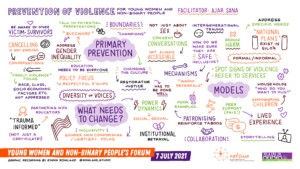
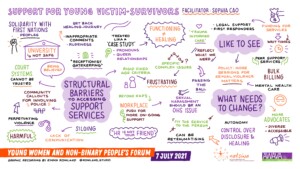
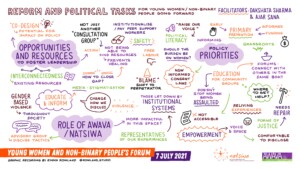
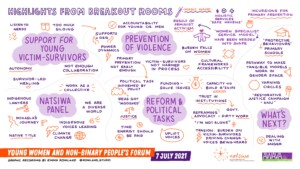
Graphic Recordings from the Young Women and Non-Binary People’s forum 7 July 2021

2021-2022 Federal Budget Analysis

AWAVA has conducted a budget analysis in relation to budget measures aimed at prevention and responses to all forms of violence against women and their children.


In response to community pressure, the government has certainly attempted to place women closer to the centre of this year’s budget. With the much-welcomed return of the Women’s Budget Statement came a total investment of $3.4 billion into policies and programs affecting women, including $1.1 billion into women’s safety, $1.9 billion into women’s workforce participation and economic security and $351.6 million into women’s health.


Read the full analysis:

Criminalisation of Coercive Control: Issues Paper

Coercive control is an umbrella term that refers to an ongoing pattern of controlling and coercive behaviours that pervade an individual’s daily life with a devastating impact. These behaviours may include physical, sexual, psychological, financial and emotional abuse and intimidation, used as tactics by a perpetrator to gain power, control and dominance over a victim/survivor. A key to the understanding of coercive control is that it is typically a course of conduct made of up of a series of incremental incidents where a single act may appear trivial, but together they form a broader pattern of abusive behaviours that serve to reinforce and strengthen the control and dominance of one person over another over time.


The abuse can occur in person as well as online and may involve the use of systems to inflict abuse. While the legislative attention on coercive control has centred largely on intimate partner violence, it is important to note that these patterns of behaviours can be present across a range of non-intimate partner relationships where individuals are in close contact, including in caregiving roles.


In order to produce this paper, AWAVA’s team undertook a literature review and held meetings with our Advisory Group members to better capture positions on the issue within our membership. While there is a consensus among our members and other experts on violence against women that coercive control is a serious and foundational part of sexual and gender-based violence against women, there are diverse views on how best to prevent, address and respond to it. Differences in legal, historical and policy contexts between jurisdictions as well as intersectional lived experiences of violence among diverse groups of women are among the reasons for different stances on the criminalisation of coercive control. This paper provides an outline of the current political and legislative landscape along with existing evidence.


Download the position paper:  


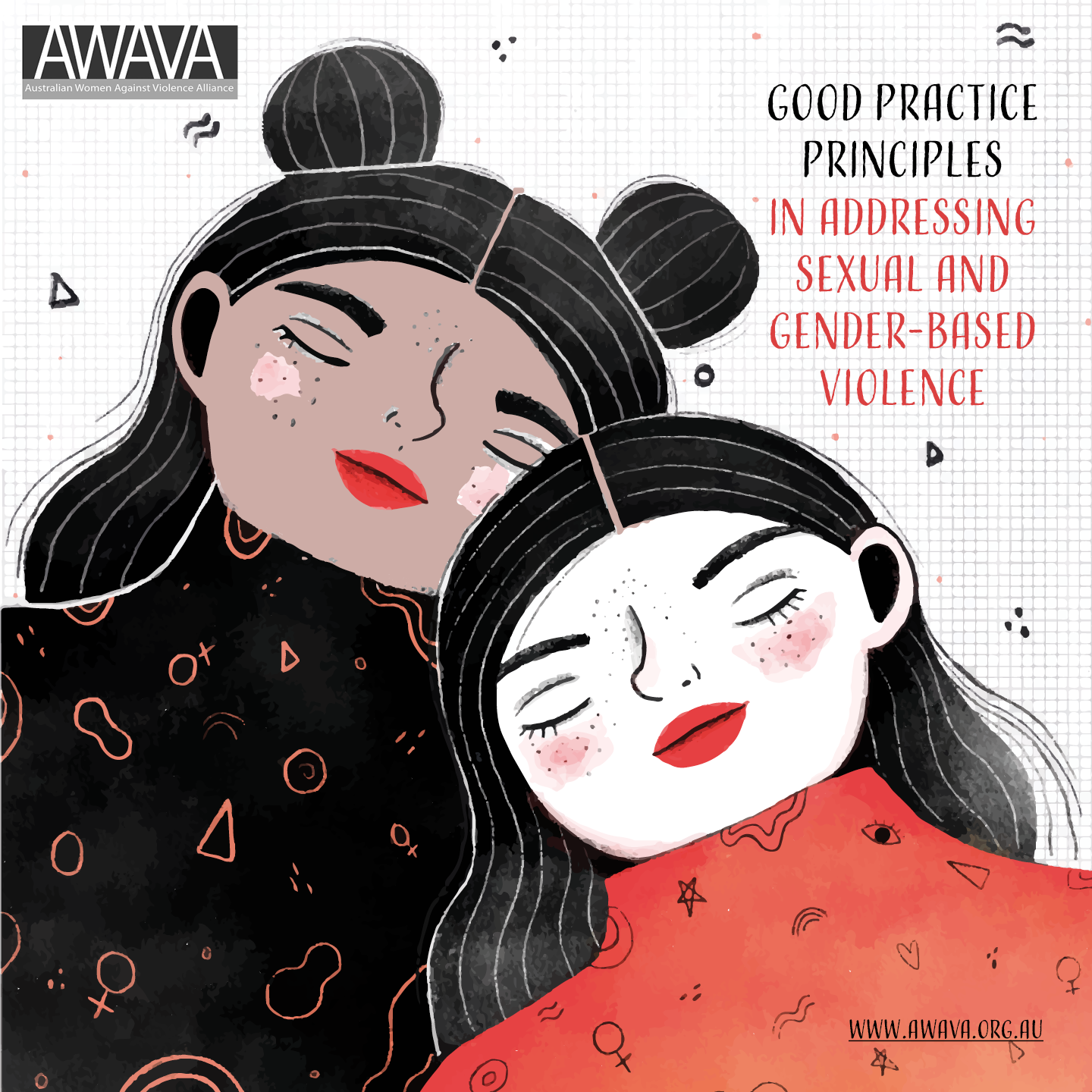
Good Practice Principles in Addressing Sexual and Gender-Based Violence

Given the high prevalence of sexual and gender-based violence and its complexity, it is critical that services working with victims/survivors of violence are appropriately equipped to support them.


The purpose of this brochure is to synthesise the unique and effective practice model derived from specialist women’s services to inform policy direction and practices of generalist services who also work with victims/survivors of sexual and gender-based violence. We use the language of ‘specialist women’s services’ to draw on their practice model and to outline required expertise however we also recognise the role community-led and –controlled organisations play in prevention and responses. Applying these principles will result in safe, just and effective outcomes for victims/survivors regardless of their backgrounds.


There are eight Good Practice Principles outlined in this document:

  1. Principle 1: A human rights-based approach
  2. Principle 2: An intersectional and equitable feminist approach
  3. Principle 3: A victim/survivor centred practice and empowerment approach
  4. Principle 4: Safety and risk focus
  5. Principle 5: Trauma-informed practice
  6. Principle 6: Perpetrator accountability
  7. Principle 7: Confidentiality, organisational accountability and service responsiveness
  8. Principle 8: Interagency collaboration

Download the full brochure:  


To promote the brochure, download and use this poster or this social media tile.


You can watch our webinar,  The unique role of specialist women’s services in ending sexual and gender-based violence, in which the brochure was launched here. A transcript of the webinar is available here.  


2020-2021 Federal Budget Analysis

AWAVA has conducted a budget analysis in relation to budget measures aimed at prevention and responses to all forms of violence against women and their children.
 

The bushfires and Covid-19 had brought on a number of social challenges for the people living in Australia. The stresses and the home confinement due to mandatory lockdown and economic insecurity have led to a spike in violence against women along with demand for frontline services serving victims/survivors of violence. At the start of the year, the Government provided the initial $150 million to meet the rising demands on the frontline services. As part of the 2020 Budget, the Government has announced the continuation of the Social and Community Sector Supplementation payments from July 2021. It has also announced a continued commitment to fund the 1800RESPECT Helpline. However, the Government has not added more funding in the forward estimates to address the ‘shadow pandemic’ of family and domestic violence.
 
Read the full analysis:  


Safe Access Zones in Australia

Australian Women Against Violence Alliance has partnered with Marie Stopes Australia and the University of Queensland (UQ) Pro Bono Centre to produce a paper on Safe Access Zones in Australia.


Safe access zones function in all jurisdictions in Australia with the exception of South Australia and Western Australia. With the move to legislate safe access zones in two remaining states, this report is crucial to our understanding of the efficacy of safe access zones with regard to sexual and reproductive rights and choices.


Read AWAVA’s Summary paper here:


Read the full paper here:


Joint NGO Submission on behalf of the Australian NGO Coalition to Australia’s 3rd Universal Periodic Review

This Joint NGO Submission is endorsed, in whole or in part, by 202 NGOs across Australia, including AWAVA. The submission was coordinated by the Human Rights Law Centre, the Kingsford Legal Centre and the Caxton Legal Centre, working with an Advisory Group comprised of 16 NGOs, which provided expert guidance on the content and focus of the submission.


The sections in the submission were developed by 21 expert and recognised NGOs, working with 36 other diverse NGOs. Particular attention was taken to ensure intersectionality across the sections, reflecting the compounding nature of discrimination and disadvantage in Australia, and the direct participation of Aboriginal and Torres Strait Islander Peoples and their organisations.


Download this report here  

Go to Top