This site is being archived soon. Visit wesnet.org.au for more information.

Federal Budget 25 – Response from National Advocacy Group

Federal Budget 2024-25
Response from the National Advocacy Group on Women on Temporary Visas Experiencing Violence

17 May 2024

The National Advocacy Group on Women on Temporary Visas Experiencing Violence has issued a response to this week’s Federal Budget.

Despite significant calls to recognise the urgency of women’s safety as a national priority, the budget measures announced on Tuesday are an inadequate response to a growing national crisis.

Australia’s migration system continues to put women at risk of violence. Perpetrators use visa status as a threat to keep women in violent relationships. Visa status prevents many women and children from accessing social services, housing and healthcare, which are essential to escape violence. Specialist domestic and family violence support services continue to be substantially underfunded to respond to the needs of women and children.

The group is asking the Government to take note of the key asks from the 2022 Blueprint for Reform which recognises and responds to a range of barriers for women on temporary visas.

Download the full Response here

The National Advocacy Group are experts from across Australia who are calling on the Australian Government to adopt the recommendations.

Adopting and implementing the recommendations in the Blueprint will help to ensure the safety of all victims/survivors of family violence.

—

Media and other queries should be directed to the Executive of the National Advocacy Group, [email protected]. Key contacts are Sophie de Rohan and Ann Emmanuel.  
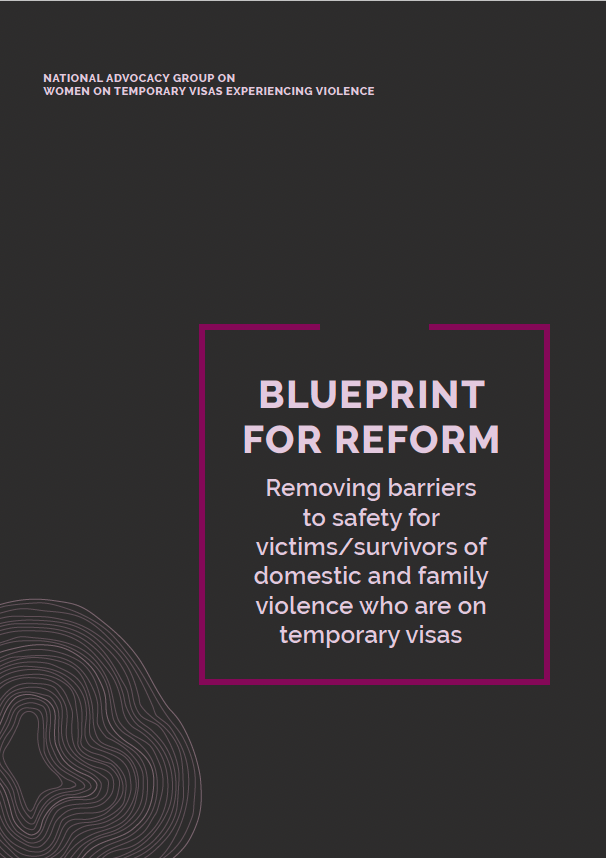
Blueprint for Reform 2022

Removing Barriers to Safety for Victims/Survivors of Domestic and Family Violence Who Are on Temporary Visas

08 December 2022


AWAVA is excited to be involved in the development and launch of the Blueprint for Reform: Removing Barriers to Safety for Victims/Survivors of Domestic and Family Violence Who Are on Temporary Visas.

The Blueprint for Reform is the culmination of work by the National Advocacy Group on Women on Temporary Visas Experiencing Violence, aimed at ensuring safety and justice to victims/survivors of family violence, regardless of visa status and type.

AWAVA and member of the National Advocacy Group, said, “We know that temporary visa holders experiencing family violence in Australia face multiple barriers to accessing safety, support, and justice. These barriers can cause women to remain in situations that are harmful and dangerous.

“As the Australian Government moves towards implementing the National Plan to End Violence Against Women and Children 2022-2032, it is imperative that all women and children are given access to safety and stability.”

Blueprint for Reform 2022 Cover

The Blueprint for Reform recognises and responds to a range of barriers for women on temporary visas. The services system is too complex and often inaccessible. When a temporary visa holder experiences family violence in Australia, her visa status determines whether she can access social security, working rights, childcare, free public health, and housing support.

These barriers are used frequently by perpetrators of family violence to further coerce and control victims/survivors.

This Blueprint includes recommendations to ensure victims/survivors access the safety and support they need in four key steps:

  1. Improve the migration system so that all women on temporary visas who experience domestic, family and sexual violence and their dependants can access protections, services and justice.
  2. Expand eligibility and access to social security (including Medicare) for women on temporary visas who are experiencing domestic and family violence.
  3. Expand eligibility and access to social and public housing for women on temporary visas who are experiencing domestic and family violence.
  4. Ensure long-term and sustainable funding for specialist and legal services that support women on temporary visas who are experiencing or are at risk of domestic, family and sexual violence.


The National Advocacy Group are experts from across Australia who are calling on the Australian Government to adopt the recommendations.

Adopting and implementing the recommendations in the Blueprint will help to ensure the safety of all victims/survivors of family violence.

—

Media and other queries should be directed to the Executive of the National Advocacy Group, [email protected].

Improvements in student safety but strong leadership needed

24 March 2022


Today’s release of the National Student Safety Survey (NSSS) 2021 findings shows a slight improvement in student safety between 2016 and 2021. One in 5 students said they had experienced sexual harassment since commencing studies in 2016, compared to 1 in 6 in 2021. The rate of sexual assault dropped from 7 per cent to 5 per cent for the same period. Universities Australia is commended for undertaking the survey. Building the evidence base is a necessary step to check progress in eliminating violence against women.


Karen Bentley, AWAVA member and CEO of Women’s Services Network (WESNET), noted, “Unfortunately progress is too slow. These findings accord with AWAVA’s own research on young people’s experiences with violence. (1) Over forty per cent of our respondents were students, and most had experienced violence in one form or another, although sexual violence was one of the forms most commonly experienced.


“Sadly the modest pace of progress is not surprising. There is a clear consensus that a key driver of gendered violence in gender inequality – the current government’s draft National Plan to End Violence Against Women and Children acknowledges this – and we continue to see disappointing progress against key gender equality indicators.”


“We know that Covid-19, insecure work and low-wage growth is exacerbating inequalities. Women and non-binary people remain underpaid, overworked and under-represented in decision-making roles. (2) We know that family and domestic violence has increased. (3) Gendered power imbalances carry over into workplaces, universities, institutions and public and private spaces.”


“Power imbalances impact beyond the act of violence itself. Consistent with the NSSS, the AWAVA survey showed that few young people formally reported violence, due mostly to a fear of not being believed or taken seriously. A large majority said their perpetrator was not held to account. Even when the victim-survivors’ stories were believed, police and institutions were unwilling to take further action against the offender.”


“Sexual violence is not a new issue at universities, and it is not confined to universities. While many universities have put in place a number of measures to combat it, there is certainly more to be done.  This has been acknowledged by the sector but it cannot be done effectively in isolation, without societal change, and it is very difficult to do without proper resourcing.”


“Universities – like women’s specialist services – have been one of the hardest-hit sectors in recent years, due to general policy settings and the impact of Covid-19 responses. Improving women’s safety is not out of reach – as evidenced by the modest improvements indicated by the NSSS – but it will take strong leadership, nationally and within each university, to prioritise women’s safety and provide equal access to the enjoyment and benefits that higher education can confer.”


—

Footnotes:

  1. Young Women’s Report (AWAVA 2022).
  2. Women working full-time hours earn $255.30 less than men per week (WGEA 2022); women consistently experience more time-stress than men (Melbourne Institute 2021, p. 12); women make up less than a third (47 of 151) of MPs in the Australian House of Representatives (APH 2022).
  3. The impact of the covid-19 pandemic on experiences of intimate partner violence among Australian women (ANROWS 2022).


ENDS

Contact: Karen Bentley, Chief Executive Officer, WESNET, [email protected] or the communications officer at [email protected].

English Language Tests Won’t Stop Family Violence, But Will Keep Families Apart

9 April 2021


The Refugee Advice and Casework Service (RACS) and Australian Women Against Violence Alliance (AWAVA) strongly oppose the Department of Home Affairs’ proposed imposition of an English language requirement, on both sponsors and applicants, for a partner visa.
 

The Department of Home Affairs suggest in their consultation that passing an English test will make partner visa applicants less vulnerable to family violence and other exploitation as they will be more easily able to access services for survivors of violence. The Department’s Consultation Paper suggests that ‘migrants who do not have sufficient English language skills may be more vulnerable to family violence and other exploitation’.
 

RACS & AWAVA in addition to a range of concerned organisations, have provided critical feedback via submission to the Department raising concern for families who could remain separated. RACS & AWAVA remain completely opposed to such paternalistic reforms that have failed to engage Culturally and Linguistically Diverse communities – the very communities it impacts.
 

Hannah Gray, Senior Solicitor and Coordinator of RACS’ Women at Risk program, says “This language creates a false association between domestic and family violence and non-English speakers and makes the unsupported claim that the way to combat such violence is by making it more difficult for non-English speaking partners to obtain visas and be reunited with their families.”
 

“Tragically, domestic and family violence occurs across all cultures and language groups. So the suggestion that the problem is exacerbated by survivors lacking the ability to speak sufficient English to seek help is highly reductive” she says.
 

Prior to the joint submission, RACS consulted extensively with a range of specialist women’s services. ”All confirmed they are strongly opposed to the proposed reforms of an English language requirement. For these groups, the suggestion it was the lack of English of survivors of violence is seen as just another form of victim blaming” says Ms Gray.
 

“Domestic and family violence is a gendered crime. There is no evidence to suggest that English-language is a predictor of domestic, family or sexual violence victimisation. Women on temporary visas need to be supported to access essential services at the points of crisis, have access to affordable and safe housing and assistance with migration matters, not being blamed for the actions of their partners who choose to use violence.” says Ms Dixson, Acting Program Manager, at the Australian Women Against Violence Alliance.
 

The submission also raises concerns about the impact of family separation, highlighting the negative impacts RACS witnesses on people seeking asylum and refugees, including ongoing trauma, prolonged uncertainty, and the potential for heightened vulnerability of female refugees and migrants.
 

“The proposed introduction of an English language requirement for both applicants and sponsors for partner visas will lead to significant barriers and delays to family reunion, and in some cases completely prevent families from being reunited causing further hardship and harm” says Ms Gray.
 

“Further, it will exacerbate existing inequalities along the lines of wealth and privilege, discriminating against those with less opportunities available to them to learn English to the same level as others.”
 

“Family reunification is already extraordinarily difficult. This proposal is yet another hurdle adversely impacting the lives of refugees in Australia.”
 

ENDS

For interview and comment contact Sarah Dale on 0419 200 637, or by email: [email protected]
 

About RACS
The Refugee Advice and Casework Service (RACS) is a strong, independent public voice for the rights of refugees and people seeking asylum. We provide critical free legal advice, assistance and representation, for financially disadvantaged and vulnerable people seeking asylum in Australia, and advocate for justice and dignity for refugees. RACS’ Family Reunion program supports refugees granted permanent residency seeking to reunite with their families after long periods of painful separation. RACS’ dedicated Women at Risk program, in conjunction with the Jesuit Refugee Service Finding Safety Program, supports women, or people who identify as female, seeking asylum, who have survived, or who fear sexual or gender based violence. For further information please contact RACS on (02) 8355 7227, or by email: [email protected].

Domestic Violence Advocates Tell Senate Committee To Reject The Government’s Plans Repeal Safe Lending Laws


26 February 2021


Financial abuse and domestic violence advocates will give evidence to the Senate Committee today about the harm women will face if the Government’s Supporting Economic Recovery Bill is passed.


Spokesperson for the Economic Abuse Reference Group Laura Bianchi said its 20 member organisations, which assist people experiencing financial abuse, have grave concerns about the impact of removing lending protections on people experiencing domestic and family violence.


Ms Bianchi, who also heads up Redfern Legal Centre’s Financial Abuse Service NSW, said current lending obligations prescribe important steps which often identify red flags in domestic and family abuse.


“Responsible lending protections are absolutely critical, because they help ensure that the lender makes inquiries as to the loan’s purpose, suitability and affordability. When used correctly, these checks and balances play an important role in preventing economic abuse,” Ms Bianchi said.


Dozens of domestic violence and economic abuse advocacy groups have joined together to urge the Senate Standing Committee on Economics to recommend this Bill does not get passed.


Quotes attributable to Chief Executive Officer of the Financial Rights Legal Centre Karen Cox


“In recent years, and especially during the pandemic, our organisations have seen an increase in online loan applications, remote signing and consent which removes opportunities for bank staff to identify red flags for financial abuse.


“Without the requirements in our current save lending laws to verify information on loan applications and to assess the requirements and objectives of borrowers, we fear there will be a tidal wave of economic abuse.”


Quotes attributable to Renata Field, Policy and Research Manager for Domestic Violence NSW:


“Any weakening of consumer protections could have devastating impacts on people who have experienced violence and abuse.


“The lending laws we have in place provide a remedy for women when lenders do not undertake the required steps or ignore the red flags of economic abuse. If this Bill is passed we know from our experience helping victim-survivors that more women will end up carrying unaffordable debts left over from abusive relationships.”


Quotes attributable to Carmel Franklin, Chief Executive Officer of Care Financial Counselling


“Removing these laws will reduce the ability of advocates like financial counsellors and community lawyers to assist survivors with debts that they accrued during abusive relationships.


“If advocates cannot help women resolve these unsuitable debts, it is almost impossible for them to re-establish their lives. It will make it more likely that victims of financial abuse are compelled to return to or remain in an abusive relationship, when the financial barriers to leaving are insurmountable.”


Quotes attributable to Chief Executive Officer of Domestic Violence NSW Delia Donovan


“It has been well documented that rates of domestic abuse have risen sharply in Australia during the COVID-19 pandemic.


“Victim-survivors need laws and policies that make it harder for perpetrators to use credit products to perpetrate economic abuse. Instead, the proposed reforms will make it easier for perpetrators of financial abuse to game the system.”

Passage of flawed merger bill tasks family law judges with an impossible task

18 February 2021


The passage of the Government’s flawed merger bill by the barest of margins is a disappointing outcome for Australian children and families and tasks Australian judges with an impossible task, a coalition of stakeholders said today.


The Law Council of Australia, Women’s Legal Services Australia, Community Legal Centres Australia, the National Aboriginal and Torres Strait Islander Legal Services and Australian Women Against Violence Alliance are among more than 155 stakeholders who have consistently opposed the Government’s bill to abolish the specialist, stand-alone Family Court out of concern it would harm, not help, Australian families and children.


The best interests of families and children are at the heart of what we do and must remain at the heart of policy development in this space.


For three years, we have put the merger proposal to proof. Not because it was popular to do so but to put to challenge a fundamental change that will directly impact on Australian lives and hard-working judges because it is our job to advocate for the best outcomes for children, families and victim-survivors of family violence.


We disagree with the Government, Senators Patrick, Hanson and Robert in relation to the claimed benefits of the merger, which are based on the widely discredited PWC Report and disputed by many stakeholders. There is much more evidence to support the damage that will be done by the merger, including harm to families and people experiencing family violence. The Government and new Court will be under heavy scrutiny to deliver court efficiency, resolve 8,000 additional cases, reduce costs, reduce the time separating families will spend before the court and reduce delays, even allowing for the impact of COVID-19.


Despite the significant backlogs facing the Courts and shortfalls in judicial officers, the Government voted against two motions on Wednesday to guarantee a minimum number of judges in the new Division 1 at either the Family Court’s current strength of 32 or the 40 judges that are at least required to meet existing need.


Those voting for the Bill have tasked the Court to deliver the projected outcomes with fewer resources than are needed to do the job. It was confirmed in the Consideration of Detail stage of the bill that there are currently eight judicial vacancies in the Family Court and Federal Circuit Court which have yet to be filled. At least ten judges practising in family law are to retire in 2021-22.


Like many others, we have warned of the dangers this legislation poses for the most vulnerable in our community at a time of relationship breakdown. We now call on the Government to step up and properly fund the family law system and legal assistance, and to repair the years of government neglect of this critical infrastructure.


We will continue to do whatever is possible to support the new Court in the delivery of justice to Australian children and families in this most critical of areas.


While we respect the will of the Parliament, what is disappointing about the process has been that the advice of highly respected experts has been consistently disregarded. Despite this, many have stood up to make their voices heard, made written and oral submissions and representations to Parliamentarians to seek to inform public debate and assist the Parliament to consider this bill. We thank stakeholders who have engaged in discussions about this important issue for their contributions and their tireless advocacy for Australian families.


Contacts

Angela Lynch AM, Women’s Legal Services Australia: 07 3392 0644
Nassim Arrage, Community Legal Centres Australia: 02 9264 9595
Dr Fiona Wade, Law Council of Australia: 0403 810 865
Lucy Brown, National Aboriginal and Torres Strait Islander Legal Services: 0435 866 462
Tina Dixson, AWAVA: 0428 541 396


Download the pdf of the media release here.

Calls for structural change to budget are building as women are left behind

Following last Tuesday’s budget announcement, there is a growing consensus that the federal budget needs fundamental change. Seventeen organisations have come together to call for a new approach to budgeting which will bring women’s needs into sharper focus.


“The Minister for Women, Marise Payne, has made it clear that she understands that women will play a vital role in this recovery and the measures outlined in the Women’s Economic Security Statement are a strong first step in that direction,” said Helen Dalley-Fisher, Senior Manager of the Equality Rights Alliance. “It’s therefore concerning that the rest of the budget failed to address the key structural issues facing women. It’s become clear that the budget process itself is one of the barriers we have to address.”


The job of confronting the bias in the budget has been made a little easier by a recognition of the need for more robust data about women’s lives. “It was pleasing to see that there will be a revision and enhancement of the ABS’ Gender Indicators report,‘ said Trish Bergin of the 50/50 by 2030 Foundation. ‘Gender relevant data is essential as a building block towards understanding the gender impact of both current and prospective policy changes”.


However, despite widespread calls for investment in social housing from economists, housing specialists and women’s groups, the budget didn’t address Australia’s dire lack of affordable housing. “We have known for years that Australia is experiencing a housing affordability crisis, with older women the fastest growing group experiencing homelessness,” said Emma Davidson of the Women’s Electoral Lobby. “Building more social housing would help with the rising tide of homelessness, while also creating jobs.”


Another area which needed but failed to get urgent attention in this budget was childcare. Chief Executive Women President, Sue Morphet, said “Increasing female full-time workforce participation is one of Australia’s biggest economic opportunities; and making early childhood education and care more affordable is one of the most effective policy levers to do that. This is not welfare; it is investment in the infrastructure women need to participate more fully in the workforce and maximise their productivity and opportunities.”


“With soaring rates of all forms of violence against women and their children, it is vital that we fund long-term solutions and building a future free from violence for people in Australia” said Tina Dixson, Acting Program Manager of the Australian Women Against Violence Alliance. “The COVID-19 pandemic has not only increased the prevalence of violence but created additional barriers for women to seek safety. Without gender responsive budgeting and commitment to ending violence against women we risk losing lives”.


The Aid budget saw a slight increase for gender equality initiatives but at just 32 per cent of overseas development assistance it falls far short of what’s needed. “Women worldwide are experiencing the worst impacts of the economic and health crises brought on by COVID-19, yet the Government continues to make cuts to the Aid budget in regions where women face persistent gender inequality, alongside the growing impacts of the pandemic,” said Michelle Higelin, Executive Director of global women’s rights organisation ActionAid Australia. “At a time when gender equality is deteriorating worldwide at an alarming pace, Australia’s leadership is vital to address the disproportionate impact this pandemic is having on women and support women leading local responses.”


“It’s time for us to join the majority of nations in the OECD and work towards a budget that is truly gender responsive,” said Helen Dalley-Fisher. “We need a budget and policy process that makes it possible for policy makers to see and address the needs of women.”


For media comment or speakers for interview, please contact:

Helen Dalley-Fisher, Equality Rights Alliance – Senior Manager on 0413 065 822 or [email protected].

Emma Davidson – Women’s Electoral Lobby on 0459 901 306
Tina Dixson – AWAVA on 0428 541 396 or [email protected]


Download a copy of this media release here:  

Safe Access Zones: Key Violence Prevention Mechanism

Violence prevention advocates, sexual and reproductive health advocates and legal experts have today released a paper that underlines the importance of safe access zones as a key violence prevention measure in Australia.

Safe access zones are allocated ‘bubbles’ of safety around facilities that provide abortion care that prohibit harassment and intimidation of patients and staff. Safe access zones are in place in all States and Territories apart from South Australia and Western Australia.


The paper highlights that picketers outside of abortion care facilities can erode community trust and feelings of safety for staff working at these facilities and patients accessing services. With a majority of patients accessing these facilities being women, ensuring patients feel safe to access abortion services is key to primary prevention of violence against women.


The University of Queensland’s Pro Bono Centre, the Australian Women Against Violence Alliance and Marie Stopes Australia have developed the paper to inform legislative debate in South Australia and Western Australia, with both States in the process of, or committed to progressing safe access zone legislation.


The paper highlights key issues in debates surrounding safe access zones, specifically, implied freedom of political communication and whether safe access zones breach this constitutional right. This was a matter considered by the High Court recently with all seven judges agreeing that safe access zones do not breach the constitutional right of implied freedom of political communication.


The paper also considers and provides recommendations on key aspects of safe access zone legislation in South Australia and Western Australia including size, definitions of prohibited behaviour, premises that are covered by the zones and exemptions.


In the next two years Australia is providing its human rights review as a part of the Universal Periodic Review as well as its report on women’s rights under the Convention on the Elimination of All Forms of Discrimination Against Women (CEDAW). This paper provides a key argument for the harmonization of Australia’s safe access zone laws to prevent violence against women and pregnant people accessing vital sexual and reproductive health services.


QUOTES FROM Professor Heather Douglas, Law School, the University of Queensland:

‘Safe access to health care should be available to everyone and safe access to abortion care should be no different to other health care.’

‘Experience shows that legislation providing for safe access zones improves the safety and security for both health workers attending work and people seeking abortion care.’


QUOTES FROM THE AUSTRALIAN WOMEN AGAINST VIOLENCE ALLIANCE (AWAVA), Tina Dixson, Acting Program Manager:

“Access to reproductive healthcare is crucial for women and people who are pregnant in upholding their reproductive rights and bodily autonomy”.

“In situations of violence, access to sexual and reproductive healthcare is about long term recovery and living lives free from violence. For women currently experiencing violence, clinics need to be safe, calm and accessible environments free from judgement and harassment”.


QUOTES FROM MARIE STOPES AUSTRALIA, Jamal Hakim, Managing Director:

“Everyone has the right to access healthcare services safely and with their privacy and dignity protected and respected. Everyone has a right to access their workplace without being intimidated and harassed.”

“Sadly, the picketers outside our clinic in Western Australia believe they can harass and intimidate people without consequences, and this is unacceptable.”

“It really is sad that we need safe access zones. However, the experience of our staff and clients has shown how necessary they are. In places where they have been enacted, they have made a huge, positive impact on the feelings of safety and privacy for staff and clients.”


– Ends –


Marie Stopes Australia is a national not for profit provider of sexual and reproductive health services including permanent and long-acting reversible contraception and abortion care. For more information on our clinic network visit mariestopes.org.au


Media contact:

Jacquie O’Brien, Director Public Affairs and Policy, Marie Stopes Australia, 0428 396 391

Tina Dixson, Acting Program Manager, Australian Women Against Violence Alliance, 0428 541 396


Download a copy of this media release here:


Experts warn COVID-19 impacts on women’s safety just beginning

Joint AWAVA and Fair Agenda media release
8 May 2020

Key domestic violence experts are issuing a joint warning that the impacts of COVID-19 on women’s safety are only just beginning to be felt, and will compound the risks women face from abusive partners or family members for months and potentially years after isolation measures are lifted.

Australia’s expert body, Australian Women Against Violence Alliance, backed by campaigning group Fair Agenda are advising that:

Everything we know about the behaviour of abusers suggests that both the immediate and the ongoing impacts of the COVID-19 pandemic will lead to increased danger for those experiencing abuse in their home. Beyond the additional risks created by isolation measures trapping many victim-survivors with abusers, the transition out of these measures will also compound safety risks over the months and potentially years of this recovery period.

Decades of evidence about perpetrator behaviour shows that governments must now plan for:
● Risk of escalating abuse in the home as isolation measures begin to lift, and some perpetrators using violence in response to the loss of control they have been able to exert in the home during lockdown;
● Surges in contact with services from victim-survivors who haven’t had the ability to safely reach out for help while they were trapped in constant proximity with their abuser;
● Escalation of surveillance, harassment and threats by separated abusive partners as they are able to travel to victim-survivors’ residences again;
● Increased numbers of women requiring crisis accommodation and case management support, as windows of opportunity for them to escape open for the first time in weeks;
● Increase in the use of violence by perpetrators when their dominance in the household is threatened by job loss or financial insecurity; and
● Greater barriers to escape for women whose financial security is undermined by job loss or financial insecurity.

All the evidence we have about compounding risk factors for violence tells us that we’re going to see more people affected by violence for the first time; and more who were already dealing with abuse facing escalated violence. Without further action from governments; our communities will not only see unfathomable health and economic impacts – but also an escalation of the family violence crisis already devastating our communities.

There are women around the country reaching out for help to escape their abuser and seek a safer future. They’re doing all they can on their own – but they need support for the next steps. Right now, governments’ decisions are leaving thousands of women on their own with an abuser who is determined to isolate and control them, and dealing with a legal system that might actually increase risks to their safety.

Governments need to: fund specialist women’s and family violence services to ensure everyone can access the service support they need for their safety; ensure the legal system makes the safety of victim-survivors and their children a priority; and assist those at particular risk due to visa status or disability to access essential support.

Quotes that can be attributed to spokespeople:

“We were already in the midst of a family violence crisis. Now the COVID-19 pandemic is adding the kind of pressure, stressors and upheaval that history shows is likely to exacerbate the violence and control that abusers are using and put more women at risk.” – Dr Merrindahl Andrew, AWAVA

“We know abusers are obsessed with building power and control over their target, and that they tend to escalate their abuse when that control is threatened. It’s why victim-survivors are most at risk when they try to escape.” – Renata Field, Domestic Violence NSW

“The first wave of impacts are already being seen – with many women trapped at home with an abuser who is now in a position to exert even more control over their lives. In the first few weeks of lockdown, we’ve seen some women reaching out for help for the first time; while others were completely cut off from the services they previously relied on for their safety.” – Kedy Kristal, Policy Officer, WA Council for Women’s Domestic and Family Violence Services

“For some, the lifting of restrictions may be the first opportunity they have to escape the house without their partner stopping them. For others, the increased opportunities for movement may mean that a separated partner starts bringing their bottled up frustration and anger back to their house, and threatening, harassing or assaulting them.” – Dr Merrindahl Andrew, AWAVA

“We know that men who perceive their role as one of dominance in their household, or feel entitled to wield control over their partner, are likely to respond to job loss or heightened financial insecurity by deciding to increase their abusive behaviour.” – Julie Oberin, Chair of WESNET, the Women’s Services Network

“For women experiencing abuse who have just lost their jobs, that financial insecurity might be the final straw that makes it impossible to escape.” – Susie Smith, Co-Chair of Embolden, South Australia’s peak body of domestic, family and sexual violence services

“The risks of this crisis and the recovery period are only just beginning to emerge – and the governments’ current response falls well short of what is needed. There are still major gaps for women’s safety that need to be a top priority for the National Cabinet and COAG.” – Renee Carr, Fair Agenda

“There are women around the country reaching out for help to escape their abuser and to build safer futures. They’re doing all they can on their own – they need support for the next steps. And right now, governments are leaving thousands of women on their own with abusers who are determined to isolate and control them.” – Renee Carr, Fair Agenda

“Recent commitments from the Morrison Government aren’t enough to meet the scale of this challenge, and the risks women are facing. Without further action, too many women will be left on their own to manage increasing risks to their safety.” – Renee Carr, Fair Agenda

“There are still many areas where resourcing decisions from governments are leaving women at risk. Both safe at home programs and refuges and other crisis accommodation aren’t resourced to help everyone reaching out to them – leaving those who need their help facing impossible situations. The services that should be there to intervene and hold perpetrators to account aren’t resourced to do that work at the scale needed.” – Renee Carr, Fair Agenda

Background

What experts say is needed

In response to Hannah Clarke’s murder and the COVIF-19 pandemic, domestic violence experts have advised governments that urgent action is needed in these areas:

Proper funding of the specialist services women rely on for their safety

The time a woman tries to escape her abuser, or reaches out for help, can be incredibly dangerous. It’s vital she can access the help she needs, when she needs it.

Even once the latest funding commitments are distributed, services still won’t be resourced to assist everyone who needs it. Experts have expressed particular concern about:
● There will still be a significant number of women who will not be able to access ​safe at home programs. ​This means they’re left to make the impossible choice between fleeing and hoping they can access homelessness services, or staying trapped at home with their abuser. Without safe at home programs which assist survivors with security for the home, protection orders and support; many women and children will remain trapped in abusive situations in perpetuity.
● Crisis accommodation ​services will still be beyond their capacity to provide physical shelter to those fleeing unsafe homes; and without the specialist staff who are needed to provide the immediate safety management assistance to those facing such significant safety risks
● Services that intervene with men at risk of using violence to change their behaviour ​expect a huge surge in demand for behaviour change programs as isolation measures lift, and warn that without additional investment in capacity, the waiting lists for intervention with men at risk of using violence will be unacceptably long, and won’t be available everywhere it’s needed.
● Family Violence Prevention Legal Services ​- the key specialist and culturally safe service for Aboriginal and Torres Strait Islander victim/survivors of family violence – particularly women and their children – are already unable to meet demand, and bracing for a massive increase in demand as restrictions start to lift.
● Community legal services​ warn that they’re still unable to meet existing unmet need; far less the further surge in demand expected as the next wave impacts are felt. These are the kinds of services women affected by domestic violence rely on to help them protect their children, to navigate the family law system, and to deal with financial abuse.

Ensuring the legal system prioritises safety

Even before the COVID19 pandemic, systemic failures in the justice system meant that many women and children facing violence were not getting adequate protection; and dealing with a legal system that sometimes increases risks to their safety.

Police and courts need to have women’s and children’s safety at the top of their agenda during this time of increased risk.

Governments need to improve AVO standards to hold perpetrators accountable and interrupt escalating violence. Too often those orders are not enforced, or don’t account for the dynamics and patterns of abuse being used, and so don’t provide the protection that’s needed for a woman or child’s safety.

While progress has been made with the urgent COVID-19 family law list enabling faster resolution of high risk parenting cases, the family law system still operates to force children into care arrangements with parents who are violent and abusive. The legislated requirement that the starting point for decisions about parenting arrangements is a presumption of shared parental responsibility must be removed so that courts can more freely consider what is in the best interests of the child in each individual circumstance with a focus on safety first.

Ensure every woman subject to violence is able to access the support she needs to be safe Economic insecurity can be an insurmountable barrier to escaping escalating violence, and loss of income due to COVID-19 will increase the barriers faced by many women trying to escape a violent perpetrator. As costs rise and access to many services becomes more difficult, experts have urged the Government to ensure that people with a disability and those on temporary visas aren’t left behind and in danger.

This crisis is making everything harder for all victim-survivors to access support, and to be safe. Unlike those relying on most other forms of income support, people living with a disability haven’t received an increase in their payment. And those on temporary visas face existing barriers to accessing services, income and basic healthcare due to strict eligibility criteria. The risks they face are likely to be compounded by perpetrators withholding and blocking access to healthcare and finances; and they face increased uncertainty about their migration status if they are to reach out for help. Women in these situations urgently need access to income support available to others – as well as housing, health services, interpreters and legal assistance.

Maintaining access to contraception and abortion care

The increase in abuse and violence is expected to include sexual violence and reproductive coercion. It’s known that forced pregnancy is often used by abusers in an attempt to tie their partner to them, and make it more difficult for them to escape and re-establish a separate life.

Experts are highlighting the importance of ensuring those who need contraception and abortion care are still able to access it. That means ensuring clinics and delivery avenues for medical abortion care remain operational, and that clients can access care.

Explaining expected impacts

Risk of escalating abuse as stay at home measures lift

We know that abusers are obsessed with building power and control over their family members, and that they tend to escalate their abuse when that control is threatened. It’s why the most dangerous time for victim-survivors is when they try to escape.

As the restrictions on movement that have afforded many abusers greater ability to monitor, harass and intimidate their partner lift, many will respond to that (as to the loss of other types of control) by deciding to escalate their use of control, abuse and violence.

Escalation of threats from separated partners

For those living separate from their abuser – the movement restrictions have prevented some of the physical harassment and stalking abusers often conduct in the wake of someone escaping. Reports show that abusers have been using online mechanisms and technology to harass and threaten partners during this time. Many will have spent those weeks stewing, and can be expected to use the lifting of movement restrictions as an opportunity to return to their ex-partner’s home to harass, intimidate or harm them.

Anticipated wave of women attempting to escape

For those who have experienced escalating violence and abuse during the lock-down period, the easing of restrictions may be their first chance to escape and find a safer place to stay. The time that a woman tries to escape is known to be the most dangerous, because abusers tend to respond to that loss of control by escalating their use violence – sometimes to lethal levels.

Refuges are not sufficiently funded to provide appropriate physical space – or the case management and therapeutic services needed to manage the risks for every person who has just escaped an abuser who may be intent on stalking, surveilling and harassing them.

Job losses likely to exacerbate abusive behaviour

Those who perceive their role as one of dominance in their household or who feel entitled to have control over their partner, job losses and heightened financial insecurity are likely to exacerbate abusive behaviour.
Evidence from Australia and international contexts shows that situations of ​heightened stress and panic, increased financial pressures, and disruption to usual personal and social roles can all compound and exacerbate the underlying inequalities and beliefs that lead to violence against women.

Job losses for victim-survivors will increase barriers to escape

Financial insecurity is a key barrier for women working to escape an abuser and build a safer future. For many, access to the money they need to relocate and live separately from their abuser are vital preconditions to escape, and their ability to remain living separately to their abuser. Many will be dealing with financial abuse that may preclude them from accessing any previous assets, and current income will be the determinant of their ability to relocate and put food on the table. Even before COVID-19, domestic and family violence was the leading cause of homelessness; now with job losses, the risks of victims/survivors facing homelessness are even greater.

The barriers to building safer futures are even higher for women on temporary visas – who may be facing job loss with none of the income support that is available to many others.

For women with disabilities the increased costs and difficulties of accessing basics like groceries may increase their reliance on the person who is abusing them. The Government’s failure to increase the disability support payment in line with other supports like JobSeeker mean women who are experiencing abuse from their carer are facing insurmountable barriers to escape.

For further information and any media inquiries please email [email protected]

Media statement: Welcome initial funding needs to be followed with further investment in safety

29 March 2020

The national alliance of organisations working to end all forms of violence against women has welcomed the announcement today of $150 million of Federal government funding to support women and children subjected to violence through the coronavirus pandemic, and noted more will be needed to manage this emerging crisis.

“This funding is badly needed and very welcome. We are heartened that the Federal Government has finally started to act on the expert advice and evidence from here and around the world – that this pandemic is increasing violence against women and their children and that we need to act urgently to increase support. Today’s announcement is a welcome start to address this problem, but it’s vital it’s not the last,” said AWAVA Program Manager Dr Merrindahl Andrew.

Demand for services is already increasing as abusers escalate their violence and people subjected to abuse find their usual support options cut off, with several services reporting increases of 20-30% on top of already escalating need following the murders of Hannah Clarke and her children.

“Today’s commitment is a positive start to begin addressing this crisis, but the scale of the funding has to be much larger to have a hope of ensuring the number of women and children who will need our assistance during this period are able to access the intensive support they will require in diverse and challenging situations during this pandemic,” Dr Andrew said.

“More funding is still needed in key areas. We estimate that the Keeping Women Safe in their Home program alone needs $180 million to meet demand Australia-wide, enabling women and children to stay in the family home where it is safe to do so,” Dr Andrew said.

“For women’s safety, during this time we also need massive, urgent investment in crisis accommodation, specialist outreach and case management services so women can be supported to develop safety plans and set up safe living situations for themselves and their children,” Dr Andrew said.

“As we shift to online and phone support, WESNET’s safe phones program, which provides safe smart phones and tech safety advice to victims/survivors and frontline workers, will be absolutely critical. Yet the government still has not announced funding to continue this service beyond 30 June – funding must be restored immediately if we are to ensure women have the technology they need to access services during this time.”

“Further changes are needed for women’s safety at this time, including additional funding for disability support pensions, increasing refuge capacity, making women on temporary visas experiencing violence eligible for all health, services and income support, ensuring access to contraception and abortion, and ensuring victims/survivors can rely on civil protection orders. We call on the Government to act on these changes next,” Dr Andrew said.

“It is positive that the new COAG Women’s Safety Council is meeting to work out how the funding should be delivered. We urge the Council to address these gaps, and to draw on the expertise of victims/survivors and the specialist services working to support them,” Dr Andrew concluded.

For media comment contact [email protected] or phone 1800 937 638

Go to Top