This site is being archived soon. Visit wesnet.org.au for more information.

Blueprint for Reform 2022

***Webinar recording out now***

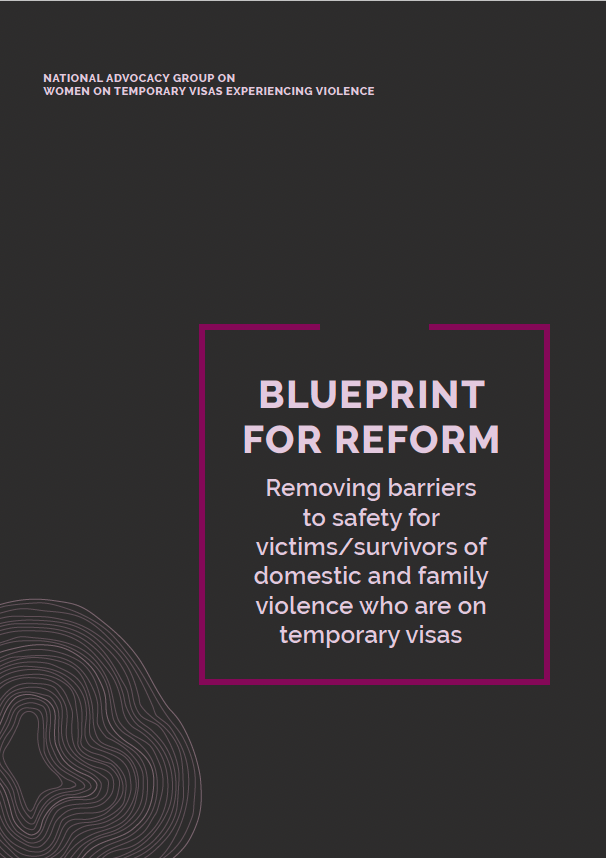
Blueprint for Reform: Removing Barriers to Safety for Victims/Survivors of Domestic and Family Violence Who Are on Temporary Visas

The Blueprint for Reform: Removing Barriers to Safety for Victims/Survivors of Domestic and Family Violence Who Are on Temporary Visas is the culmination of work by the National Advocacy Group on Women on Temporary Visas Experiencing Violence, aimed at ensuring safety and justice to victims/survivors of family violence, regardless of visa status and type.

We know that temporary visa holders experiencing family violence in Australia face multiple barriers to accessing safety, support, and justice. These barriers can cause women to remain in situations that are harmful and dangerous.

As the Australian Government moves towards implementing the National Plan to End Violence Against Women and Children 2022-2032, it is imperative that all women and children are given access to safety and stability.

The Blueprint for Reform recognises and responds to a range of barriers for women on temporary visas. The services system is too complex and often inaccessible. When a temporary visa holder experiences family violence in Australia, her visa status determines whether she can access social security, working rights, childcare, free public health, and housing support.

These barriers are used frequently by perpetrators of family violence to further coerce and control victims/survivors.

This Blueprint includes recommendations to ensure victims/survivors access the safety and support they need in four key steps:

  1. Improve the migration system so that all women on temporary visas who experience domestic, family and sexual violence and their dependants can access protections, services and justice.
  2. Expand eligibility and access to social security (including Medicare) for women on temporary visas who are experiencing domestic and family violence.
  3. Expand eligibility and access to social and public housing for women on temporary visas who are experiencing domestic and family violence.
  4. Ensure long-term and sustainable funding for specialist and legal services that support women on temporary visas who are experiencing or are at risk of domestic, family and sexual violence.

The National Advocacy Group are experts from across Australia who are calling on the Australian Government to adopt the recommendations.

Adopting and implementing the recommendations in the Blueprint will help to ensure the safety of all victims/survivors of family violence.

Queries should be directed to the Executive of the National Advocacy Group, [email protected].

—
Download the report:

Download the one-pager:

Blueprint for Reform 2022 Cover

Watch the Webinar of the Launch from June 2023

2020-2021 Federal Budget Analysis

AWAVA has conducted a budget analysis in relation to budget measures aimed at prevention and responses to all forms of violence against women and their children.
 

The bushfires and Covid-19 had brought on a number of social challenges for the people living in Australia. The stresses and the home confinement due to mandatory lockdown and economic insecurity have led to a spike in violence against women along with demand for frontline services serving victims/survivors of violence. At the start of the year, the Government provided the initial $150 million to meet the rising demands on the frontline services. As part of the 2020 Budget, the Government has announced the continuation of the Social and Community Sector Supplementation payments from July 2021. It has also announced a continued commitment to fund the 1800RESPECT Helpline. However, the Government has not added more funding in the forward estimates to address the ‘shadow pandemic’ of family and domestic violence.
 
Read the full analysis:  


Letter to Women’s Safety Ministers on urgent actions for women’s safety

5 March 2020


Dear Women’s Safety Ministers,
As specialists with years of experience working with and for women and children subjected to violence, we know that long-term, major reforms are needed over the coming months and years to achieve lasting improvements to safety and justice.


We also know there are key changes your governments can make immediately that will dramatically improve the safety of many women and children within weeks.


As well as committing to comprehensive reform to prevent all forms of violence against women, we urge you to action these five desperately needed changes at your meeting on Friday:


1. Fully fund the specialist services that improve women’s safety, and hold men who use violence to account, including:

    • The safety planning, risk assessment and wrap-around individual support provided by specialist women’s services,
    • The safe at home programs and emergency accommodation services provided by specialist homelessness providers working specifically with victim-survivors of violence,
    • The legal assistance and representation provided by specialist women’s legal services, Family Violence Prevention Legal Services, community legal centres, Aboriginal legal services, and Legal Aid,
    • The perpetrator intervention, men’s behaviour change programs and fathering programs provided by accredited men’s behaviour change experts,
    • The specialist and culturally-safe services that are best able to assist Aboriginal and Torres Strait Islander women and women from migrant and refugee backgrounds,
    • The disability advocacy and domestic violence services needed to support women with disabilities to overcome the barriers to achieving safety after violence from a partner, carer or in an institutional setting,
    • The safe phones program, which has been found be effective in delivering victims/survivors greater technology safety,
    • LGBTIQ+ services and LGBTIQ+-specific resources, programs and targeted community education campaigns,
    • Supporting community-based services to lead the conversations needed to change the attitudes and behaviours that enable violence, including empowering bystanders.


2. Remove the presumption of equal shared parental responsibility and emphasis on shared parenting in the Family Law Act 1975, to ensure a child’s safety and wellbeing are the key considerations, so that courts are determining the best parenting arrangement for their needs and circumstances.

3. Initiate a standard screening, risk assessment and referral process nationally, to ensure public health, social and community services are trained to identify key safety risks early for people experiencing violence in their relationships, and able to refer them to the services that can help them achieve safety and recover.

4. Agree to institute improved AVO standards to make clear what is expected of police, magistrates and courts to hold perpetrators accountable, and ensure women and children subjected to domestic and family violence are able to rely on these orders to achieve safety and justice.

5. Ensure victims/survivors seeking help can access free translating and interpreting services, so that regardless of their disability, cultural or language background, or geographical location, any woman reaching out for help to build a safer future is able to access the assistance she needs.


As with all initiatives for improved community safety and wellbeing, these urgent steps must be taken in a way that responds to the factors that shape people’s experiences of violence and encounters with institutions. These can include: the ongoing impacts of colonisation, race, class, sexual orientation and gender identity, ethnicity, nationality, religion, dis/ability and age, as well as the community attitudes, geographical isolation and the poor connectivity experienced by women in remote, rural and regional areas.

Further to these five immediate interventions, we note that the national alliance tasked with bringing together organisations to develop solutions, Australian Women Against Violence Alliance (AWAVA), has presented comprehensive advice on the major long-term reforms needed including the Blueprint for Reform for women on temporary visas experiencing violence, and that Women’s Legal Services Australia has mapped out the steps required for Safety First in Family Law. These solutions will require meaningful and sustained investment. AWAVA, its members and allies stand ready to work with governments to design and implement these reforms together.

This national crisis cannot be solved overnight. But actioning these five changes will bring immediate and substantial improvement to the safety of many women and children currently at risk, and will save lives. We urge you to do your part.

Signed,


  1. National Aboriginal and Torres Strait Islander Women’s Alliance
  2. Embolden (SA peak body of domestic, family and sexual violence services)
  3. Women’s Legal Services Queensland
  4. Women’s Legal Services Tasmania
  5. Ruby Gaea Darwin Centre Against Sexual Violence
  6. Sexual Assault Support Service Tasmania
  7. Aboriginal & Torres Strait Islander Women’s Legal Service North Queensland Inc.
  8. Emma House Domestic Violence Service
  9. Women’s Council for Domestic and Family Violence Services WA
  10. North Queensland Women’s Legal Service
  11. Equality Rights Alliance
  12. WESNET – The Women’s Services Network
  13. Annie North Inc
  14. Domestic Violence NSW
  15. Women’s Legal Service NSW
  16. economic Security4Women
  17. Limestone Coast Family Violence Action Group
  18. National Rural Women’s Coalition
  19. CASA Forum – Victorian Centres Against Sexual Assault
  20. Ending Violence Against Women Queensland
  21. Seras Women’s Shelter Inc.
  22. Mackay Women’s Services
  23. Association of Women Educators
  24. National Council of Single Mothers & their Children
  25. YWCA Canberra
  26. Women’s Safety NSW
  27. Mitcham Family Violence Education and Support Service
  28. Centre for Non-Violence
  29. Eastern Region Domestic Violence Services Network Inc. – Koolkuna
  30. Communicare Women’s Support Services
  31. Carnarvon Family Support Services
  32. WRISC Family Violence Support Inc.
  33. Women’s Centre Far North Queensland
  34. Migrant Women’s Support Program of Women’s Safety Services SA
  35. Lucy Saw Centre Association Inc.
  36. Penrith Women’s Health Centre
  37. Australasian Centre for Human Rights and Health
  38. Macleod Accommodation Support Service Inc.
  39. inTouch Multicultural Centre Against Family Violence
  40. North Shore Women’s Benevolent Association Limited
  41. Mid Coast Women’s Domestic Violence Court Advocacy Service
  42. safe steps Family Violence Response Centre
  43. Darwin Aboriginal & Islander Women’s Shelter
  44. Harmony Alliance: Migrant and Refugee Women for Change
  45. Accountability Matters Project
  46. DVConnect
  47. Domestic Violence Action Centre Toowoomba
  48. Gold Coast Domestic Violence Prevention Centre
  49. Domestic Violence Crisis Service Canberra
  50. Immigrant Women’s Support Service
  51. Sonshine Sanctuary Association
  52. Beryl Women Inc.
  53. Edon Place and Centre for Women & Co.
  54. Lou’s Place
  55. Cairns Regional Domestic Violence Service
  56. Women’s Information, Support and Housing in the North
  57. Settlement Services International
  58. Multicultural Centre for Women’s Health
  59. Northern Territory Council of Social Service
  60. Domestic Violence Victoria
  61. Project Respect
  62. Melaleuca Refugee Centre
  63. Dawn House Inc.
  64. Western Women’s Domestic Violence Court Advocacy Service
  65. Bramwell House (Salvation Army)
  66. Domestic Violence Resource Centre Victoria
  67. WASH House Inc.
  68. Immigrant Women’s Speakout Association Inc.
  69. Immigration Advice and Rights Centre
  70. Australian Women’s Health Network
  71. Centre Against Sexual Assault Central Victoria
  72. Open Support
  73. Women’s Legal Service (South Australia)
  74. Family Violence Prevention Legal Services National Forum
  75. Women’s Legal Services Australia
  76. No To Violence
  77. Take It Seriously
  78. YWCA Australia
  79. Refugee Advice & Casework Service (Aust) Inc.
  80. Jesuit Refugee Service (JRS) Australia
  81. Salvation Army National Family Violence Stream
  82. Economic Justice Australia
  83. Eastern Domestic Violence Service
  84. West Connect Domestic Violence Services

Thinking of engaging with the Select Committee inquiry into family law?

AWAVA’s position


Along with Fair Agenda and over 100 peak bodies and practitioners, we opposed the establishment of the inquiry. We made a joint statement calling for immediate action to make family law safer, separate from this unnecessary and harmful inquiry.


Now that the inquiry is going ahead against our advice, we are reluctantly engaging with it for two reasons: First, because we know the inquiry was set up to give a platform for those who seek to discredit victims/survivors and prioritise “parents’ rights” to have access to children over safety, and we need to counter these damaging narratives. Second, we are engaging with the inquiry in support of victims/survivors who may wish to participate.


Suggested Draft Text for Submissions 


AWAVA has prepared suggested draft text and references to assist organisations writing submissions to the Joint Select Committee on Australia’s Family Law System. It is drawn from AWAVA’s (ongoing) drafting of our own submission but does NOT represent finalised text for citation or attribution to AWAVA. It is text that you might like to use in preparing your own submission, which will then be attributed to you or your organisation.


AWAVA has an extension for our submission to 31 January 2020. If you are planning to make a submission we encourage you to seek a submission too, by emailing the Committee secretariat at [email protected]


We encourage you to adapt the text to suit your own work and if possible to include de-identified case studies and details drawing on your practice or experience. We do NOT encourage you to reproduce this whole text verbatim as your submission. It is a resource, not a template. Submissions will be more persuasive and influential if they are different and draw from different sources of knowledge, testimonies etc.


Where possible, please tie recommendations you make to recommendations that appear in existing reports/reviews etc. This is to reinforce the message that this inquiry was not necessary and that Government already has information at hand to guide much-needed urgent reforms to the system.


Download the draft suggested text for submissions here


Safeguards and protocols


Partly as a result of AWAVA’s and others’ advocacy, on 25 November the Senate agreed to a motion calling on the Government to: put in place “the essential safeguards being called for by women’s safety experts to protect witnesses during the conduct of the inquiry, including rules about giving evidence in confidence or remotely, ensuring safe access to hearing venues, and media protocols”, “not [hold] hearings until such safeguards and support for survivors of violence are implemented,” and ensure “adequate specialist and domestic family violence services are available to respond to additional demand resulting from the inquiry.”


You can read the full motion here (on p65). Further advocacy will be required to ensure all the relevant safeguards are put in place. You can read a news article on the motion here.


The Committee has published protocols in relation to submissions and hearings. You can read them here.


Submissions


AWAVA will make a submission to try to counter some of the misinformation that is being perpetuated through the inquiry process, and to reiterate our calls for action to make the system safer drawing on the recommendations of previous reviews and inquiries.


We know that some people and organisations in our network are also thinking of making a submission; we recommend using the suggested draft text for submissions. 


It is important that the inquiry consider the perspectives of victims/survivors and the organisations working to support them. However, we understand that some people and organisations may not be in a position to engage with the inquiry.


Submissions close on 18 December (AWAVA has asked for this to be extended but at this stage the deadline stands). Information about making a submission is available here.


*** Update (29 Nov): AWAVA has been given an extension for our submission until 31 January 2020, and the Committee Secretariat has said they will consider other requests for extensions. You can email the Committee Secretariat to ask for an extension via [email protected] ***


Key steps AWAVA is taking:

– write to the Committee Secretariat to ask for essential safeguards be put in place for victims/survivors [done – see above on safeguards]

– writing our own submission drawing on input from our Advisory Group [in progress]

– compiling resources to inform people and organisations wishing to engage with the inquiry [see resources below; more in progress]


Resources for organisations


Here are some suggestions about preparing a submission:


1. You may wish to open your submission with reference to support for the joint statement opposing the inquiry;


2. You may then wish to turn your mind to the terms of reference of the inquiry (any or all of these that you feel you want to address). We will have a draft out soon from which you might like to refer or draw, but we would encourage you to explain your own reasons for your position. Remember that you are allowed to address “any related matters”, so if you have points to make that don’t seem to fit neatly into any of the other terms of reference that’s OK.


3. You may wish to tie any of your recommendations to those which have been previously made by the Australian Law Reform Commission (ALRC) in its Review of the Family Law System, the Social Policy and Legal Affairs Parliamentary Inquiry into a Better Family Law System to support and protect those affected by Family Violence or others. This act of tying new recommendations to existing recommendations will further make the point that the inquiry itself was unnecessary in the first place, and efforts, time and resources should have instead been put into responding to the existing recommendation before the government to put safety first in family law.


Resources:


AWAVA / Fair Agenda Joint Statement


Safety First in Family Law plan (Women’s Legal Services Australia)


AWAVA, NATSIWA and Harmony Alliance submission to the first stage of the ALRC review


AWAVA’s submission in response to the ALRC review discussion paper


Resources for individuals


We are asking the committee to make sure that victims/survivors have access to free counselling and other support, in recognition that engaging with this inquiry may be retraumatising and distressing, as well as potentially posing safety and legal risks. Some general services are listed below.


Individual people giving evidence or making submissions need to be aware that there are laws restricting people from making details about their family law cases public.


This includes Section 121 of the Family Law Act which “restricts the publication of any accounts of any proceedings, or parts of any proceedings, or lists of proceedings (subject to permissible exceptions) under the Act that identify the parties or others involved in the case. The restriction applies to publication, or other dissemination, to the public or a section of the public, and can apply to disclosures online as well as through the media. Breaches of section 121 are offences punishable by imprisonment of up to one year.” (Source: Federal Register of Legislation)


We are asking for the committee to make sure that free legal advice is available for people who wish to give evidence or make submissions to the inquiry, so that you can do so in compliance with Australian law. We will keep you updated about advice or other resources that are made available.


Help and support


If you, a child, or another person is in immediate danger, call 000.


Helplines & websites


These organisations offer 24/7 telephone support and counselling services, and online chat, for specific community

groups and for people in specific situations.


1800 RESPECT
The national sexual assault, domestic and family violence counselling service. 24/7 phone and online services.
ph: 1800 737 732

Australian state and territory contact details for specialist sexual assault and domestic and family violence support services can be found at 1800 Respect services and support website.


KIDS HELPLINE

Kids Helpline is a counselling service for Australian children and young people aged between 5 and 25 years. 24/7 phone and online services.

ph: 1800 55 1800


MENS LINE
Professional support and information service for Australian men. 24/7 phone and online services.

ph: 1300 78 99 78


MEN’S REFERRAL SERVICE (MRS)

MRS provides anonymous and confidential telephone counselling, information and referrals to men to help them take action to stop using violent and controlling behaviour.

ph: 1300 766 491


NAPCAN

Go to the Urgent Help section of the National Association for Prevention of Child Abuse and Neglect (NAPCAN) website for contact details of agencies which assist with reporting child abuse and neglect.

Help and support details here have been compiled using Our Watch‘s help and support page (any errors remain our own).

Joint Statement – Make family law safe: stop putting victim-survivors of family violence and child abuse in harm’s way

Over 100 peak bodies and practitioners working to prevent and respond to violence against women and children have today launched a joint statement rejecting the legitimacy of the Government’s new Family Law Inquiry.


The statement, organised by community campaigning group Fair Agenda and AWAVA, the body set up to inform government policy on violence against women, denounces the delay in real action and urges five immediate changes to improve safety in the system, noting concerns about the safety of victim/survivors participating in the Inquiry, and declaring their focus will remain on responding to the unprecedented levels of demand for safety support, with many unable to divert vital resources to this dangerous inquiry.


Immediate action is required to stop putting victim-survivors of violence and abuse at risk, starting with:


1. Making sure courts identify safety risks that should be considered in any court decision, by implementing consistent screening and risk assessment process to protect children and parents at risk of violence;


2. Ensuring the courts have access to all relevant information by establishing a national information sharing framework to ensure information from state jurisdictions can be considered where relevant, and the courts are supported to make informed decisions that prioritise child safety and wellbeing;


3. Ensuring victim-survivors of family violence are supported and don’t have to go through the court process alone – by providing social and legal supports for all parties to family law matters involving family violence or child abuse;


4. Prioritising matters where people are at high-risk – by creating a specialist case management stream for family violence matters involving children and parents at serious risk of harm, and


5. Requiring those who influence court proceedings to have competency in identifying and responding to domestic and family violence in diverse family contexts – by implementing an accreditation framework for all court officials and family law practitioners and professionals, starting with court report writers and supervised contact centre workers.


Read the media release here:


Read the full Joint Statement here as a PDF document:


Joint Statement


Make family law safe: stop putting victim-survivors of family violence and child abuse in harm’s way


18 October 2019


As peak and practitioner bodies charged with preventing and responding to violence against women and children we do not accept the legitimacy of the Government’s new select committee inquiry into Family Law. We are alarmed that it is proceeding against the unanimous advice of experts in the domestic and family violence sector.


This Inquiry is not only unnecessary, it is dangerous. We know what is needed to improve the system. The decision to further delay implementing these urgently needed changes is absolutely unconscionable. Women’s and children’s lives are on the line. They cannot wait another year for action.


The use of domestic and family violence is having a devastating impact in our communities – 8 women are hospitalised at the hands of a current or ex-partner every day, with Aboriginal and Torres Strait Islander women 32 times more likely to be hospitalised than non-Indigenous women. Right now many of the people trying to escape this violence and abuse are forced through the family law system.


This system is consistently failing them. It is manifestly unfit for purpose – it is failing to identify harm, actively discouraging people from disclosing violence, and forcing children into contact with abusive parents. In many cases it is facilitating further violence and harm.


This situation is so dire that more than one in three children post-separation report feeling “not at all safe” in their care arrangements.


Cases before the courts are often complex, and every case is different. Our government needs to ensure the court has all the information and expertise it requires to determine what’s best for a child’s safety and wellbeing, particularly in the context of family violence and child abuse.


Immediate action is required to stop putting victim-survivors of violence and abuse at risk, starting with:


1. Making sure courts identify safety risks that should be considered in any court decision, by implementing consistent screening and risk assessment process to protect children and parents at risk of violence;


2. Ensuring the courts have access to all relevant information by establishing a national information sharing framework to ensure information from state jurisdictions can be considered where relevant, and the courts are supported to make informed decisions that prioritise child safety and wellbeing;


3. Ensuring victim-survivors of family violence are supported and don’t have to go through the court process alone – by providing social and legal supports for all parties to family law matters involving family violence or child abuse;


4. Prioritising matters where people are at high-risk – by creating a specialist case management stream for family violence matters involving children and parents at serious risk of harm; and


5. Requiring those who influence court proceedings to have competency in identifying and responding to domestic and family violence in diverse family contexts – by implementing an accreditation framework for all court officials and family law practitioners and professionals, starting with court report writers and supervised contact centre workers.


Beyond these initial urgent safety changes, the system needs comprehensive reform in accordance with expert advice including the domestic and family violence sector.


We emphasise that the achievement of any substantive improvement in the safety of the family law system will require the Federal Government ending the under-resourcing which puts victims of family violence and child abuse at unacceptable risk.


Peak and practitioner bodies stand ready to co-design and help implement reforms that are focused on improving the safety of the system. But we refuse to be complicit in the harm created by this new inquiry.


Given the nature of this inquiry, the manner in which it has been set up, and the composition and expressed positions of those leading it, we are aware that many victims-survivors do not feel safe to participate.


We remain extremely concerned that any victim-survivors who do wish to ensure their experiences are considered by this process will be unable to do so safely. In any inquiry like this where victim-survivors’ testimonies must be central, essential safeguards and supports must be put in place to make the process safe for them to participate. Such safeguards should include domestic and family violence and cultural competency training for committee members, options to give evidence anonymously and remotely including via audio visual link, provision of all Inquiry materials in the full range of accessible formats, including Easy English, funded access to counselling and legal services, and media protocols around reporting.


Finally, we note that as representatives of the organisations working on the frontline responding to women and children impacted by domestic and family violence, our primary objective will always be the safety of those who rely on our services. Some organisations in our sector will engage with the inquiry under the principle of minimising harm for victim-survivors and ensuring evidence is circulated to counter misinformation. For many organisations their focus will be on responding to the unprecedented levels of demand for safety support, and therefore they will not be in a position to divert vital resources to this dangerous inquiry.


Signed,


National Aboriginal and Torres Strait Islander Women’s Alliance
WESNET – The Women’s Services Network
Harmony Alliance – Migrant and Refugee Women for Change
Women With Disabilities Australia
National Council of Single Mothers and their Children
National Child Protection Alliance
Women’s Legal Services Australia
Women’s Safety NSW
Coalition of Women’s Domestic Violence Services of SA
Women’s Council for Domestic and Family Violence Services (WA)
Domestic Violence NSW
Domestic Violence Victoria
Domestic Violence Resource Centre Victoria
Women’s Community Health Network WA
Women’s Health NSW
No To Violence
Doctors Against Violence Towards Women
National Family Violence Prevention Legal Services Forum
YWCA Australia
Community Legal Centres Australia
People With Disability Australia
In Touch Multicultural Centre Against Family Violence
Carrie’s Place Domestic Violence and Homelessness Services
North Coast Women’s Domestic Violence Court Advocacy Service
Yarredi Services Inc
Women’s Community Shelters
Northern Rivers Women and Children’s Services Inc
Penrith Women’s Health Centre
Leichhardt Women’s Community Health Centre
Women’s Health and Resources Foundation
Sydney Women’s Domestic Violence Court Advocacy Service
Warrina Domestic and Family Violence Specialist Services
North West Sydney Women’s Domestic Violence Court Advocacy Service
Central Coast Women’s Domestic Violence Court Advocacy Service
Women’s Centre for Health and Wellbeing Albury Wodonga
Central West Women’s Domestic Violence Court Advocacy Service
Parramatta Women’s Domestic Violence Court Advocacy Service
Women’s Centre for Health Matters ACT
Sydney Women’s Counselling Centre
Hunter Women’s Domestic Violence Court Advocacy Service
Sisters Inside
Marie Stopes Australia
Association of Women Educators
Women’s Legal Service Queensland
Women’s Legal Service NSW
NSW Older Women’s Network
Sexual Assault Support Service (Tas)
CASA Forum – Victorian Centres Against Sexual Assault
Safe Steps Victoria
Project Respect
Wirrawee Gunya
Wilmah
Jessie Street
Penrith Women’s Refuge
Sera’s Women’s Shelter
Women’s Centre Far North Queensland
Australasian Centre for Human Rights and Health
Linking Communities Network Ltd, Griffith
Griffith Women’s Refuge
Emma House Domestic Violence Services
Engender Equality
Mitcham Family Violence Education and Support Service
Jenny’s Place Inc
Nova for Women and Children
Newcastle Staying Home Leaving Violence
Annie North Women’s Refuge
Port Stephens Family and Neighbourhood Services
99 Steps – CALD specific DFV service in Logan/Beenleigh
Women’s Information, Support & Housing in the North
Women’s Information and Referral Exchange
Australian Muslim Women’s Centre for Human Rights
Centre Against Violence
Eastern Domestic Violence Service
Safe Futures Foundation
Bethany Community Support
Emerge Women & Children’s Support Network
Northern Specialist Family Violence Service, Berry Street.
Kara House Inc.
WRISC Family Violence Support Inc.
Centre for Non-Violence
WAYSS Housing and Support Services
Georgina Martina Inc.
Northern Sydney Women’s Domestic Violence Court Advocacy Services
Blue Mountains Women’s Domestic Violence Court Advocacy Services
South Coast Women’s Domestic Violence Court Advocacy Services
Mallee Sexual Assault Unit Inc.
Mallee Domestic Violence Services
Western Specialist Family Violence Service, Berry Street
Southern Sydney Women’s Domestic Violence Court Advocacy Service
Far South Coast Women’s Domestic Violence Court Advocacy Service
Mid Coast Women’s Domestic Violence Court Advocacy Service
South Eastern Women’s Domestic Violence Court Advocacy Service
Macarthur Women’s Domestic Violence Court Advocacy Service
Women’s Health West
Orana House Inc
Cairns Regional Domestic Violence Service
North Queensland Domestic Violence Resource Service
Lucy Saw Centre
Macarthur Women’s Domestic Violence Court Advocacy Service
YWCA Canberra
Elizabeth Morgan House
Western Integrated Family Violence Committee
Starick
Community Legal Centres NSW
Flemington and Kensington Community Legal Centre
Good Shepherd Australia New Zealand
Good Samaritan Inn
Quantum Support Services Inc
Salvation Army Family and Domestic Violence Services Western Australia
The Salvation Army Australia

Blueprint for Reform

Removing Barriers to Safety for Victims/Survivors of Domestic and Family Violence who are on Temporary Visas


Violence against women is a grave violation of human rights. The National Plan to Reduce Violence Against Women and their Children envisions an Australia free from all forms of violence and abuse against women and their children.
 

On the international stage, Australia is leading the way in efforts to implement the Convention on the Elimination of All Forms of Discrimination Against Women, the Women, Peace and Security Agenda and the 2030 Agenda for Sustainable Development and uphold human rights bodies such as the Human Rights Council and the United Nations Commission on the Status of Women.
 

Victims/survivors should be empowered to make decisions which promote their safety, well-being and recovery through access to specialist services including housing, health, legal, social security, education and stable visa status. Victims/survivors and their dependants should have a right to determine their place of residence without impediment from the perpetrator.
 

In 2018 the National Advocacy Group on Women on Temporary Visas Experiencing Violence produced a Path to Nowhere report that examined the issues for women on temporary visas experiencing domestic, family and sexual violence and their dependants. Report findings highlighted a national crisis, affirmed by evidence and reviews nationally, which requires immediate law and policy reform by the Australian and State and Territory governments.

 
Women and their children have the right to be safe from all forms of violence in Australia, regardless of their visa status. This Blueprint sets out necessary reforms to achieve safety for all women.


To improve women’s and children’s access to safety and justice, we call on the Commonwealth, State and Territory governments to implement the following three steps:
 
1. Improve the migration system so that all women on temporary visas who experience domestic, family and sexual violence and their dependants can access protections, services and justice.
2. Ensure eligibility and access to services and government support are based on women’s needs for safety and recovery, regardless of their migration status.

3. Ensure that women on temporary visas who have experienced domestic, family and sexual violence and their dependants have immediate and full access to safety, protection, justice and fully funded specialist support with demonstrated gender expertise and cultural competency.


Download Blueprint for Reform here: 

Download social media images here.


Primary Prevention of Violence Against Women: A survey of activities in Australia – Report

26 September 2019


Primary prevention is an approach to address the underlying gendered and other intersecting drivers of violence to stop violence before it occurs. Primary prevention of violence against women encompasses activities to build respectful relationships and increase gender equality to reduce and ultimately end violence against women. It also includes activities to counter other forms of discrimination that combine with gender inequality and can contribute to increased severity or prevalence of violence against women experiencing these multiple forms of discrimination.


Between December 2018 and February 2019 AWAVA conducted a survey of prevention activities, led by our Violence Prevention Working Group. This was the first attempt to map primary prevention activities across Australia. The survey aimed to create a picture of activities to inform policy, practice and advocacy, and to identify key enablers as well as barriers and challenges to prevention work.


Read the report on the survey here:


Analysis of the Fourth Action Plan

The Fourth Action Plan of the National Plan to Reduce Violence Against Women and Their Children has been announced and endorsed by the Council of Australian Governments.
AWAVA has prepared an analysis of the Fourth Action Plan mapping it against our earlier submission during the consultations.


In summary, the Fourth Action Plan is positive in articulating some strong principles for addressing violence against women and their children in a holistic way and is to be welcomed for giving attention to diverse groups of women previously marginalised in policy development. Challenges remain in embedding an intersectional lens in policy, resourcing (in particular to specialist women’s services), and systems improvements in key areas including migration, family law, and social security. AWAVA looks forward to working closely with the government towards the development of a robust implementation plan for the Fourth Action Plan that addresses measures of prevention and response to VAW in a holistic manner.


Download the full analysis here:


At the 2019 Domestic Violence NSW Conference Imagining a world without gendered violence, AWAVA Program Manager Dr. Merrindahl Andrew presented findings from a 2018 survey conducted to consult on the development of the Fourth Action Plan, and AWAVA’s policy position on and analysis of the Fourth Action Plan. Find the slides from the presentation here: 

AWAVA’s 2018 Wrap-Up


In 2018 some important steps were taken to prevent and respond to violence against women in Australia.

Here are some of the biggest stories…


National Plan (Fourth Action Plan)

The National Plan to Reduce Violence Against Women and their Children (2010-2022) is the major Australian policy framework for efforts to end violence against women.

As we enter the last stage of the 12-year plan, the Australian Government is consulting on the final three-year action plan, to cover 2019–2022.

It is essential that the work to end violence against women continues through a second National Plan and coordinated efforts between the civil society and governments.


AWAVA’s submission on the development of the Fourth Action Plan: https://awava.org.au/2018/09/26/in-focus/submission-fourth-action-plan?doing_wp_cron=1546820620.9314379692077636718750


2018 CEDAW Shadow Report – Violence Against Women in Australia

On 2-3 July 2018, the United Nations Committee on the Elimination of Discrimination Against Women reviewed Australia’s record on women’s rights.

In addition to a report by the Australian Government, the CEDAW Committee was informed by civil society.

AWAVA, along with other organisations, submitted a Shadow Report on violence against women.

The CEDAW Committee made over 90 recommendations for improvements.

Civil society groups can now use these recommendations to continue to advocate for women’s human rights in Australia.


News: https://theconversation.com/un-delivers-strong-rebuke-to-australian-government-on-womens-rights-100089

AWAVA’s Shadow Report: https://awava.org.au/2018/06/15/submissions/2018/2018-cedaw-shadow-report-violence-against-women


Sexual violence/harassment

Across the world, the repercussions of #MeToo and long-term activism on sexual violence and harassment continue to be felt.

In Australia, End Rape on Campus released The Red Zone, a major report on sexual violence and hazing in university residential colleges.

EROC and its allies have called for an independent taskforce to oversee universities’ and residences’ responses.

However, no steps have yet been taken to establish one.

The Australian Human Rights Commission (ARHC) launched an inquiry into workplace sexual harassment, as more accounts of harassment and assault emerge.

The AHRC also released a toolkit to help facilitate discussion about sexual harassment in workplaces, community groups and among friends.


News: https://www.abc.net.au/news/2018-02-26/report-into-university-colleges-reveals-bizarre-rituals/9478036

News: https://www.abc.net.au/news/2018-06-20/ahrc-to-launch-inquiry-into-sexual-harassment/9887268

The Red Zone report: http://apo.org.au/node/134766


Dowry abuse

In June, a Senate Inquiry into the practice of dowry and the incidence of dowry abuse in Australia was announced.

Dowry is a cultural practice involving the exchange of substantial gifts at the time of marriage. Dowry does not necessarily lead to abuse, but in the context of gender inequality dowry abuse can develop as a form of male violence against women. It can occur alongside other forms of violence such as sexual abuse and financial abuse.

Efforts to prevent and respond to dowry abuse in Australia should be a part of a general commitment to ending violence against women.


News: https://www.abc.net.au/news/2018-09-21/dowry-abuse-in-australia-senate-inquiry-begins/10292714

AWAVA’s Submission in response to the Senate Inquiry on dowry abuse: https://awava.org.au/2018/08/28/submissions/submission-on-the-practice-of-dowry-and-the-incidence-of-dowry-abuse-in-australia


Path to Nowhere: report on women on temporary visas experiencing violence released

In December, the National Advocacy Group on Women on Temporary Visas Experiencing Violence released the report “Path to Nowhere”.

A national survey found women on temporary visas experiencing violence face specific and additional barriers to support and services.

Women on temporary visas are often unable to access Centrelink payments, Medicare, crisis accommodation and long-term housing.

The National Advocacy Group calls for the government to fully implement all recommendations made in the report as a matter of urgency.


Path to Nowhere report: https://awava.org.au/2018/12/11/research-and-reports/path-to-nowhere-report-women-on-temporary-visas-experiencing-violence-and-their-children


DV leave

A new entitlement of five days unpaid domestic violence leave was created.

The next step is a minimum of 10 days paid leave to support victims/survivors.


News: https://www.abc.net.au/news/2018-08-01/employees-now-entitled-to-unpaid-domestic-violence-leave/10060366

AWAVA’s 2018-2019 Pre-Budget Submission: https://awava.org.au/2018/02/01/submissions/2018-2019-pre-budget-submission


Review of the Family Law system

In 2018 the Australian Law Reform Council (ALRC) embarked on a major review of the family law system.

The review is intended to ensure the family law system meets the contemporary needs of families and effectively addresses family violence and child abuse.

Safety and wellbeing for victims/survivors of violence and children should be central to any reforms to the family law system.

Often, domestic and family violence is not identified, or victims/survivors are not properly represented.

This means some victims/survivors and their children end up being forced to have ongoing contact with an abusive parent, putting them at further risk.

AWAVA addressed this and other issues through submissions to the ALRC in 2018, working with our allies to call for safety first in family law.


News: https://www.abc.net.au/news/2018-05-30/sweeping-changes-to-family-court-as-broader-review-continues/9813434

AWAVA’s submission to the inquiry into the Family Court restructure: https://awava.org.au/2018/11/16/submissions/submission-to-the-inquiry-into-the-federal-circuit-and-family-court-of-australia-consequential-amendments-and-transitional-provision-bill-2018-and-federal-circuit-and-family-court-of-australia-bill

AWAVA’s submission in response to the ALRC Discussion Paper Review of the Family Law System: https://awava.org.au/2018/11/16/submissions/submission-in-response-to-the-alrc-discussion-paper-review-of-the-family-law-system


Ban of the Direct Cross-examination in Family Court

In a major step forward, alleged family violence offenders are no longer allowed to cross-examine victims/survivors in Family Court proceedings.

In introducing the ban, the Government responded to long-term advocacy from women’s services and the legal sector.

The Government accepted that a ban on cross-examination was needed for fairer outcomes and to prevent re-traumatisation of victims/survivors.

Cross-examination may be allowed in some instances but questioning will be by legal representatives.


News: https://www.abc.net.au/news/2018-06-28/domestic-violence-offenders-can-no-longer-cross-examine-victims/9915058


What do you think were the major steps in 2018 towards ending violence against women?

Have we missed something big?

What did you do that made a difference?

Please share your reflections in the comments, or email us!

Become a Friend and Supporter at www.awava.org.au

Submission on the development of the Fourth Action Plan

This submission draws on the survey conducted by AWAVA in May-June 2018, as well as AWAVA’s policy positions established in consultation with our members and networks including peak bodies and other diverse organisations from every State and Territory in Australia working in areas such as domestic and family violence, sexual assault, legal assistance, and education.


The Fourth Action Plan is a milestone in the efforts to respond to violence against women in Australia. Being the last four-year plan of the 12-year timeframe, it represents a crucial opportunity for honest evaluation and thoughtful planning towards ongoing, consistent and well-resourced efforts to reduce and ultimately end violence against women.

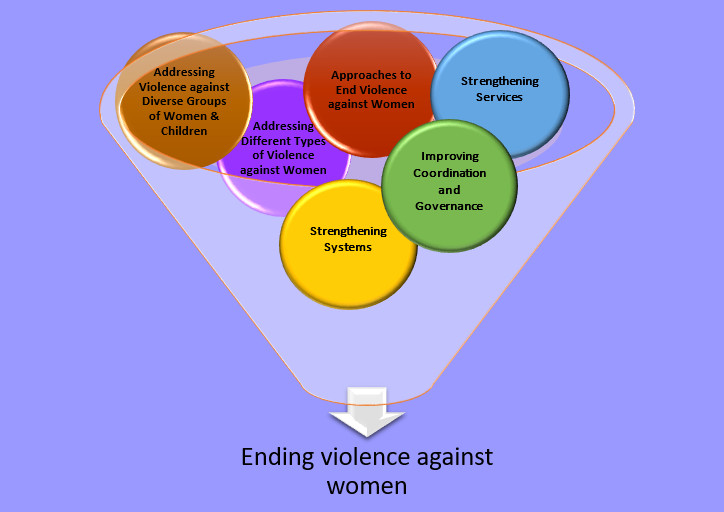
AWAVA offers a comprehensive structure that policy-makers might find useful in conceptualising the priority areas for the Fourth Action Plan, and working towards a second National Plan. We offer a framework for addressing violence against women and their children holistically by taking intersectional approaches to end violence against women, addressing violence against diverse groups of women and their children, addressing different types of violence against women, strengthening systems and services, and improving coordination and governance. For all the efforts to be sustainable and successful, long-term funding is required.
 

Download the full Position Paper here 


Download the Executive Summary here  

Go to Top