Weekly Round-Up 2018 Archive
[/fusion_builder_column][/fusion_builder_row][/fusion_builder_container]

[/fusion_builder_column][/fusion_builder_row][/fusion_builder_container]
In 2018 some important steps were taken to prevent and respond to violence against women in Australia.
Here are some of the biggest stories…
National Plan (Fourth Action Plan)
The National Plan to Reduce Violence Against Women and their Children (2010-2022) is the major Australian policy framework for efforts to end violence against women.
As we enter the last stage of the 12-year plan, the Australian Government is consulting on the final three-year action plan, to cover 2019–2022.
It is essential that the work to end violence against women continues through a second National Plan and coordinated efforts between the civil society and governments.
AWAVA’s submission on the development of the Fourth Action Plan: https://awava.org.au/2018/09/26/in-focus/submission-fourth-action-plan?doing_wp_cron=1546820620.9314379692077636718750
2018 CEDAW Shadow Report – Violence Against Women in Australia
On 2-3 July 2018, the United Nations Committee on the Elimination of Discrimination Against Women reviewed Australia’s record on women’s rights.
In addition to a report by the Australian Government, the CEDAW Committee was informed by civil society.
AWAVA, along with other organisations, submitted a Shadow Report on violence against women.
The CEDAW Committee made over 90 recommendations for improvements.
Civil society groups can now use these recommendations to continue to advocate for women’s human rights in Australia.
AWAVA’s Shadow Report: https://awava.org.au/2018/06/15/submissions/2018/2018-cedaw-shadow-report-violence-against-women
Sexual violence/harassment
Across the world, the repercussions of #MeToo and long-term activism on sexual violence and harassment continue to be felt.
In Australia, End Rape on Campus released The Red Zone, a major report on sexual violence and hazing in university residential colleges.
EROC and its allies have called for an independent taskforce to oversee universities’ and residences’ responses.
However, no steps have yet been taken to establish one.
The Australian Human Rights Commission (ARHC) launched an inquiry into workplace sexual harassment, as more accounts of harassment and assault emerge.
The AHRC also released a toolkit to help facilitate discussion about sexual harassment in workplaces, community groups and among friends.
News: https://www.abc.net.au/news/2018-06-20/ahrc-to-launch-inquiry-into-sexual-harassment/9887268
The Red Zone report: http://apo.org.au/node/134766
Dowry abuse
In June, a Senate Inquiry into the practice of dowry and the incidence of dowry abuse in Australia was announced.
Dowry is a cultural practice involving the exchange of substantial gifts at the time of marriage. Dowry does not necessarily lead to abuse, but in the context of gender inequality dowry abuse can develop as a form of male violence against women. It can occur alongside other forms of violence such as sexual abuse and financial abuse.
Efforts to prevent and respond to dowry abuse in Australia should be a part of a general commitment to ending violence against women.
News: https://www.abc.net.au/news/2018-09-21/dowry-abuse-in-australia-senate-inquiry-begins/10292714
AWAVA’s Submission in response to the Senate Inquiry on dowry abuse: https://awava.org.au/2018/08/28/submissions/submission-on-the-practice-of-dowry-and-the-incidence-of-dowry-abuse-in-australia
Path to Nowhere: report on women on temporary visas experiencing violence released
In December, the National Advocacy Group on Women on Temporary Visas Experiencing Violence released the report “Path to Nowhere”.
A national survey found women on temporary visas experiencing violence face specific and additional barriers to support and services.
Women on temporary visas are often unable to access Centrelink payments, Medicare, crisis accommodation and long-term housing.
The National Advocacy Group calls for the government to fully implement all recommendations made in the report as a matter of urgency.
Path to Nowhere report: https://awava.org.au/2018/12/11/research-and-reports/path-to-nowhere-report-women-on-temporary-visas-experiencing-violence-and-their-children
DV leave
A new entitlement of five days unpaid domestic violence leave was created.
The next step is a minimum of 10 days paid leave to support victims/survivors.
AWAVA’s 2018-2019 Pre-Budget Submission: https://awava.org.au/2018/02/01/submissions/2018-2019-pre-budget-submission
Review of the Family Law system
In 2018 the Australian Law Reform Council (ALRC) embarked on a major review of the family law system.
The review is intended to ensure the family law system meets the contemporary needs of families and effectively addresses family violence and child abuse.
Safety and wellbeing for victims/survivors of violence and children should be central to any reforms to the family law system.
Often, domestic and family violence is not identified, or victims/survivors are not properly represented.
This means some victims/survivors and their children end up being forced to have ongoing contact with an abusive parent, putting them at further risk.
AWAVA addressed this and other issues through submissions to the ALRC in 2018, working with our allies to call for safety first in family law.
News: https://www.abc.net.au/news/2018-05-30/sweeping-changes-to-family-court-as-broader-review-continues/9813434
AWAVA’s submission to the inquiry into the Family Court restructure: https://awava.org.au/2018/11/16/submissions/submission-to-the-inquiry-into-the-federal-circuit-and-family-court-of-australia-consequential-amendments-and-transitional-provision-bill-2018-and-federal-circuit-and-family-court-of-australia-bill
AWAVA’s submission in response to the ALRC Discussion Paper Review of the Family Law System: https://awava.org.au/2018/11/16/submissions/submission-in-response-to-the-alrc-discussion-paper-review-of-the-family-law-system
Ban of the Direct Cross-examination in Family Court
In a major step forward, alleged family violence offenders are no longer allowed to cross-examine victims/survivors in Family Court proceedings.
In introducing the ban, the Government responded to long-term advocacy from women’s services and the legal sector.
The Government accepted that a ban on cross-examination was needed for fairer outcomes and to prevent re-traumatisation of victims/survivors.
Cross-examination may be allowed in some instances but questioning will be by legal representatives.
What do you think were the major steps in 2018 towards ending violence against women?
Have we missed something big?
What did you do that made a difference?
Please share your reflections in the comments, or email us!
Become a Friend and Supporter at www.awava.org.au
In 2018, AWAVA hosted an intern, Tatiana Zhdanova, from the Australian National Internship Program. Drawing on expert interviews with women’s legal and court advocacy services, Tatiana prepared a report on common patterns and outcomes for children and their parents in cases where children are exposed to domestic and family violence. The report also proposes recommendations to improve outcomes for children and mothers who are victims/survivors.
The National Advocacy Group on Women on Temporary Visas Experiencing Violence has released the report “Path to Nowhere”. The report draws from data collected by an online survey which was developed for service providers to submit data on women with worked with or who sought assistance from them during the month of August 2018.

In summary the survey process found that during the month of August:
You can download the report here:
AWAVA’s Primary Prevention Survey has closed. Thank you to everyone who responded. We are now analysing the results and expect to release a report by the end of May.

AWAVA is conducting a survey of primary prevention activities across Australia. This survey is led by AWAVA’s Violence Prevention Working Group.
Click here to take the survey.
What is the survey about?
This survey maps activities across Australia that are working to build respectful relationships and increase gender equality so that violence against women doesn’t happen. This is called ‘primary prevention’ of violence against women.
Who should complete it?
Any organisations, services or activities that work to build respectful relationships and/or increase gender equality are in scope.
This includes activities that have the specific purpose of preventing violence against women such as Respectful Relationships programs in schools, but it also includes activities to promote gender equality more broadly. For example, an organisation advocating for Aboriginal and Torres Strait Islander women’s economic empowerment would be considered as doing primary prevention work, even if violence against women was not a major focus of their work.
How long will it take?
The survey is in two parts. Part 1, about your organisation and activities, will take 10-30 minutes to complete. The optional Part 2, about opportunities, constraints and enablers for your work, will also take 10-30 minutes.
Click here to take the survey.
Is it anonymous?
For Part 1, you can choose to remain anonymous, or you can agree to share your information on a public register to increase your agency’s availability to the public and to allied organisations.
For Part 2, all answers will be kept anonymous.
All information collected by the survey will be managed in accordance with WESNET’s Privacy Policy.
What will be the outcomes?
We will produce a report on the survey’s findings which can be used in policy and practice advocacy. All participants will be provided with a copy of the report. We will also create a searchable online register of activities where survey respondents agree to make their information public.
Why you should participate:–
Click here to take the survey.
Download a Word document version of the survey: Please share this information with your networks: Share this survey on social media! Download a flyer about the survey here: For more information or to get in touch
Email: [email protected]
Phone: (02) 6175 9924
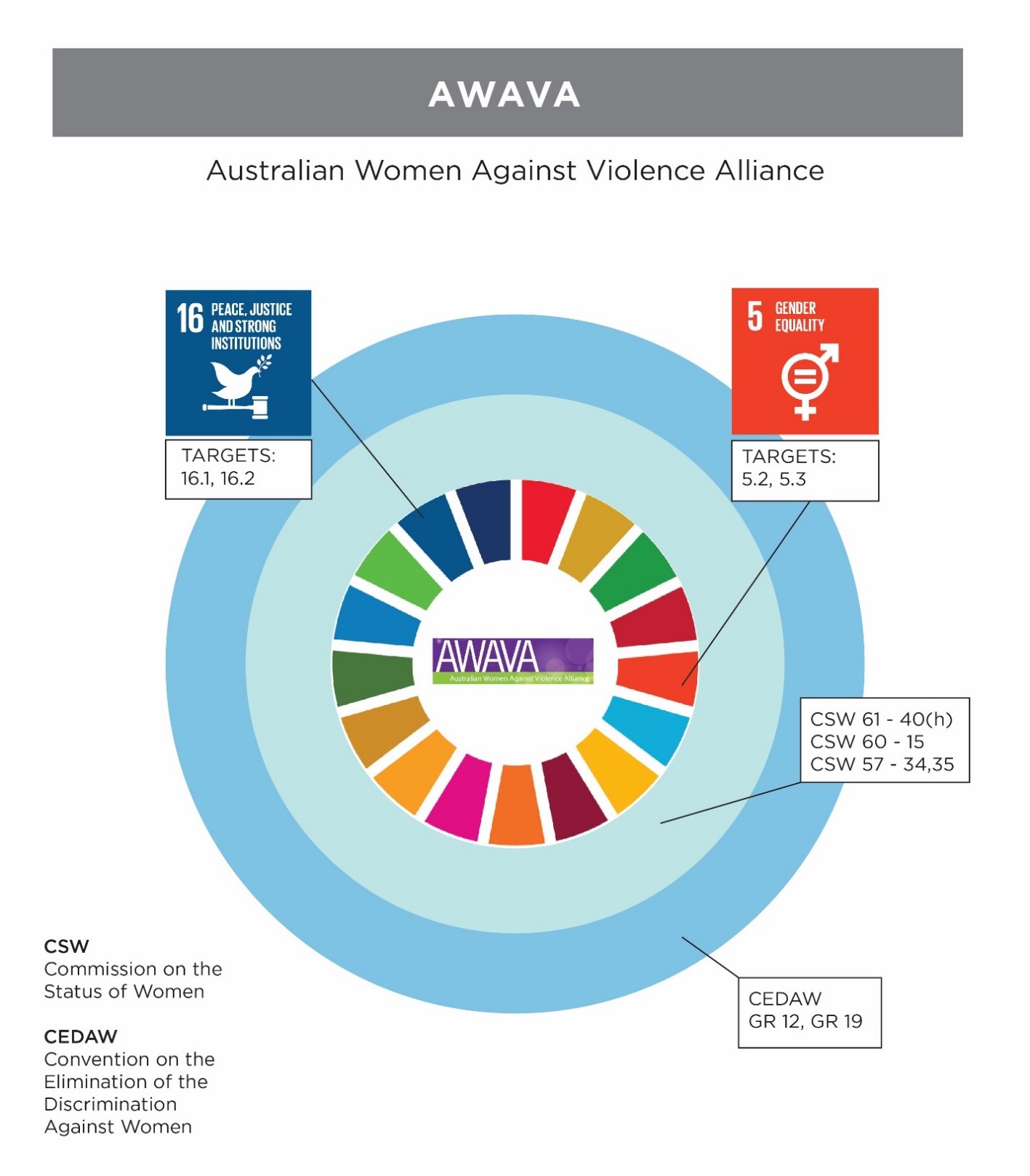
This document outlines AWAVA’s domestic advocacy priorities against international frameworks and
commitments on gender equality and women’s rights.
AWAVA Advocacy Priorities