This site is being archived soon. Visit wesnet.org.au for more information.

About AWAVA Secretariat

This author has not yet filled in any details.
So far AWAVA Secretariat has created 504 blog entries.

Young Women’s Report
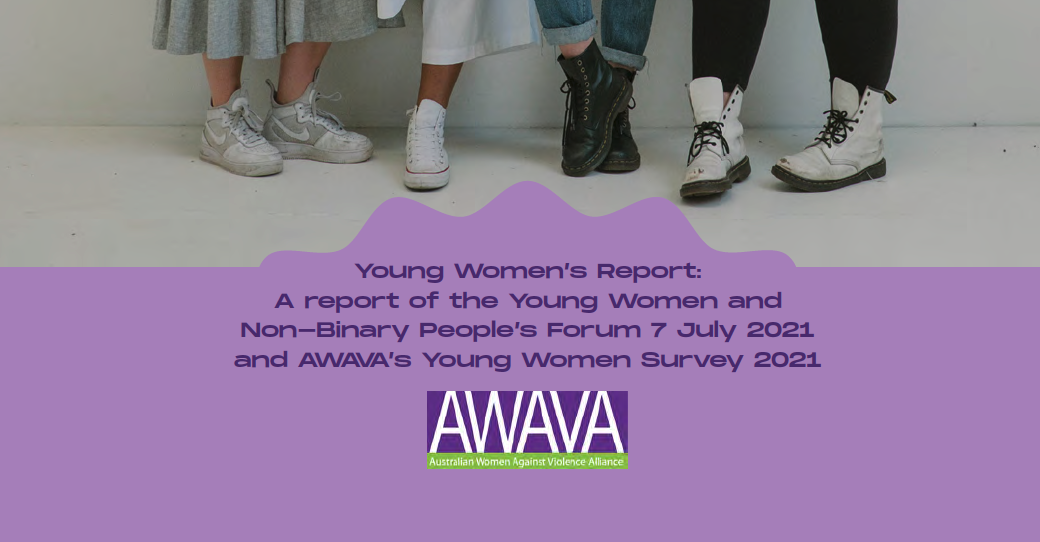
Young Women’s Report: A report of the Young Women and Non-Binary People’s Forum 7 July 2021 and AWAVA’s Young Women Survey 2021

This ground breaking report explores a range of issues associated with gender-based violence and its impact on young women and non-binary people.

Drawing on both the 2021 survey conducted by the Australian Women Against Violence Alliance (AWAVA) and translated into Easy English by Women With Disabilities Australia (WWDA), as well as a subsequent community forum hosted by AWAVA and the National Aboriginal Torres Strait Islander Women’s Alliance (NATSIWA), this ground-breaking report explores a range of issues associated with gender-based violence and its impacts on young women and non-binary people.

These two key elements – the survey and the forum – combined to provide rich new insights. The survey yielded unique aggregate information, while the forum served to add depth to our understandings, particularly around people’s experiences. The project was intentionally designed to amplify the voices of those young women and non-binary people who tend to be underrepresented in traditional policy settings.

The report introduces new ways to understand both interpersonal and structural experiences of diverse forms of violence, relying on first-hand accounts from young people living in a range of circumstances across Australia. Importantly, the report captures what justice means to young victim-survivors – a question that is rarely asked.

On 17th February, AWAVA, WESNET, NATSIWA and WWDA launched online the ‘Report on Young Women and Non-Binary People’s Experiences of Gender-Based Violence across Australia‘. The webinar launch brought to light key findings of the report and highlighted unique elements of the survey and forum design. It also included a panel of young women and non-binary people, including Is Hay, Margherita Dall’Occo, Mali Hermans and Louise Wellington who discussed violence prevention, reporting mechanisms, service gaps and what meaningful change to end gender-based violence looks like. In case you missed it or would like to share it with your networks you can watch the report launch webinar recording here.

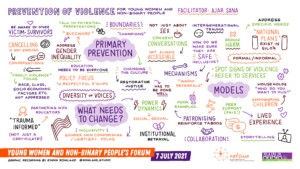
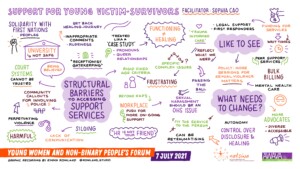
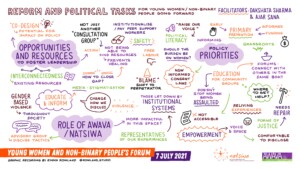
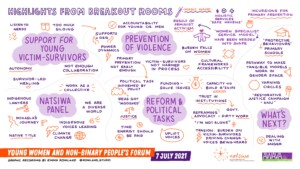
Graphic Recordings from the Young Women and Non-Binary People’s forum 7 July 2021

2021-2022 Federal Budget Analysis

AWAVA has conducted a budget analysis in relation to budget measures aimed at prevention and responses to all forms of violence against women and their children.


In response to community pressure, the government has certainly attempted to place women closer to the centre of this year’s budget. With the much-welcomed return of the Women’s Budget Statement came a total investment of $3.4 billion into policies and programs affecting women, including $1.1 billion into women’s safety, $1.9 billion into women’s workforce participation and economic security and $351.6 million into women’s health.


Read the full analysis:

Submission to the Royal Commission into Violence, Abuse, Neglect and Exploitation of People with Disability: Violence and Abuse of People with Disability at Home

In this submission we highlight that women with disability are more likely to experience more severe and frequent violence, by a wider array of perpetrators. They are additionally likely to encounter more barriers in seeking protection and justice. Girls and young women with disability are exposed to a broad range of violence perpetrated by carers, parents, guardians, peers, educators, service providers, and others, including dating partners. Violence can take many forms, including structural and institutional forms of gender-based violence related to law, the state and culture.


Download our submission here

English Language Tests Won’t Stop Family Violence, But Will Keep Families Apart

9 April 2021


The Refugee Advice and Casework Service (RACS) and Australian Women Against Violence Alliance (AWAVA) strongly oppose the Department of Home Affairs’ proposed imposition of an English language requirement, on both sponsors and applicants, for a partner visa.
 

The Department of Home Affairs suggest in their consultation that passing an English test will make partner visa applicants less vulnerable to family violence and other exploitation as they will be more easily able to access services for survivors of violence. The Department’s Consultation Paper suggests that ‘migrants who do not have sufficient English language skills may be more vulnerable to family violence and other exploitation’.
 

RACS & AWAVA in addition to a range of concerned organisations, have provided critical feedback via submission to the Department raising concern for families who could remain separated. RACS & AWAVA remain completely opposed to such paternalistic reforms that have failed to engage Culturally and Linguistically Diverse communities – the very communities it impacts.
 

Hannah Gray, Senior Solicitor and Coordinator of RACS’ Women at Risk program, says “This language creates a false association between domestic and family violence and non-English speakers and makes the unsupported claim that the way to combat such violence is by making it more difficult for non-English speaking partners to obtain visas and be reunited with their families.”
 

“Tragically, domestic and family violence occurs across all cultures and language groups. So the suggestion that the problem is exacerbated by survivors lacking the ability to speak sufficient English to seek help is highly reductive” she says.
 

Prior to the joint submission, RACS consulted extensively with a range of specialist women’s services. ”All confirmed they are strongly opposed to the proposed reforms of an English language requirement. For these groups, the suggestion it was the lack of English of survivors of violence is seen as just another form of victim blaming” says Ms Gray.
 

“Domestic and family violence is a gendered crime. There is no evidence to suggest that English-language is a predictor of domestic, family or sexual violence victimisation. Women on temporary visas need to be supported to access essential services at the points of crisis, have access to affordable and safe housing and assistance with migration matters, not being blamed for the actions of their partners who choose to use violence.” says Ms Dixson, Acting Program Manager, at the Australian Women Against Violence Alliance.
 

The submission also raises concerns about the impact of family separation, highlighting the negative impacts RACS witnesses on people seeking asylum and refugees, including ongoing trauma, prolonged uncertainty, and the potential for heightened vulnerability of female refugees and migrants.
 

“The proposed introduction of an English language requirement for both applicants and sponsors for partner visas will lead to significant barriers and delays to family reunion, and in some cases completely prevent families from being reunited causing further hardship and harm” says Ms Gray.
 

“Further, it will exacerbate existing inequalities along the lines of wealth and privilege, discriminating against those with less opportunities available to them to learn English to the same level as others.”
 

“Family reunification is already extraordinarily difficult. This proposal is yet another hurdle adversely impacting the lives of refugees in Australia.”
 

ENDS

For interview and comment contact Sarah Dale on 0419 200 637, or by email: [email protected]
 

About RACS
The Refugee Advice and Casework Service (RACS) is a strong, independent public voice for the rights of refugees and people seeking asylum. We provide critical free legal advice, assistance and representation, for financially disadvantaged and vulnerable people seeking asylum in Australia, and advocate for justice and dignity for refugees. RACS’ Family Reunion program supports refugees granted permanent residency seeking to reunite with their families after long periods of painful separation. RACS’ dedicated Women at Risk program, in conjunction with the Jesuit Refugee Service Finding Safety Program, supports women, or people who identify as female, seeking asylum, who have survived, or who fear sexual or gender based violence. For further information please contact RACS on (02) 8355 7227, or by email: [email protected].

How to participate in parliamentary processes: an advocacy guide

Advocacy has long been used as a feminist tool to challenge and disassemble sexist attitudes, policies and practices. By looking first at parliamentary inquiries, followed by the process of lobbying, this blog outlines how to effectively engage with politicians and take advantage of parliamentary processes to support the rights and freedoms of women and girls in Australia.


1. Parliamentary Inquiries


Parliamentary inquiries provide a vital avenue for community members and organisations to examine government departments, interrogate and develop policy and review legislation before it’s enacted.


Most parliamentary inquiries will provide a terms of reference that highlight the key focus areas of the inquiry and questions it hopes to answer. For your submission to be regarded, you need to respond to at least one of these terms of reference, drawing on facts, opinions, arguments and recommendations for action to strengthen your advocacy position. Whilst written submissions are a commonly requested format, parliamentary committees can also request your expertise through online surveys and questionnaires.


Submission checklist (Parliament of Australia, 2020):

  • Has my submission been written for the purposes of the inquiry?
  • Have I checked that this is not material that has been published previously?
  • Have I commented on some or all of the terms of reference?
  • Have I provided a summary of the submission at the front and numbered the pages (for lengthy submissions).
  • Have I provided my return postal or email address and contact details with the submission?
  • Have I ensured that my personal details are excluded from the body of the submission?
  • If the submissions contain confidential information, have I made this clear on the front of the submission and included reasons for requesting confidentiality?


For more information on dealing with parliamentary committees please see here.


After making a submission to a parliamentary inquiry you may be invited to appear as a witness at a Committee Public Hearing. Public hearings provide committees with the opportunity to ask witnesses to clarify and expand on their written submissions. These can take a number of forms, including roundtables, workshops and community statement sessions. Generally, these committee hearings are conducted in public, with the media present, and are often broadcasted, with transcripts being made available later on the Australian Parliament website.  Witnesses are always given “reasonable opportunity”, before appearing, to object to the broadcasting of proceedings (Parliament of Australia, 2020).


More information on the procedure of parliamentary inquiries and your rights as an attendee are available here.


2. Lobbying


If you have identified a feminist issue that is not currently being addressed by a Parliamentary Inquiry, you may wish to engage in lobbying to bring the attention to it. Lobbying is a type of advocacy that seeks to influence the actions, policies or decisions of government through engaging directly with politicians.


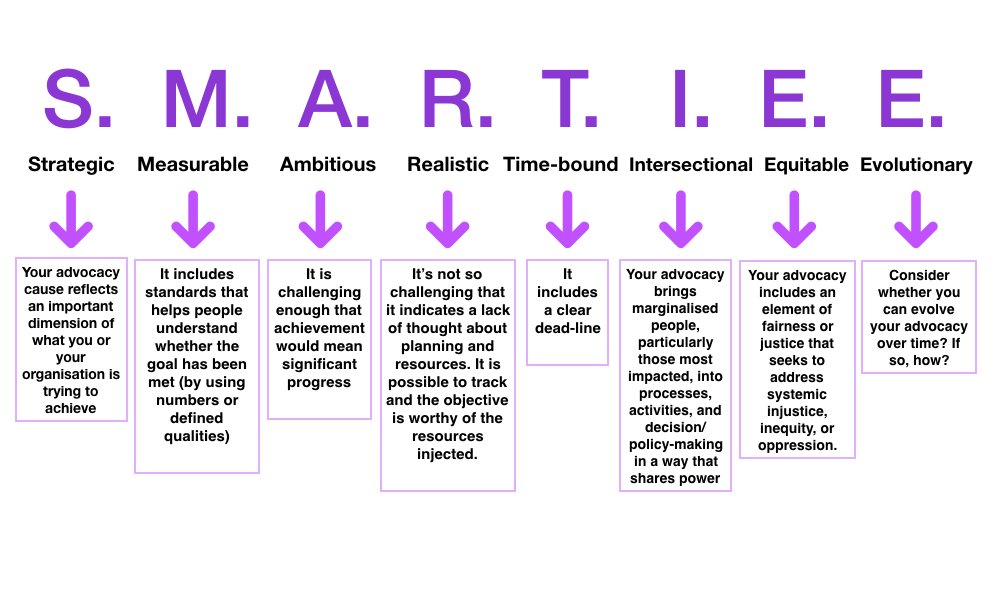
Step one: Identifying and designing an advocacy issue (SMARTIEE).


S.M.A.R.T.I.E.E. is a good framework to keep in mind when designing an advocacy case that will be effective at driving sustainable, structural change (YWCA 2020):


(SMARTIEE) Strategic: Your advocacy cause reflects an important dimension of what you or your organisation is trying to achieve Measurable: It includes standards that helps people understand whether the goal has been met (by using numbers or defined qualities) Ambitious: It is challenging enough that achievement would mean significant progress Realistic: It’s not so challenging that it indicates a lack of thought about planning and resources. It is possible to track and the objective is worthy of the resources injected. Time-bound: It includes a clear deadline. Intersectional: Your advocacy brings marginalised people, particularly those most impacted, into processes, activities, and decision/policymaking in a way that shares power. Equitable: Your advocacy includes an element of fairness or justice that seeks to address systemic injustice, inequity, or oppression. Evolutionary: Consider whether you can evolve your advocacy over time? If so, how?

A note on intersectionality:

In terms of gender, intersectionality highlights that there is no one homogenous experience of gender discrimination. Instead, it highlights that oppression and privilege are impacted by different “social relations, historical experiences and forms of discrimination”, including racism, ableism, homophobia, transphobia, classism and many others (The Opportunity Agenda, 2017). Ensuring your issue is both feminist and intersectional is essential for your advocacy to lead to a positive and sustainable change for all women. Here is how you can do it in 6 steps (YWCA, 2020):


Intersectionality Step 1: Identify who or what cause you are advocating for Step 2: Consider the power structures within which your issue operates Step 3: Consider what privileges or oppressions you bring to the table because of your identity/ies and lived experience Step 4: Consider who is most impacted by the issue Step 5: Ask yourself what you know about the issue, and what else u need to know—challenge your assumptions Step 6: Ensure your advocacy includes marginalised voices, and the people who are the most impacted

More information on intersectionality and its relationship to power, privilege, identity, oppression can be found in the YWCA’s Advocacy Toolkit.


Step 2: Appealing directly to politicians   


a) WHO should you target?


a green woman icon

Local Representatives

Local representatives have made a commitment to representing their local community members. As a result, they are the typically the first point of contact and can be helpful for gaining access to advisors, ministers and relevant committees.


a green woman icon

Advisors

Advisors prepare briefs on bills going through parliament and help the Minister and their department engage with stakeholders. They play a role in ensuring policy decisions are made on behalf of the community. Convincing advisors of the importance of your issue is a key first step in gaining the approval of Ministers/Shadow Ministers.


a green woman icon

Ministers/Shadow Ministers

Ministers and/or Shadow Ministers are best positioned for producing structural policy change at state and federal levels. A list of the current ministers and shadow ministers can be found on the Parliament House Website.


These resources can be used to understand what issues are important to politicians and their constituency. This research will help you to target politicians who will be sympathetic to your cause and frame your advocacy issue in a way that appeals to their interests and values:

a) Parliamentarians first speeches. These speeches are found on the parliamentarian’s profile pages that can be found on the parliament house website.

b) Voting History: Found on the TheyVoteForYou and OpenAustralia

c) The Hansard: Provides an online written record of parliamentary proceedings

d) Social media and media reports

e) Committee membership: Found on the Parliamentary Profile Page.

f) Party Platform


b) WHAT can parliamentarians do to help your advocacy?


In the following ways, members of parliament can increase recognition of your cause, spark debate and challenge government to recognise the presence of dissenting voices (Richards, 2019).


What parliamentarians can do to support your advocacy: 1) Raise Awareness through public platforms including social media, attending your events, and/or writing letters and signing their name in support 2) Direct a question at the responsible minister in the House of Reps or Senate that scrutinises the consequences of a proposed bill or amendment 3) Give speeches on behalf of your case to the House of Reps or Senate 4) Support your issue in a parliamentary vote. (Make sure to look at the make-up of the cross bench in the House and Senate - the positions of cross-benchers can determine the success or failure of policy)


c) HOW can you advocate to parliamentarians?


a green image of three human figure and a graph arrow pointing up

Data Collection and Ethical Story Telling:

Whilst storytelling humanises your advocacy, data provides politicians with measurable and accessible evidence that supports your claims. It is essential that you gain the explicit permission of any person/group/organisation whose story you wish to include and provide them with the opportunity to be involved throughout the lobbying process. Data must be reliable (drawn from reputable sources), honest and straightforward (Richards, 2019).


a green image of two text bubbles

Messaging and Framing:

It’s a good idea to design a short and simple advocacy message that reflects your objectives, targets and strategy. Your message should be framed according to the values and interests of your target parliamentarians and their electorate, however it’s important to ensure community voices are not compromised in an effort to appeal to parliamentarians (Richards, 2019).


a green image of a watch displaying the time

Timing:

Unlike parliamentary inquiries that provide an agenda and due date for submissions, lobbying can be done at any point of the political cycle. In saying this, some times are better than others, including:

  • When a party is settling its platform. Prior to an election campaign, politicians have the most flexibility to work with advocates on policy change.
  • During sitting week (this requires travel to Canberra):
    • Monday and Tuesday of sitting weeks are the days parties hold most of their policy committee and party room meetings
    • parliamentarians are also required to attend question time from 2.00 pm to 3.10 pm every day during sitting weeks.
    • The House of Representatives and the Senate usually operate between 9.30 am and 8.00 pm.
  • On a significant date. E.g., when a new bill is up for debate, when an issue is topical in the news (e.g., sexual violence in Federal Parliament) or on a noteworthy date such as International Women’s Day.


Inappropriate times for advocacy include:

  • During an election campaign (this is too late to engage politicians).
  • The weeks prior to a long break is a difficult time for politicians to gain any momentum on your issue before parliament goes into recess.
  • Budget week. This is a busy time, where politicians have little extra capacity to engage with advocates (YWCA, 2020).


Preparing for an Interaction

Who should I take?

Limit your group to three. Assigning roles and tasks to each member can help to ensure your meeting flows smoothly.


What should I take?

It is recommended to bring (and leave behind) a one-to-two-page support document. This should include evidence and data supporting your advocacy case.


What should I say?

Begin your meeting by briefly explaining who you are, who you represent, what work you do, and why you have asked to meet with them. Make sure you use a mix of evidence. It’s important that you illustrate that your issue exists (by using data) and that it matters (by using case studies).


What if I get a bad response?

Following the meeting, send any requested evidence or information to the politician’s office. Also re-examine any notes and/or feedback to make sure there were no misunderstandings during your meeting.


Advocacy is often the most successful when it reflects the concerns of the broader sector and community. Remaining intersectional, developing strong relationships, acknowledging political contexts and framing problems and solutions in a way that centres politics are therefore all vital components for driving sustainable policy change that benefits the lives of all women in Australia.


For more information on feminist advocacy please see the following sources:


For more information on intersectionality and how to be an ally please see the following sources:


Domestic Violence Advocates Tell Senate Committee To Reject The Government’s Plans Repeal Safe Lending Laws


26 February 2021


Financial abuse and domestic violence advocates will give evidence to the Senate Committee today about the harm women will face if the Government’s Supporting Economic Recovery Bill is passed.


Spokesperson for the Economic Abuse Reference Group Laura Bianchi said its 20 member organisations, which assist people experiencing financial abuse, have grave concerns about the impact of removing lending protections on people experiencing domestic and family violence.


Ms Bianchi, who also heads up Redfern Legal Centre’s Financial Abuse Service NSW, said current lending obligations prescribe important steps which often identify red flags in domestic and family abuse.


“Responsible lending protections are absolutely critical, because they help ensure that the lender makes inquiries as to the loan’s purpose, suitability and affordability. When used correctly, these checks and balances play an important role in preventing economic abuse,” Ms Bianchi said.


Dozens of domestic violence and economic abuse advocacy groups have joined together to urge the Senate Standing Committee on Economics to recommend this Bill does not get passed.


Quotes attributable to Chief Executive Officer of the Financial Rights Legal Centre Karen Cox


“In recent years, and especially during the pandemic, our organisations have seen an increase in online loan applications, remote signing and consent which removes opportunities for bank staff to identify red flags for financial abuse.


“Without the requirements in our current save lending laws to verify information on loan applications and to assess the requirements and objectives of borrowers, we fear there will be a tidal wave of economic abuse.”


Quotes attributable to Renata Field, Policy and Research Manager for Domestic Violence NSW:


“Any weakening of consumer protections could have devastating impacts on people who have experienced violence and abuse.


“The lending laws we have in place provide a remedy for women when lenders do not undertake the required steps or ignore the red flags of economic abuse. If this Bill is passed we know from our experience helping victim-survivors that more women will end up carrying unaffordable debts left over from abusive relationships.”


Quotes attributable to Carmel Franklin, Chief Executive Officer of Care Financial Counselling


“Removing these laws will reduce the ability of advocates like financial counsellors and community lawyers to assist survivors with debts that they accrued during abusive relationships.


“If advocates cannot help women resolve these unsuitable debts, it is almost impossible for them to re-establish their lives. It will make it more likely that victims of financial abuse are compelled to return to or remain in an abusive relationship, when the financial barriers to leaving are insurmountable.”


Quotes attributable to Chief Executive Officer of Domestic Violence NSW Delia Donovan


“It has been well documented that rates of domestic abuse have risen sharply in Australia during the COVID-19 pandemic.


“Victim-survivors need laws and policies that make it harder for perpetrators to use credit products to perpetrate economic abuse. Instead, the proposed reforms will make it easier for perpetrators of financial abuse to game the system.”

Passage of flawed merger bill tasks family law judges with an impossible task

18 February 2021


The passage of the Government’s flawed merger bill by the barest of margins is a disappointing outcome for Australian children and families and tasks Australian judges with an impossible task, a coalition of stakeholders said today.


The Law Council of Australia, Women’s Legal Services Australia, Community Legal Centres Australia, the National Aboriginal and Torres Strait Islander Legal Services and Australian Women Against Violence Alliance are among more than 155 stakeholders who have consistently opposed the Government’s bill to abolish the specialist, stand-alone Family Court out of concern it would harm, not help, Australian families and children.


The best interests of families and children are at the heart of what we do and must remain at the heart of policy development in this space.


For three years, we have put the merger proposal to proof. Not because it was popular to do so but to put to challenge a fundamental change that will directly impact on Australian lives and hard-working judges because it is our job to advocate for the best outcomes for children, families and victim-survivors of family violence.


We disagree with the Government, Senators Patrick, Hanson and Robert in relation to the claimed benefits of the merger, which are based on the widely discredited PWC Report and disputed by many stakeholders. There is much more evidence to support the damage that will be done by the merger, including harm to families and people experiencing family violence. The Government and new Court will be under heavy scrutiny to deliver court efficiency, resolve 8,000 additional cases, reduce costs, reduce the time separating families will spend before the court and reduce delays, even allowing for the impact of COVID-19.


Despite the significant backlogs facing the Courts and shortfalls in judicial officers, the Government voted against two motions on Wednesday to guarantee a minimum number of judges in the new Division 1 at either the Family Court’s current strength of 32 or the 40 judges that are at least required to meet existing need.


Those voting for the Bill have tasked the Court to deliver the projected outcomes with fewer resources than are needed to do the job. It was confirmed in the Consideration of Detail stage of the bill that there are currently eight judicial vacancies in the Family Court and Federal Circuit Court which have yet to be filled. At least ten judges practising in family law are to retire in 2021-22.


Like many others, we have warned of the dangers this legislation poses for the most vulnerable in our community at a time of relationship breakdown. We now call on the Government to step up and properly fund the family law system and legal assistance, and to repair the years of government neglect of this critical infrastructure.


We will continue to do whatever is possible to support the new Court in the delivery of justice to Australian children and families in this most critical of areas.


While we respect the will of the Parliament, what is disappointing about the process has been that the advice of highly respected experts has been consistently disregarded. Despite this, many have stood up to make their voices heard, made written and oral submissions and representations to Parliamentarians to seek to inform public debate and assist the Parliament to consider this bill. We thank stakeholders who have engaged in discussions about this important issue for their contributions and their tireless advocacy for Australian families.


Contacts

Angela Lynch AM, Women’s Legal Services Australia: 07 3392 0644
Nassim Arrage, Community Legal Centres Australia: 02 9264 9595
Dr Fiona Wade, Law Council of Australia: 0403 810 865
Lucy Brown, National Aboriginal and Torres Strait Islander Legal Services: 0435 866 462
Tina Dixson, AWAVA: 0428 541 396


Download the pdf of the media release here.

Criminalisation of Coercive Control: Issues Paper

Coercive control is an umbrella term that refers to an ongoing pattern of controlling and coercive behaviours that pervade an individual’s daily life with a devastating impact. These behaviours may include physical, sexual, psychological, financial and emotional abuse and intimidation, used as tactics by a perpetrator to gain power, control and dominance over a victim/survivor. A key to the understanding of coercive control is that it is typically a course of conduct made of up of a series of incremental incidents where a single act may appear trivial, but together they form a broader pattern of abusive behaviours that serve to reinforce and strengthen the control and dominance of one person over another over time.


The abuse can occur in person as well as online and may involve the use of systems to inflict abuse. While the legislative attention on coercive control has centred largely on intimate partner violence, it is important to note that these patterns of behaviours can be present across a range of non-intimate partner relationships where individuals are in close contact, including in caregiving roles.


In order to produce this paper, AWAVA’s team undertook a literature review and held meetings with our Advisory Group members to better capture positions on the issue within our membership. While there is a consensus among our members and other experts on violence against women that coercive control is a serious and foundational part of sexual and gender-based violence against women, there are diverse views on how best to prevent, address and respond to it. Differences in legal, historical and policy contexts between jurisdictions as well as intersectional lived experiences of violence among diverse groups of women are among the reasons for different stances on the criminalisation of coercive control. This paper provides an outline of the current political and legislative landscape along with existing evidence.


Download the position paper:  


Weekly Round-Up 2020 Archive


Women exploited by controversial rehabilitation centre, family violence expected to spike in post-COVID Christmas, reports and more. 17 December 2020
“Activism against violence against Indigenous women is every damn day” writes Marlene Longbottom, systemic failing in police handling of DFV and more. 8 December 2020
Family and Federal Court merger risks the lives of women and children, women with disability being turned away from DFV services, webinars and more. 1 December 2020
A mass imprisonment crisis of women in Australia is growing, changes to responsible lending laws risk more financial abuse, reports and more. 17 November 2020
Celebrating NAIDOC Week, trans people subjected to sexual assault by health professionals, calls for research and more.  10 November 2020
Claims of state mismanagement of violence prevention program in West Kimberley, new men’s behaviour change program for SA, reports and more. 3 November 2020
Survey highlights young men’s alarming attitudes towards violence, Aged Care Royal Commission hears shocking rates of sexual abuse, surveys and more. 27 October 2020
Family violence workers burnt out in midst of pandemic, abusers in the ranks of Australian police forces, resources and more.
21 October 2020
Calls for structural changes to budget, concerns over new English test for partner visas, webinars and more.
14 October 2020
Budget fails women trying to escape violence, new report on online abuse and young women, resources and more.
8 October 2020
Vital report on family violence and temporary visa holders during COVID-19, QLD police under scrutiny for sexist ad campaign, resources and more.
29 September 2020
COVID-19 recession is ‘trapping’ women in violent households, calls for voices of criminalised women to be centred, webinars and more.
22 September 2020
Welfare campaigners warn poverty looms for 1.1 million children as COVID supplement cut, first Gender Equality Commissioner for VIC and more.
10 September 2020
Extensive new report on sexual violence in Australia, advocates call for VIC gag laws to be repealed, resources, webinars and more.
3 September 2020
Women’s Safety Ministers meeting does not bring new actions on DFV, advocates urge to apply a gender lens to COVID recovery, research and more.
27 August 2020
Increased access to hospitals for women on temporary visas in NSW, police mistake leads to loss of victim/survivors’ info in WA, webinars and more.
13 August 2020
Barriers for migrant and refugee women experiencing violence, Aboriginal and Torres Strait Islander healing programs study, resources and more.
6 August 2020
New Closing the Gap targets, third anniversary of the report into Sexual Assault and Harassment on Australian University Campuses and more.
30 July 2020
Calls for Federal Government to deliver on Superannuation scheme for women after separation, LGBTI family violence forum, resources and more.
23 July 2020
New data shows 1 in 10 Australian women have experienced DFV during COVID-19 pandemic, proposed telehealth changes cause concern, research and more.
16 July 2020
Dr Merrindahl Andrew leaves AWAVA, new DFV funding for LGBTQI community, surveys, resources and more.
9 July 2020
Aboriginal Domestic & Family Violence specialists plea for urgent action, new DFV laws in WA, resources, reports and more.
2 July 2020
News laws for victims/survivors of sexual assault in NT, advocacy on Victims Support Scheme in NSW, reports and more.
25 June 2020
Family Law bill introduced, police violence against women, resources, webinars and more.
18 June 2020
New parliamentary inquiry into domestic violence to probe national failures, solidarity with Black lives matter movement, resources and more.
4 June 2020
$21 million boost for NSW domestic violence services, AbSec to lose half its funding, research reports and more.
28 May 2020
Domestic violence inquiry ends with no hearings or recommendations, new family violence awareness campaigns amidst COVID-19, webinars and more.
21 May 2020
COVID-19 impacts on women’s safety only beginning, new research agenda on financial abuse, surveys and more.
14 May 2020
More support needed for temporary migrants facing family violence, research project for frontline workers, webinars and more.
7 May 2020
Family court to triage family violence matters within 72 hours, advice on Covidsafe app for survivors, resources and more.
1 May 2020
Coroner refers death in custody of Aboriginal woman Tanya Day for possible prosecution, shared custody in the time of coronavirus, surveys and more.
24 April 2020
WESNET Safe Phones program receives welcome funding reprieve, fears for refugee and migrant women during COVID-19, resources and more.
9 April 2020
$150 million funding to address domestic and family violence amidst COVID-19, what COVID-19 lockdowns mean for sex workers, COVID-19 resources and more.
2 April 2020
Calls for Federal Government support for women subjected to violence amongst COVID-19, new disability support toolkit, resources, webinars and more.
26 March 2020
Warnings of increased violence against women during pandemic, assisting victims/survivors remotely, calls to abandon Family Law Inquiry, and more. 20 March 2020
Government criticised for ignoring expert advice on family violence, workplace sexual harassment, temporary migration & violence, scholarships & more. 12 March 2020
Special meeting of Women’s Safety Ministers, new website for women and girls with disability, research, events and more! 6 March 2020
Victims/survivor’s struggle for safety post-separation, calls for domestic violence deaths data transparency, research, reports and more. 27 February 2020
Media guidelines for reporting violence against women, cashless debit card fails to reduce family violence, resources, events and more. 20 February 2020
Ochre Ribbon Week, NT debates court changes for victim/survivors, reports, events and more! 13 February 2020
Fiji announces National Action Plan to prevent gender-based violence, free dental care for women experiencing violence, events, resources and more! 6 February 2020
Police attitudes towards sexual assault revealed, poverty and disability preventing women from leaving violence, relief resources, surveys and more! 30 January 2020
Bushfire Crisis and Climate Emergency, Extensive relief resources listed, Black Deaths in Custody, Reproductive Abuse and more. 23 January 2020


Highlights from AWAVA’s 16 Days of Activism against Gender-Based Violence Campaign

About 16 Days of Activism against Gender-Based Violence Campaign


Led by women’s rights defenders, the 16 Days of Activism against Gender-Based Violence is an annual international campaign that begins on 25 November, the International Day for the Elimination of Violence against Women, and runs until 10 December, Human Rights Day. It was initiated by activists at the inaugural Women’s Global Leadership Institute in 1991 and continues to be coordinated each year by the Center for Women’s Global Leadership. It galvanizes the advocacy and actions by individuals, communities and institutions around the world to eliminate violence against women and girls.


AWAVA’s 2020 16 Days theme: Communities Driving Change


The Australian Women Against Violence Alliance community is comprised of 25 specialist women’s services and over 500 individual friends and supporters from across all states and territories. We wanted to use the opportunity during our 16 Days Campaign to provide a platform and amplify the voices of our community, made up of diverse leaders, frontline workers and advocates, many with lived experience of violence. This is how Communities Driving Change was selected as AWAVA’s theme for 16 Days campaign, with the accompanying hashtag #AllVoicesForSafety and #16days.


AWAVA invited members of our community to share what they are doing to drive change and what their priorities are for safety. Throughout the period of the 16 Days Campaign, we featured our diverse community members on AWAVA’s Facebook and Twitter, including interviews with Harmony Alliance who work with migrants and refugee women, Women With Disabilities Australia (WWDA), Project Respect who work with sex works and who are victims/survivors of trafficking, National Council for Sing Mothers and Their Children, Older women NSW, the National Rural Women’s Coalition and many other organisations working to end gender-based violence across Australia.


Spotlight on Aboriginal and Torres Strait Islander Women


Spotlight on Rural, Regional and Remote Women


Spotlight on Trafficked Women and Women Working in Sex Industry 


AWAVA also spoke with two survivor advocates working with Domestic Violence NSW, Jane Matts and Rachael Natoli.


In this space, Jane is “working with women in Queensland and NSW who have had their voices ignored in Family Court/Federal Circuit Court (FCC). Many have had their children removed as a result of poor management of DV/child sex abuse.”


Read the full post here.


Thank you to all the Friends and Supporters who submitted your responses and those who have liked and shared these important messages. We created a digital clip featuring submissions from Marie Stopes Australia, Children by Choice Association Inc, Central Coast Community Women’s Health Centre and more.


Visit AWAVA’s Facebook and Twitter to see all the posts.


Collectively, our community called for programs and services that tailor to the diversity of victims/survivor’s and that are trauma-informed, along with many other good practices principles that can be found in the revised Good practice principles in addressing sexual and gender-based violence: Drawing on the unique practice model of specialist women’s services brochure, which was launched during the 16 Days Campaign period. Building on over 40 years of feminist and social justice approaches, the impact and effectiveness of specialist women’s services is underpinned by a set of good practice principles that are supported by international research and evidence-based practice. These principles should inform the delivery and coordination of all essential services responding to women and children subjected to violence.


In marking the launch of the Good Practice Principles brochure, we also hosted a webinar with representatives from our organisational members who contributed to this important work.


Moderated by Tina Dixson, Acting Program Manager, AWAVA, the panel was made up of:

  • Bonney Corbin, Australian Women’s Health Network, Marie Stopes Australia
  • Kedy Kristal, Centre for Women’s Safety and Wellbeing
  • Yvette Cehtel, Women’s Legal Services Tasmania
  • Karen Bentley, WESNET

A recording of the webinar will be uploaded shortly.


Thank you everyone, for your engagement in building our community to end violence against women, wherever you are. We look forward to working together in the 2021 16 Days Campaign and beyond!


Checkout other organisations’ 16 Days Campaign


DVNSW

YWCA Australia

UN Women


Go to Top