This site is being archived soon. Visit wesnet.org.au for more information.

Day 5 Spotlight on Violence against Women Human Rights Defenders

In 1998, a landmark Declaration on Human Rights Defenders was adopted by the UN General Assembly, providing recognition to people who work to protect and promote human rights. While in every region human rights defenders become subjected to violence, women human rights defenders are often targeted not only for their “activism but also because of their gender and their activities are repeatedly delegitimized and denigrated”.

[1]


With the recognition of the gendered dimension of human rights work, in 2013 the UN General Assembly adopted a Resolution 18 focusing solely on women human rights defenders.[2] The resolution provides a comprehensive and nuanced understanding of the “structural and systemic discrimination and violence they face and calls upon states to create a safe and enabling environment for them”.[3]


Amnesty International states that “women human rights defenders face various forms of gender-based violence in addition to the attacks other human rights defenders might face, including sexual violence, and threats, harassment and defamation campaigns linked to their status as women”.[4]  Often, women human rights defenders work in traditional settings and challenge traditional norms, thus becoming more vulnerable to gender-based violence and attacks. Women are also often subjected to family and community rejection because of the perceived fear from the latter that women’s human rights work threatens their culture, tradition or values.


Women who are adopting intersectional approaches in their human rights work and who are working with Indigenous communities, LBGTIQ communities or others experience double if not triple discrimination. Amnesty International states that “LGBTI defenders experience intersectional discrimination, both for their work as human rights defenders and because they experience transphobic or homophobic discrimination because they are or are perceived as being LGBTI”.[5]


Women are often subjected to sexual harassment during official negotiations or advocacy meetings, including by being objectified and disregarded as experts. Consider these two recent examples from UN climate negotiations.


Women working on the issues of sexual and reproductive rights, gender equality, family and domestic violence are also vulnerable to abuse and threats, including technology-facilitated abuse. For women in regional and rural areas, the risks are increased due to the fact that they are normally known to both victim/survivors and perpetrators. Women also become targets for trolling and cyberbullying online for promoting of equality and rights of women and girls.


It is important to recognise the specific challenges this group of defenders face, in order to strengthen protection mechanisms and other responses to their specific concerns at both local and international levels.


Today on the International Day of Human Rights Defenders, we are celebrating the courage and commitment of women who dedicate their lives to achieve justice and equality for all.


 Resources:  


References cited:

[1] Amnesty International (2017) Human Rights Defenders under threat: shrinking space for civil society.  

[2] https://www.awid.org/news-and-analysis/first-resolution-protecting-women-human-rights-defenders-adopted-un-amid-strong  

[3] Amnesty International (2015) Their lives on the line: Women human rights defenders under attack in Afghanistan.  

[4] Amnesty International (2017) Human Rights Defenders under threat: shrinking space for civil society. 

[5] Ibid. 


Day 4 The Unique Role of Specialist Women’s Services in Ending Violence against Women

One of the core priorities of AWAVA is to promote the unique role of special women’s services in ending violence against women. Building on feminist and social justice approaches, the impact and effectiveness of specialist women’s services is underpinned by a set of good practice principles that are supported by international research and evidence-based practice.  


These principles should underpin the delivery and coordination of all essential services responding to women and children subjected to violence. Get your copy online or in print (contact us for a free copy to be posted to you).  


Resources: 

Day 3 Spotlight on Violence against Aboriginal and Torres Strait Islander Women and Girls

Aboriginal and Torres Strait Islander women are overrepresented in statistics on family and domestic violence, child removal, sexual violence and imprisonment.  In working to overcome this violence and trauma, Aboriginal and Torres Strait Islander women are helping to build strong communities and families with women’s and children’s safety at the centre. 

What we know now is:  

  • Aboriginal and Torres Strait Islander women are 45 times more likely to experience family violence than non-Indigenous women.
    [1] 
  • Their experiences of violence are likely to be more severe and to occur more often than for women from non-Indigenous backgrounds. This results in Aboriginal and Torres Strait Islander women being 35 times more likely to be hospitalised as a result of domestic or family violence and up to 3.7 times more likely than other women to be victims of sexual violence.[2] 
  • Aboriginal and Torres Strait Islander children are overrepresented in child removal:“In 2013, peak Aboriginal and community service organisations warned the Victorian government that the rate of Aboriginal child removal in Victoria was exceeding levels seen at any time since white invasion”[3]. 
  • At 30 June 2015, the rate of Aboriginal and Torres Strait Islander children on orders was nine times that for non-Indigenous children.[4]
  • Aboriginal and Torres Strait Islander women are far more likely to be imprisoned that non-Indigenous men.[5]This makes Aboriginal and Torres Strait Islander women the fastest growing prison population. 
  • A 2003 study of Aboriginal women in NSW prisons found that over 75% of Aboriginal women had being sexually assaulted as a child, just under 50% had been sexually assaulted as adults and almost 80% were victims of family violence.[6] 
  • 1 in 2 Indigenous Australians report image-based abuse victimisation while the rates of image-based abuse for non-Indigenous population is 1 in 5.

It is critically important to recognise that these measures of violence and imprisonment are inherently linked to the ongoing impacts of colonisation, including the continued dispossession from cultural lands, the breakdown of traditional social, cultural and legal institutions, forced removal of children, and the ongoing experience of discrimination and marginalisation that results in significantly lower health, education, employment outcomes and welfare dependency and poverty for Aboriginal and Torres Strait Islander people.  

These factors increase the risk of Aboriginal and Torres Strait Islander women experiencing family violence and sexual violence. In addition to this, Aboriginal and Torres Strait Islander women’s experience of social and cultural marginalisation, racism, and lack of culturally sensitive services also act as barriers to accessing support services. Interacting with these historical and current factors, gender inequality negatively impacts the well-being and day to day experiences of Aboriginal and Torres Strait women and girls.  

In the face of these challenges, there are many Aboriginal and Torres Strait Islander women working to create safe and connected families in which women and children can flourish, by speaking out about violence and supporting others, including men, to create positive changes. Some examples of this work include: the National Aboriginal and Torres Strait Islander Women’s Alliance, the Ngaanyatjarra, Pitjantjatjara and Yankunytjatjara Women’s Council (NPY Women’s Council), Baabayn Aboriginal Corporation, Hey Sis, and the Wirrpanda Foundation’s Deadly Sista Girlz program. 

Below are some resources on the causes and consequences of violence, child removal, and incarceration, which offer solutions to advance the rights and well-being of Aboriginal and Torres Strait Islander people. Overall, there is an urgent need for the stronger inclusion of First Nations People’s voices in policies and practice.  


Resources:  


Cited references: 

[1] Government of Western Australian (2001) Gordon Inquiry Report. Available at http://www.strongfamilies.wa.gov.au/about/How_it_started/gordon_inquiry    

[2] See: Australian Institute of Health and Welfare, Family Violence Among Aboriginal and Torres Strait Islander Peoples (2006). 

[3] ALWAYS WAS, ALWAYS WILL BE KOORI CHILDREN. Systemic inquiry into services provided to Aboriginal children and young people in out-of-home care in Victoria http://www.ccyp.vic.gov.au/downloads/always-was-always-will-be-koori-children-inquiry-report-oct16.pdf  

[4] Children Protection 2014-2015 AIHW 

[5] Baldry, E., Cunneen, C. (2014). Imprisoned Indigenous women and the shadow of colonial patriarchy. Australian and New Zealand Journal of Criminology. 

[6] Lawrie cited in Natalie Taylor & Judy Putt, “Adult sexual violence in Indigenous and culturally and linguistically diverse communities in Australia,” Trends and Issues in crime and criminal justice, Australian Institute of Criminology, September 2007 at 2. 


Day 2 of the #16Days of Activism

This year the 16 Days of Activism campaign continues to highlight specific Sustainable Development Goals through its Orange Days theme.

Sustainable Development Goal number 5 commits to achieve gender equality and empower all women and girls. Gender equality is a fundamental human right. Most importantly it is a necessary foundation for an equal and sustainable world free from violence. Effective mainstreaming of gender equality should cut across all policies and areas of life: providing women and girls with equal access to education, health care, equal pay, eradication of homelessness and poverty, and representation in political and economic decision-making processes.

In mainstreaming gender equality, it is critical that we take intersectional approaches recognising not only the diversity of women but also the diversity of social locations, privileges and histories of their oppression and silencing. The theme of the 2017 “Leave no one behind” offers an opportunity for all of us to spotlight the consequences of violence against women and girls within the most marginalised groups, including Aboriginal and Torres Strait Islander women, women from refugee and migrant backgrounds, women with disabilities, people who identify as LGBTIQ, and many more. It offers us the opportunity to reflect on our advocacy and work more strongly towards solutions.

Resources:

#16Days of Activism – Leave no one behind: End violence against women and girls

Today, on the International Day for the Elimination of Violence against Women we are joining millions of people in the 16 Days of Activism against Gender-Based Violence campaign, which aims to raise public awareness and mobilise people everywhere to bring about change. The 16 days run from 25th November to 10th December, which is Human Rights Day. The theme of the 2017 campaign is “Leave no one behind: End violence against women and girls”.

Over the next 16 days we will be talking about diverse groups of women, manifestations of violence against women and, most importantly, the solutions.
Join the conversation with us:
26.11. Day 2 Sustainable Development Goal 5: Gender Equality
27.11. Day 3 Spotlight on violence against Aboriginal and Torres Strait Islander women and girls
28.11. Day 4 The unique role of specialist women’s services in ending violence against women
29.11. Day 5 Spotlight on violence against women human rights defenders
30.11. Day 6 Spotlight on violence against the LGBTIQ community
01.12. Day 7 Violence against Women and HIV transmission
02.12. Day 8 Economic empowerment for women as a driver for gender equality and prevention of violence against women
03.12. Day 9 Spotlight on violence against women with disabilities
04.12. Day 10 Removal of children from parents with disabilities
05.12. Day 11 Spotlight on violence against migrant and refugee women
06.12. Day 12 Gender-responsive housing and homelessness policy
07.12 Day 13 Spotlight on violence against women in rural, regional and remote communities
08.12 Day 14 Technology-facilitated abuse & violence against women
09.12 Day 15 Greater commitment to ending violence against women
10.12. Day 16 International Human rights Day.

Join the conversation using hashtags #OrangeTheWorld #16Days

Help us end violence against women

In two days the world will mark the International Day for the Elimination of Violence against Women.  

 In Australia, we live in a society where one in three women has experienced physical violence since the age of 15 and one in five women has experienced sexual violence. This makes the commitment to end violence against women a responsibility for everyone.  


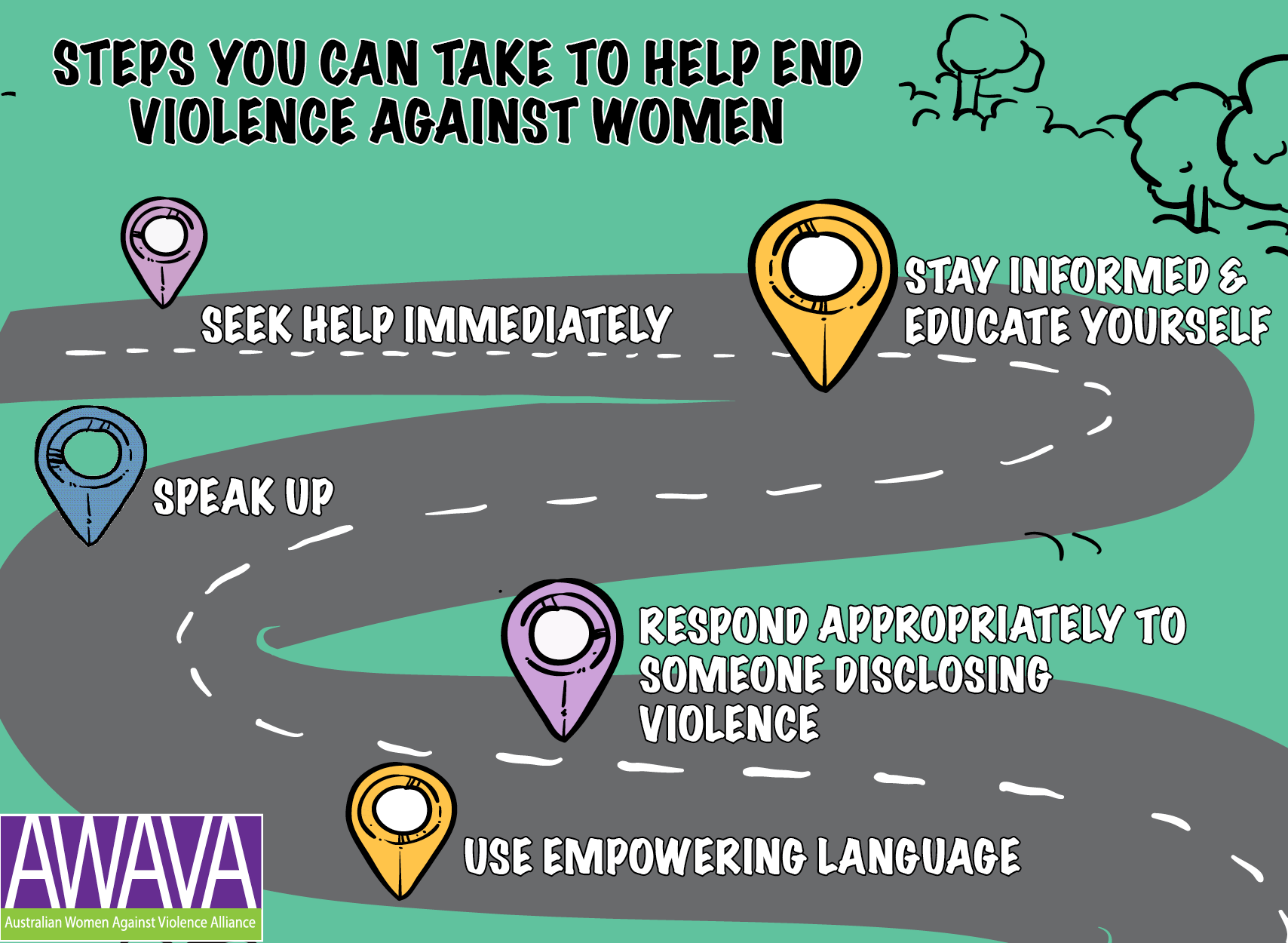
 AWAVA has produced a brochure with some practical steps and knowledge so our joint actions to eliminate violence against women will make a positive difference.  


Download resources:  

  • Steps you can take to help end violence against women – Glossy
  • Facebook Header Image

  • Social Media Images

#16Days Of Activism 2016

16 Days of Activism to Promote and Protect Specialist Women’s Services

 25 Nov – 10 Dec 2016

design

Points and sources

  • It is a human rights obligation to provide support services to women and children subjected to violence.

Source: A recent legal ruling has established that failure to provide access to immediate protection (in this case where a victim could not access a shelter and had no legal or other avenues to create safety) will mean a state is in violation of the United Nations Convention on the Elimination of all Forms of Violence against Women. See AT v Hungary – CEDAW Committee Recommendation No. 19 para 24 (r) (iii); Beijing Platform Strategic Objective D1 para 125 (a), echoed by the Secretary General at p80 of his report; CEDAW Committee Decision 2005 Communication No.2/2003.

http://www.un.org/womenwatch/daw/cedaw/protocol/decisions-views/CEDAW%20Decision%20on%20AT%20vs%20Hungary%20English.pdf

  • Services that address the gendered dynamics of violence lead to better outcomes than those that are ‘neutral’ or generic. 

Sources: Queensland sexual assault services (2010) The Right to Choose Enhancing best practice in responding to sexual assault in Queensland

http://www.communitydoor.org.au/sites/default/files/Right%20to%20choose%20final%20pdf%20with%20covers.pdf; Nichols, A. (2011) ‘Gendered Organizations: Challenges for Domestic Violence Victim Advocates and Feminist Advocacy’, Feminist Criminology, 6(2), 111-113. The United Nations General Assembly (1993) ‘Declaration on the Elimination of Violence Against Women’ recognises that violence against women is a cause and consequence of gender inequality and states that services should be delivered based on this understanding. G.A. res 48/104, 1993 (DEVAW) http://www.un.org/documents/ga/res/48/a48r104.htm article 4 (g).

  • Women and children dealing with violence report being more satisfied with gender-sensitive specialist services than with generic services. 

Sources: Chung, D., Colley, D. and Zannettino, L. (2004) Effective Integrated Approaches in the Delivery of Services and Responses for Women Experiencing Domestic Violence, Research and Education Unit on Gendered Violence, University of South Australia, Adelaide and Partnerships Against Domestic Violence, Canberra; Zannettino, L. (2006) Better Outcomes for the Protection of Children Affected by Domestic Violence: Developing Interagency Collaboration between Child Protection and Domestic Violence Services: A Research Report, Research and Education Unit on Gendered Violence in partnership with the Department for Families and Communities, South Australia

  • International standards say women-only and women-led services must be a central part of the service response to violence. 

Sources: Council of Europe (2006) Combatting Violence Against Women: Stocktaking study on the measures and actions taken in Council of Europe member states (2006)

http://avrupa.info.tr/fileadmin/Content/Downloads/PDF/CDEG(2006)3_en.pdf; Council of Europe (2008) Combating violence against women: minimum standards for support  services (2008)

http://www.coe.int/t/dg2/equality/domesticviolencecampaign/Source/EG-VAW-CONF(2007)Study%20rev.en.pdf; UN Women (2015) Essential Services Package for Women and Girls Subject to Violence Core Elements and Quality Guidelines 

http://www2.unwomen.org/-/media/headquarters/attachments/sections/library/publications/2015/essential-services-package-en.pdf?v=1&d=20161111T173648


Read our Policy Brief on the Role of Specialist Women’s Services here.

Your stories

AWAVA wants to know what your personal feminist project is! We want to raise awareness about the fantastic initiatives that women around Australia are passionate about, and are dedicating their time and energy to. It doesn’t matter how big or small, we are interested in knowing what is being done around the country to address violence and gender inequality. Read the ‘Your Stories’ section of our blog to learn what women around the country are doing, and join the conversation about violence and what can be done!


If you have a story to share, or know someone who is making a difference in your school, university, workplace or local community, email us on [email protected] with the subject ‘STORY SHARE’ to tell us all about it!

Women Who Inspire

We are very lucky to be working with incredibly inspiring and committed women through our advisory group. Interested in learning more about the work our members do? We will be sharing information about the work that our members do and stories of their experiences of working in the sector.

Click here to read about their important work.

Go to Top