This site is being archived soon. Visit wesnet.org.au for more information.

About AWAVA Program Manager

This author has not yet filled in any details.
So far AWAVA Program Manager has created 72 blog entries.

Weekly Round-up *21 September

Changes to the definition of domestic violence and abuse were announced this week in Australia and in the UK: the definition in Queensland has been expanded to include non-violent behaviour, and in the UK  ‘coercive control’ – the pattern of ongoing power and control – is now recognised.

This is particularly significant given preparations for the 57th session of the Commission for the Status of Women (CSW57) started this week in Bangkok (17-20 September), with experts worldwide meeting to discuss the priority theme: Elimination and prevention of all forms of violence against women and girls. Expert papers include the UK’s Marai Larasi’s Media as a site to Prevent Violence Against Women and Lara Fergus’ background paper on prevention of violence against women – a ‘must read’ for those preparing to go to CSW in March 2013.

UK Professor, Liz Kelly, was over in Australia and gave a seminar on the UK National Plan and European approaches to addressing violence against women.  She gave an important reminder that the needs of survivors need to be at  the centre, women-only services are important to restore control and we need “”One Stop People”” to support women, rather than splitting off women’s lives into “”issues””.   It was interesting to hear her views that the strength of UK Strategy on VAW is its focus on primary prevention and that there is a need to strengthen engagement across all of Government.

In the news…

Around the country

  • Queensland’s new domestic and family violence legislation came into effect on 17 September and includes a new definition for domestic and family violence which includes behaviour such as economic, emotional and psychological abuse, physical or sexual abuse or other behaviour which controls or dominates another person

Internationally

Can you help?  Call for interview and survey participants on sexual assault on older women

Preventing Sexual Assault of Older Women is a three year project which is exploring the sexual assault of older women through the perspectives of older women, their families and service providers. The project’s broad aim is to strengthen the community’s ability to prevent the sexual assault of older women that occurs in private homes, aged care settings and the wider community.

The project is a collaboration Australian Research Centre in Sex, Health and Society at La Trobe University and the National Ageing Research Institute; the McCaughey Centre; The Centre for Women’s Health, Gender and Society; Alzheimer’s Australia and the Council on the Ageing, Victoria.

Researchers want to hear from:

1) Older women who have been sexually assaulted (after the age of 65 years+)

2) The families/friends of older women who have been sexually assaulted

3) Service providers who work with older women/ or other related services

For further information about interviews or to receive a survey pack click here  Alternatively, you can complete the survey by clicking on the link to the following website: http://www.surveymonkey.com/s/preventingsexualassaultofolderwomen

Upcoming Events

NEW EVENTS!!

Save the date: 28-30 April 2013 – The Australian Migrant and Refugee Women’s Alliance (AMaRWA) will be holding a 2 day national conference on the elimination of violence against culturally and linguistically diverse women, supported by AWAVA.  Put it in your diary!

23 November 2012:  Not1More/White Ribbon Day – White Ribbon Day activities in Melbourne include awareness-raising, White Ribbon Lunch, Walk Against Family Violence at 2pm, Not1more will be remembering victims of family violence and offering the opportunity for people to take the White Ribbon Oath in Federation Square, Melbourne

26-28 November 2012:  Pathways to Change Conference for practitioners and policy developers to explore practice responses to children and young people displaying Problem Sexualised Behaviour and Sexually Abusive Behaviour.  The conference is being held in Hobart, Tasmania, register now.

‘Miss Representation’ Screening Tour: Women in Film & Television (WIFT) NSW are planning a series of screenings of ‘Miss Representation’ across Australia in 2012/13. If you are interested in hosting a screening of this film in partnership with WIFT NSW please email them

September

October

  • 2 October: Everyone™s Business: developing workplace programs for the primary prevention of violence against women on , register on-line now
  • 4 October:  Women in Film & Television (WIFT) NSW is celebrating their 30th Anniversary by hosting a special screening of the documentary ‘Miss Representation’, 5.30pm: Meet & Mingle + Drinks, 6.30pm: Screening & Forum at Dendy Opera Quays, Circular Quay, Sydney.  Buy tickets here ($30-$40)
  • 7 October: 2-5pm, Melbourne, Women’s International Solidarity Australia are screening Dreams of Dutiful Daughters about Burmese women™s lives, showing the vulnerability of women in poverty crossing the border to Thailand and their to exposure to exploitation and violence including sex trafficking.  Cost $15-$25.  Bookings are essential RSVP.
  • WESNET’s Safety Net Technology Safety Training is coming to Canberra 31 October, 1 November – click here for more information and to register

November

Later

  • 21 March 2013: Australian Women’s Coalition is calling young women between 18 – 30 years who live, study or work in Auburn, Bankstown, Liverpool or Coffs Harbour NSW, or in Canberra, ACT to be a part of SHOUT!  A series of three free workshops will run in each location, complemented by an online network of support and skills-sharing and a local network of participants and AWC member organisations. The workshops will culminate in community events on Harmony Day next year, . Find out more here

Internationally:

  • 7-9 November, Vancouver: 2012 National Research Day conference hosted by the FREDA Centre for Research on Violence Against Women and Children (School of Criminology, Simon Fraser University), in partnership with the Ending Violence Association of British Columbia (EVA BC), the Canadian Observatory on the Justice System™s Response to Intimate Partner Violence, and the BC Society of Transition Houses
  • 4-15 March 2013: 57th Session of the Commission for the Status of Women (CSW57), New York, priority theme: Eliminating and prevention all forms of violence against women and girls


Media Release: Stopping Violence Against Women Before It Happens: Toolkit

The National Rural Women’s Coalition (NRWC), AWAVA and  Queensland Centre for Domestic and Family Violence Research (CDFVR), CQUniversity Toolkit Stopping Violence Against Women Before it Happens: A Practical Toolkit for Communities launched by Minister Julie Collins

“We need to break the silences that surround violence against women. We need men and women in our communities to have those difficult conversations and to start to redress gender and other social inequalities.  We need our communities to recognise that it’s everyone’s responsibility to address violence against women – this Toolkit is a great starting point.” – Julie Oberin, Chair of Australian Women Against Violence Alliance


Read Minister Collins’ Media Release and Project Partners’ Media Release


Click to download: Stopping Violence Against Women Before it Happens: A Practical Toolkit for Communities

Stopping Violence Against Women Before It Happens Community Toolkit Launched

“We need to break the silences that surround violence against women. We need men and women in our communities to have those difficult conversations and to start to redress gender and other social inequalities.  We need our communities to recognise that it’s everyone’s responsibility to address violence against women – this Toolkit is a great starting point.” – Julie Oberin, Chair of Australian Women Against Violence Alliance


Capture (2)A joint project with the National Rural Women’s Coalition (NRWC) and the Queensland Centre for Domestic and Family Violence Research (CDFVR), CQ University led to the development of a toolkit focusing on preventing violence before it occurs by working to change its underlying causes.  The Toolkit is intended to empower rural women to lead their community in the implementation of the National Plan to Reduce Violence against Women and their Children The Minister for the Status of Women, Julie Collins, formally launched Stopping Violence Against Women Before it Happens: A Practical Toolkit for Communities at the Country Women’s Association of Australia’s National Conference in Hobart on 28 August 2012. Read Minister Collins’ Media Release.
 

The 15 easy-to-understand factsheets support the National Plan and explain the concept of primary prevention of violence against women, setting the focus on the community as the driving force for changing societal attitudes.  The development of the Toolkit was inspired by two community consultations held at Emerald, in central Queensland, and Broken Hill, in western New South Wales. Read the consultation blogs for more detail.  Start using the Toolkit in your communities!


Read the Project Partners’ Media Release

“We know from the conversations in Emerald and Broken Hill, and the work we do across Queensland, that there is great strength and commitment in rural and remote communities to change the conditions that foster violence against women.  The Toolkit includes practical ideas that can be adapted and used in any community towards achieving that goal.” – Heather Nancarrow, Director of the Queensland Centre for Domestic and Family Violence Research (CDFVR), CQUniversity.


“Women from regional, rural and remote communities drove the development of this toolkit. It recognises the specific needs and complexities of addressing violence in those communities, but this is first and foremost a community resource. To succeed in ending violence against women we need to engage communities like Emerald and Broken Hill all over Australia.”– Darriea Turley, President, National Rural Women’s Coalition


Click to download: Stopping Violence Against Women Before it Happens: A Practical Toolkit for Communities

Hard copies can be ordered for $35 here

Latest National Plan Update

Information on progress against the National Plan to Reduce Violence Against Women and their Children 2010-22 and the National Priorities is now available following the first National Plan Implementation Panel (NPIP) in April 2012.  The update is provided from the National Plan Secretariat, Safety Taskforce Branch, FaHCSIA and can be accessed here

Some of the highlights:

Primary prevention activities during 2012-13 include:

  • inclusion of respectful relationship education in the national curriculum: the draft curriculum is due to be developed by the end of 2012, followed by national consultation in the first half of 2013 for finalisation by the end of 2013
  • development of primary prevention benchmarks; and
  • working with media to help guide and shape the broader conversation about violence against women

Keep an eye out for:

  • National standards for telephone and/or online counselling services report: due by October 2012 with recommendations
  • Expansion of 1800RESPECT to support frontline workers: work has started on an online portal
  • Women with Disability: Women with Disability Australia is undertaking broad consultations to analyse service delivery barriers, identify and develop resources and possible areas for structural reform to improve access for women with disability who experience or are at risk of violence
  • Building the Evidence Base: Work is well progressed with the Australian Bureau of Statistics (ABS) to conduct the Personal Safety Survey in 2012.  Reporting from the survey is currently on track to be available in the second half of 2013

Advocating for Inclusion of DV as Ground of Discrimination

AWAVA joined several of our Advisory Group member organisations in writing to the Attorney-General on 21 June in support of including domestic violence as a ground of discrimination in the consolidated Commonwealth Anti-Discrimination Laws.

In January 2012, AWAVA formally endorsed and supported the Australian Domestic and Family Violence Clearinghouse (ADFVC) submission to the Attorney-General’s Department.

AWAVA firmly agrees with providing an express protection for victims of domestic violence.  The fact that women endure discrimination in the workplace, or in securing accommodation or services, as a consequence of experiencing, or having experienced domestic violence is unacceptable.

Read AWAVA’s letter

Read AWAVA’s endorsement of, and ADFVC’s submission, back in January 2012

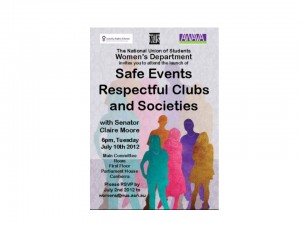
Launch of NUS Safe Events Respectful Clubs and Societies (SERCS)

AWAVA is supporting and endorsing the Safe Events Respectful Clubs and Societies (SERCS) program that has been developed by one of our Advisory Group member organisations, the National Union of Students (NUS), by NUS Women’s Officer, Noni Sproule, in partnership with South Eastern Centre Against Sexual Assault (SECASA)

SERCS is a resource and training that has been put together to assist clubs and societies and student organisations to run events which are inclusive and safe for all people.  It has been created in recognition of the important role that student organisations play in the creation of culture and community within universities.

The project is being launched by Senator Clare Moore and is supported and endorsed by two of the commonwealth-funded National Women’s Alliances, AWAVA and the Equality Rights Alliance.

Launch Details:

Date:     10 July 2012

Time:    6pm

Where:  Parliament House, Canberra

RSVP:    email: [email protected] by 2 July

Click here for invite


Seeking Endorsements for NGO CEDAW Report

]

Show your support and endorse the NGOs’ Follow-Up Report to CEDAW

AWAVA and NATSIWA are seeking endorsement, in part or in full, for the NGOs’ Follow-up Report to the CEDAW Committee’s 2010 Interim Recommendations on addressing violence against women, and actions for Aboriginal and Torres Strait Islander women

Show your organisations support for the report by adding your organisation’s endorsement by close on Thursday 9 August, you can email us for a copy of the report.  A final version will be published on our website following submission to the CEDAW Committee in August.

Thank you for your support!

Coordinating NGO CEDAW Report

We asked you what you thought the priority actions on VAW and for Aboriginal & Torres Strait Islander women were back in June.  Our online survey sought your views on Australia™s performance on actions on violence against women and for Aboriginal and Torres Strait Islander women, the National Plan to Reduce Violence Against Women and their Children and what Australia™s priorities on violence against women and for Aboriginal and Torres Strait Islander women needed to be.

AWAVA and NATSIWA asked for your input into the non-government organisations™ response to the CEDAW July 2010 Concluding Observations recommendations on action on violence against women and for Aboriginal and Torres Strait Islander women

So, what™s was the survey for?

The survey assessed NGOs’views of the National Plan to Reduce Violence Against Women and their Children and what they thought Australia™s priorities on violence against women and for Aboriginal and Torres Strait Islander women needed to be. It was used specifically to produce the NGO report for the CEDAW Committee.  The NGO report provides additional information and an alternative view for the CEDAW Committee when it considers the Australian Government™s response to its July 2010 recommendations.

What is CEDAW?

The United Nations Convention for the Elimination of Discrimination Against Women, CEDAW, is an  international treaty that Australia is signatory to.  Many countries around the world, including Australia, signed on to this convention and agreed to try and implement mechanisms in their country to eliminate discrimination against women.

What does it aim to achieve?

The convention aims to:

¢ Eliminate discrimination against women
¢ Achieve substantive equality
¢ Take action in both the public and private spheres
¢ Take action in all areas of women™s lives
¢ Take action for all women
Although violence against women is not specifically included, it is referenced in the CEDAW general recommendations 12 (1989) & 19 (1992) and covered in many of the CEDAW articles (1, 2, 3, 5, 6, 11, 12, 14, 16)

How are countries held to account?

As a signatory to the Convention, the United Nation requires each country to prepare a report around every 4 years about how the government has been implementing policies and programs to meet the conventions requirements. There is a Government report, and a Shadow Report which is prepared by NGOs.  The UN CEDAW Committee reviews these and prepares a report back to each country outlining how it is progressing and makes recommendations on areas for improvement.

When was Australia last reviewed?

In July 2010 the UN CEDAW Committee reviewed the Australian Government™s compliance with CEDAW and how Australia has implemented the treaty into its laws and policies. The committee made two specific recommendations for actions on violence against women and Aboriginal and Torres Strait Islander women, in its Concluding Observations and requested an update on progress at the 2-year mark, prior to a full review in 2014. The Australian Government has to report back to the CEDAW committee on its progress on these two areas (paragraph 29 and 41) by July 2012

For more information about the 2010 review of Australia and the CEDAW Committee™s other recommendations please see the Australian NGO CEDAW Action Plan.

Why are we doing an NGO report?

The NGO report provides additional information and an alternative view to the CEDAW Committee when it considers Australia™s response to its recommendations. We took NGOs’ views on how policies, programs and practices really work, on what works well and where more needs to be done.  The NGO report is high-level and focussed, capturing the key points raised.

The survey responses helped both AWAVA and NATSIWA capture what the sector and communities want to see on violence against women and actions for Aboriginal and Torres Strait Islander women, it will also feed into the preparations for the Commission for the Status of Women 57th session in March 2013 where the theme is Elimination and prevention of all forms of volence against women and girls. 

Who coordinated the interim NGO report?

Two of the Commonwealth-funded National Women™s Alliances, AWAVA, and the National Aboriginal and Torres Strait Islander Women™s Alliance, NATSIWA, coordinated the NGO response to the CEDAW recommendations.


Weekly Round-up* 25 May

This week’s round-up certainly has an international flavour, with all of our articles coming from outside Australia this week.

  • In NZ, Women’s Refuge are still wanting more information on the police statistics of domestic and family violence
  • Anushay Hossain speaks out about rape as a weapon of war in the Bangledesh war of Independence, and the legacy this left
  • Jessica Buchleitner takes a look at the need to ‘destigmatise’ rape and hold rapists to account around the world
  • In South Africa, there is progress being made in ending Ukuthwala – the ‘tradition’ of kidnapping young women and forcing them to marry
  • Still in South Africa, and the disturbing news article that highlights the often increased risk of rape for women with disabilities
  • In post-conflict West Africa, domestic violence is now emerging as the biggest threat to West African women
  • and finally, an interesting article from Rita Banerji, a gender activist and blogger from India

Upcoming Events and Training

NEW!!!

Still Time to Register!

June

July

  • The Association of Women Educators conference being held in July 2012 – for details and registration click here
August

Later 

  • The No To Violence conference in November 2012
  • The 7th Womens Health Conference will be held in Sydney in 2013
  • Australian Women’s Coalition is calling young women between 18 – 30 years who live, study or work in Auburn, Bankstown, Liverpool or Coffs Harbour NSW, or in Canberra, ACT to be a part of SHOUT!  A series of three free workshops will run in each location, complemented by an online network of support and skills-sharing and a local network of participants and AWC member organisations. The workshops will culminate in community events on Harmony Day next year, 21 March 2013. Find out more here


Politicians and Media to lift their game on sexist remarks

AWAVA joins the growing expressions of concern about the misogynistic and sexist treatment of Australia’s first woman Prime Minister, Julia Gillard, within Parliament, in the media and within the community.

AWAVA endorses the Open Letter from women’s organisations nationally stating that the public treatment of the Prime Minister is akin to the scourge of interpersonal violence that affects 1 in 3 Australian women.

These comments are unacceptable:

Alan Jones suggests placing the Prime Minister in a bag and drowning her at sea (Alan Jones June 2011, July 2011)

Grahame Morris proposes kicking her to death (Grahame Morris Feb 2012)

Tony Abbott wants a ‘target on her head’ (Tony Abbott March 2011)

the anti-Carbon Tax movement brandish ‘burn the witch’ placards (March 2011)

AWAVA welcomes informed political analysis and debate and demands that the media and politicians lift their game.


Go to Top