This site is being archived soon. Visit wesnet.org.au for more information.

Blueprint for Reform 2022

Removing Barriers to Safety for Victims/Survivors of Domestic and Family Violence Who Are on Temporary Visas

08 December 2022


AWAVA is excited to be involved in the development and launch of the Blueprint for Reform: Removing Barriers to Safety for Victims/Survivors of Domestic and Family Violence Who Are on Temporary Visas.

The Blueprint for Reform is the culmination of work by the National Advocacy Group on Women on Temporary Visas Experiencing Violence, aimed at ensuring safety and justice to victims/survivors of family violence, regardless of visa status and type.

AWAVA and member of the National Advocacy Group, said, “We know that temporary visa holders experiencing family violence in Australia face multiple barriers to accessing safety, support, and justice. These barriers can cause women to remain in situations that are harmful and dangerous.

“As the Australian Government moves towards implementing the National Plan to End Violence Against Women and Children 2022-2032, it is imperative that all women and children are given access to safety and stability.”
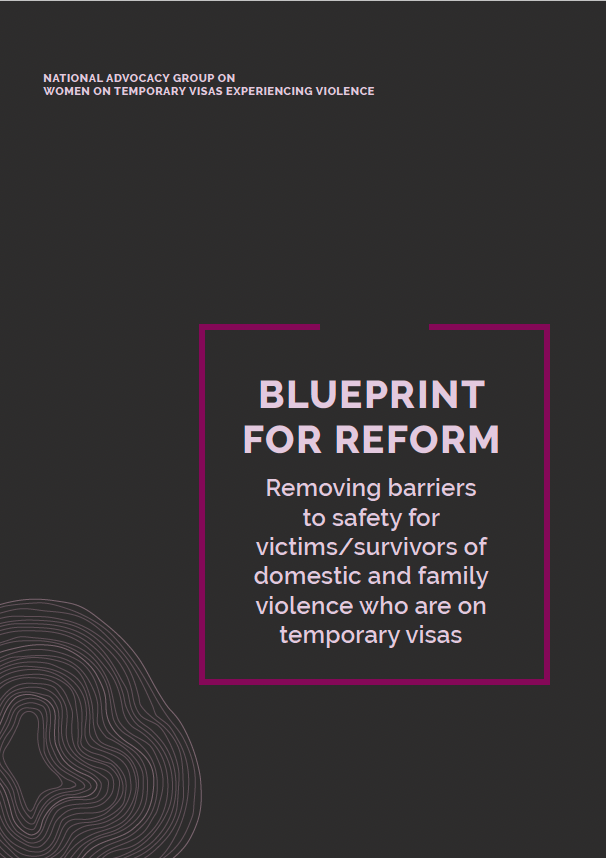
Blueprint for Reform 2022 Cover

The Blueprint for Reform recognises and responds to a range of barriers for women on temporary visas. The services system is too complex and often inaccessible. When a temporary visa holder experiences family violence in Australia, her visa status determines whether she can access social security, working rights, childcare, free public health, and housing support.

These barriers are used frequently by perpetrators of family violence to further coerce and control victims/survivors.

This Blueprint includes recommendations to ensure victims/survivors access the safety and support they need in four key steps:

  1. Improve the migration system so that all women on temporary visas who experience domestic, family and sexual violence and their dependants can access protections, services and justice.
  2. Expand eligibility and access to social security (including Medicare) for women on temporary visas who are experiencing domestic and family violence.
  3. Expand eligibility and access to social and public housing for women on temporary visas who are experiencing domestic and family violence.
  4. Ensure long-term and sustainable funding for specialist and legal services that support women on temporary visas who are experiencing or are at risk of domestic, family and sexual violence.


The National Advocacy Group are experts from across Australia who are calling on the Australian Government to adopt the recommendations.

Adopting and implementing the recommendations in the Blueprint will help to ensure the safety of all victims/survivors of family violence.

—

Media and other queries should be directed to the Executive of the National Advocacy Group, [email protected].

Improvements in student safety but strong leadership needed

24 March 2022


Today’s release of the National Student Safety Survey (NSSS) 2021 findings shows a slight improvement in student safety between 2016 and 2021. One in 5 students said they had experienced sexual harassment since commencing studies in 2016, compared to 1 in 6 in 2021. The rate of sexual assault dropped from 7 per cent to 5 per cent for the same period. Universities Australia is commended for undertaking the survey. Building the evidence base is a necessary step to check progress in eliminating violence against women.


Karen Bentley, AWAVA member and CEO of Women’s Services Network (WESNET), noted, “Unfortunately progress is too slow. These findings accord with AWAVA’s own research on young people’s experiences with violence. (1) Over forty per cent of our respondents were students, and most had experienced violence in one form or another, although sexual violence was one of the forms most commonly experienced.


“Sadly the modest pace of progress is not surprising. There is a clear consensus that a key driver of gendered violence in gender inequality – the current government’s draft National Plan to End Violence Against Women and Children acknowledges this – and we continue to see disappointing progress against key gender equality indicators.”


“We know that Covid-19, insecure work and low-wage growth is exacerbating inequalities. Women and non-binary people remain underpaid, overworked and under-represented in decision-making roles. (2) We know that family and domestic violence has increased. (3) Gendered power imbalances carry over into workplaces, universities, institutions and public and private spaces.”


“Power imbalances impact beyond the act of violence itself. Consistent with the NSSS, the AWAVA survey showed that few young people formally reported violence, due mostly to a fear of not being believed or taken seriously. A large majority said their perpetrator was not held to account. Even when the victim-survivors’ stories were believed, police and institutions were unwilling to take further action against the offender.”


“Sexual violence is not a new issue at universities, and it is not confined to universities. While many universities have put in place a number of measures to combat it, there is certainly more to be done.  This has been acknowledged by the sector but it cannot be done effectively in isolation, without societal change, and it is very difficult to do without proper resourcing.”


“Universities – like women’s specialist services – have been one of the hardest-hit sectors in recent years, due to general policy settings and the impact of Covid-19 responses. Improving women’s safety is not out of reach – as evidenced by the modest improvements indicated by the NSSS – but it will take strong leadership, nationally and within each university, to prioritise women’s safety and provide equal access to the enjoyment and benefits that higher education can confer.”


—

Footnotes:

  1. Young Women’s Report (AWAVA 2022).
  2. Women working full-time hours earn $255.30 less than men per week (WGEA 2022); women consistently experience more time-stress than men (Melbourne Institute 2021, p. 12); women make up less than a third (47 of 151) of MPs in the Australian House of Representatives (APH 2022).
  3. The impact of the covid-19 pandemic on experiences of intimate partner violence among Australian women (ANROWS 2022).


ENDS

Contact: Karen Bentley, Chief Executive Officer, WESNET, [email protected] or the communications officer at [email protected].

Go to Top