This site is being archived soon. Visit wesnet.org.au for more information.

About AWAVA Secretariat

This author has not yet filled in any details.
So far AWAVA Secretariat has created 504 blog entries.

Day 13 Spotlight on violence against women in rural, regional and remote communities

Women living in rural, regional or remote areas are at a higher risk of experiencing family violence.

[1] One of the recent studies on legal needs in rural, regional and remote areas identified a mix of multiple needs in the areas of family violence (73%), housing (69%), and family law (65%).[2]  Additionally, the New South Wales Bureau of Crime Statistics and Research crime mapping tool indicates that certain outer rural, regional and remote areas of NSW experience incidents of particular crimes at high rates –for example, assault and sexual offences.[3] Meanwhile, Saunders’ recent research into sexual harassment in the workplace in rural, regional and remote locations has found that of 84 rural women interviewed, 73% reported having experienced unwelcome sexualised behaviour in the workplace.[4]


For women experiencing family violence there are a number of barriers to obtain access to justice. They range from a lack of appropriate and accessible support services to a lack of transport that compounds barriers to safety.[5] Furthermore, women experiencing family violence are disadvantaged by a lack of local access to specialist Magistrates’ Courts including the Family Violence Division.[6]


Harris et al report ‘an inequitable provision of justice services between metropolitan and rural, regional, and remote communities, raising concerns regarding equitable justice outcomes’. They identify particular risks for people with a mental health condition, survivors of family violence, and Aboriginal and Torres Strait Islander people, people from culturally and linguistically diverse [7] backgrounds and children who engage with Magistrates Courts in rural, regional, and remote Australia. Additionally, the Centre for Rural Regional Law and Justice has particularly drawn attention to the need to expand family violence specialist services to regional Magistrate’s Courts, as its research highlights that women’s safety is placed at risk in regional areas where the complexities of family violence are not understood or dealt with appropriately by the court.[8]


Other issues in courts include a lack of mediation services, poor security, and a lack of separate waiting areas or client interview rooms, safe spaces for victims of violence, and video-conferencing facilities in smaller regional courts.[9] With limited telecommunications and lack of connection to public services, rural and regional women are at risk of poorer health outcomes and have greater vulnerability to family violence.[10]


It is vital that the government provides sufficient funding to organisations working in the areas of domestic and family violence and sexual assault, as well as ensures that women in rural, regional and remote areas have equal access to services including access to court facilities, transport and telecommunications.


For more resources check out The National Rural Women’s Coalition https://nrwc.com.au/  

References cited:  

[1] The Women’s Services Network (WESNET), 2000, Domestic violence in rural Australia: a literature review, Department of Transport and Regional Services, Canberra: http://dpl/Books/2000/DomesticViolenceRegional.pdf. See also: Domestic and family violence in regional, rural and remote communities An overview of key issues Monica Campo and Sarah Tayton CFCA Practitioner Resource— December 2015 https://aifs.gov.au/cfca/publications/domestic-and-family-violence-regional-rural-and-remote-communities). See also: Lucinda Jordan and Lydia Philips, Women’s experiences of surviving family violence and accessing the Magistrates’ Court in Geelong, Victoria (CRRLJ, Deakin University: 2013, 9, citing eg Council of Australian Governments, National Implementation Plan to Reduce Violence against Women (Commonwealth of Australia: 2012).

[2] Hume Riverina Community Legal Service (‘HRCLS’), Piecing together the puzzle: the perspective of community organisations about legal need (June 2015), https://humeriverinacommunitylegalservice.wordpress.com/2015/08/26/piecing-together-the-puzzle-theperspective-of-community-organisations-about-legal-need/

[3]See: http://crimetool.bocsar.nsw.gov.au/bocsar/

[4] Skye Saunders, Whispers from the Bush: The Workplace Sexual Harassment of Australian Rural Women (TheFederation Press: 2015), 2-3.

[5] Lucinda Jordan and Lydia Philips, Women’s experiences of surviving family violence and accessing the Magistrates’ Court in Geelong, Victoria (CRRLJ, Deakin University: 2013, 9, citing eg Council of Australian Governments, National Implementation Plan to Reduce Violence against Women (Commonwealth of Australia: 2012).

[6] Tony Vinson and Margot Rawsthorne, with Adrian Beavis and Matthew Ericson, Dropping off the edge 2015: persistent communal disadvantage in Australia (Jesuit Social Services/Catholic Social Services Australia: 2015).

[7] Law Council of Australia, Report into the Rural, Regional and Remote Areas Lawyers Survey (July 2009), https://www.lawcouncil.asn.au/policy-agenda/advancing-the-profession/rural–regional-and-remote-areaslawyers.

[8] CRRLJ and NRLJA, Joint Submission to the Productivity Commission Inquiry into Access to Civil Justice, 4 http://www.pc.gov.au/inquiries/completed/access-justice/submissions.

[9] Law Council of Australia The Justice Project (2017) Rural, Regional and Remote Australians Consultation Paper

[10] Safe And Strong A Victorian Gender Equality Strategy, The State of Victoria, available at http://www.vic.gov.au/system/user_files/Documents/women/161108_Victorian_Gender_Equality_Strategy_ONLINE.pdf


Day 12 Gender-responsive housing and homelessness policy

Homelessness Policy with Women at the Centre: Surveying the Connections between Housing, Gender, Violence and Money.


by Hannah Gissane, Equality Rights Alliance and Merrindahl Andrew, Australian Women Against Violence Alliance. Published originally in the Parity Journal, August 2017, Vol 30/6.


Not all women who experience housing stress or need homelessness services are (or will identify as) ‘escaping domestic violence’, but all are affected by being women in a society with entrenched patterns of women being subjected to violence of various kinds. They may also have ongoing impacts from experiences of violence throughout their life-course. Conversely, not all women trying to build lives free of violence need or want homelessness services, but all are affected by housing affordability and need safe and secure homes.


Forty years ago, the main responses to violence were centred on helping women and children escape domestic violence to safe temporary accommodation, often refuges/shelters run and staffed by women working initially in unfunded and informal structures. These organisations have since become more numerous and more formal in their governance, and have become part of the broader semi-funded homelessness services system. In empirical terms, they provide services to an ever-increasing number of women who for various overlapping reasons need crisis accommodation and related support.

[1]


At the same time, policy-makers and non-government organisations have developed a rapidly-expanding range of initiatives to respond to violence against women, including Safe at Home programs, perpetrator interventions and men’s behaviour change programs, and workplace based responses, as well as prevention programs.[2] These include bystander training, improvements to media reporting of violence, and numerous initiatives to promote gender equality in the workplace, online and in community settings such as sporting clubs. However, specialist women’s homelessness services (and the other women’s services against violence that they work alongside) have never been accorded the secure, central, self-determining place in policy responses to violence that they should have had.


Therefore, while the service and prevention landscape is changing rapidly, we need to maintain a focus on respecting and securing the role of women’s services including refuges and shelters, while being clear that these services do not represent the full range of responses needed to prevent violence and support women who have been subjected to it.


Likewise, homelessness services generally have adapted to embody the understanding that housing and accommodation is not just about ‘heads on beds’ or ‘a roof for the night’.


Homelessness is a social, familial, interpersonal, health, legal and especially economic condition and the term ‘homeless’ represents experiences that are structured by those conditions. The concept of what is a ‘home’ and the attendant connotations of ‘safety’, comfort and security are clearly, from a feminist point of view as well as other perspectives, deeply problematic.[3] If a key feature of ‘home’ is ‘safety’, then perhaps we should consider as ‘homeless’ women who have a fixed address but are subjected to violence and abuse in both ‘private’ and ‘public’ life, and who lack the economic and legal power to successfully and without repercussion remove violent people from their homes.[4]


What implications do these issues have for national homelessness policy?


Firstly, the policy area is deeply related to gender and violence. Women are the primary beneficiaries of housing support systems, making up the majority of public housing tenants, Commonwealth Rent Assistance (CRA) recipients and people approaching specialist homelessness services.[5] Domestic and family violence is the single largest reason for people to seek homelessness services and six out of ten homelessness service clients in 2014–15 were female.[6] Therefore issues of gender and violence are not marginal to the ‘main problem’ of homelessness and housing; they are central. An effective national homelessness policy has to put these issues at the centre.


Secondly, an effective national homelessness policy needs to address and respond to the longer-term legacy of funding and service arrangements, and to be realistic about the different sectors and purposes within which services work. Specialist women’s services funded with ‘homelessness money’ are part of broader service sectors addressing women’s needs arising from their experiences of violence and oppression. These linkages, common projects and connected forms of support need to be recognised and strengthened in any new policy framework.

The National Housing and Homelessness Agreements (NHHA) heralds a long-awaited recognition of the Federal Government’s role in responding to housing unaffordability and homelessness. The size, scope and ambition of this role remains to be seen as negotiations for the NHHA get under way, noting that funding remains at much the same levels as in the previous agreements.


For the NHHA to work for women, it needs to be supported by Federal Government initiatives that relate to gender equality, such as measures to boost participation in the paid workforce and reduce violence against women and their children, and ideally a national strategy for gender equality across all policy areas. As Kennet and Chan articulate, ‘housing systems and opportunities are embedded within structured and institutional relations of power which are gendered.’[7] Recognition that the feminisation of poverty and violence shapes women’s housing outcomes is vital if the NHHA is to reshape housing systems in a way that does not unduly disadvantage women.


The key features of a gender responsive housing and homelessness policy framework would:


Revitalise housing support systems with a significant and renewed commitment to direct Government investment in public housing. The swelling numbers of (particularly) older, single women approaching homelessness services have become a ‘symbol of housing insecurity in Australia’[8] and underline the chronic, long-term underinvestment in housing support systems.[9] Long-term housing is the biggest gap in specialist homelessness provision with only 11 per cent of older people in need of it able to be assisted.[10]


Recognise the diversity of responses needed across the housing continuum and the need for structural, as well as, individualised responses: The Productivity Commission’s draft report into Introducing Competition and Informed Consumer Choice into Human Services[11] makes recommendations to replace incomebased rent setting in public housing with a standardised CRA regime. Standardised approaches such as this need to be resisted, as a diversity of housing supports is needed to respond to the multiplicity of housing stress and homelessness experiences.


Recognise and support a diversity of tenures: The majority 2015 Senate Inquiry report on housing affordability, Out of Reach, recommended renting be recognised as a mainstream form of tenure with corresponding policy and legislative reform to ensure ‘longer, safer and secure tenancies.’[12] Likewise, alternative forms of ownership such as shared equity schemes and community land trusts offer a possible pathway into housing security for some mid-life women experiencing housing insecurity, and should be supported with appropriate safeguards.[13]


 Recognise and support a diversity of housing types: All new builds should be accessible for people with disability and our ageing population. All Commonwealth funding for States and Territories for new build housing must meet the Silver Standard Design in the Liveable Housing Australia guidelines.


Recognise and respect women’s specialist services through increased and longer funding terms and embedded standards reflecting the good practice principles developed by specialist women’s services over decades.


These entail:


  1. a rights-based approach that enables understanding of the gendered nature of the violence, its causes and consequences and
  2. empowers survivors / victims by enabling self-determination, control over processes and choice. Good practice service provision, taking
  3. a client-centred approach, remains accountable to victims/survivors and
  4. places their safety, needs and interests at the centre of all decisions. It also works to ensure that
  5. perpetrators are held accountable for their use of violence. Good practice service provision delivers
  6. culturally-sensitive, holistic and accessible services to diverse groups of women.[14]


Include specialist gendered and ageing services and advice: as highlighted in a number of reports, programs like Assistance with Care and Housing for the Aged will need to be expanded to accommodate projected demand,[15] and should include ‘light touch’ support for older single women presenting with ‘low needs.’


Direct funding to providers and services with demonstrated expertise and experience in service and housing provision to people on low incomes and experiencing disadvantage and marginalisation.[16] Opt against systems that outsource housing and homelessness services to for-profit private sector providers and/or favour large generalist services over more stand-alone specialist services. Recognise the expertise and experience of non-government services and the need to promote service sectors that are diverse in organisational form and focus.


Be accountable and transparent about funding for gendered services, including services responding to violence against women. The difficulty in tracking funding for these services has been articulated by the COAG Council; ‘with funding provided under a mix of different funding streams that have a range of stated objectives, it is difficult to ensure domestic violence services have appropriate levels of funding, or to monitor where government funds are being directed in the context of changing levels of demand.’[17]More generally, we need a dedicated framework for the funding of prevention and response programs relating to violence against women at the Commonwealth level, which transparently tracks and measures funding both in aggregate and through separate programs and portfolios, including housing and homelessness.


Link with an increase in income support payments: the combination of an unaffordable housing market and a wholly inadequate income support system works to ‘trap people in severe rental stress.’[18]  Adequate income support payments, including rent assistance, are critical to ensuring women are able to access affordable and appropriate housing, particularly single mothers.[19]


Create space to research and respond to other issues that are often sidelined or invisible in policy and public debates on homelessness, including the link between sexual violence and housing/ homelessness;[20] responses to the distinct needs of people who are trans, non-binary, lesbian, gay and bisexual (particularly young people in these groups);[21] access to public and community housing for people who are not citizens or permanent residents; and access to income support for people on temporary visas.


References cited:

[1]Cooper E 2017, ‘Two in Three People Seeking Homelessness Help are Women’, Pro Bono Australia

[2] Oberin J and Mitra-Kahn T 2013, ‘Stopping violence before it occurs: Responding to the pathways into gendered homelessness’, Parity, vol.26, no.7, pp.15–17.

[3] Beavis K 2017, Research Brief: Family Violence and Homelessness, Gender and Family Violence — Monash Arts Focus Program, Monash University.

[4] 4. Nunan C and L Johns 1996, Raising the Roof on Women’s Homelessness — A framework for Policy Development, WESNET, Canberra. See also Chamberlain C and MacKenzie D 2008, Counting the Homeless: Australia 2006, Australian Census Analytic Program, pp. 2–3

[5] 5. Australian Women Against Violence Alliance (AWAVA) and Equality Rights Alliance (ERA) 2017, Submission to the Productivity Commission Introducing Competition and Informed User Choice into Human Services Draft Report, p.5 http://www.equalityrightsalliance.org.au/ wp-content/uploads/2017/07/AWAVA-andERA-Submission-to-PC-Draft-Report-onHuman-Services-20170714.pdf

[6] 6. Australian Institute of Health and Welfare 2015, Specialist Homelessness Services 2014–15: Clients, Services and Outcomes, Australian Government, Canberra. http://www.aihw.gov.au/homelessness/ specialist-homelessness-services-2014-15/ clients-services-outcomes/

[7] 7. Kennet P and Wah Chan K 2011, Women and Housing: An International Analysis, Routledge, Oxon, p. 1.

[8] Petersen M and Parsell C 2014, Older Women’s Pathways out of Homelessness in Australia, Institute for Social Science Research, Brisbane, p.12; https://www.mercyfoundation.com.au/ _uploads/_cknw/files/FINAL%20Feb %202014%20Petersen%20%20Parsell %20Older%20women’s%20pathways %20out%20of%20homelessness.pdf

[9] ibid.

[10] ibid

[11] Productivity Commission 2017, Introducing Competition and Informed User Choice into Human Services: Reforms to Human Services Draft Report, Australian Government, Canberra.

[12] Senate Economics References Committee 2015, Out of Reach? The Australian Housing Affordability Challenge, p. 228.

[13] Sharam A 2015, The voices of mid-life women facing housing insecurity, Swinburne Institute for Social Research, Hawthorn.

[14] AWAVA 2016, The role of specialist women’s services in Australia’s response to violence against women and their children, Canberra http://localhost/awava/2016/04/07/ research/role-specialist-womens-servicesaustralias-response-violence-womenchildren; AWAVA 2017, The Unique Role of Specialist Women’s Services in Ending Violence Against Women, Canberra http://localhost/awava/2017/08/10/research/ brochure-unique-role-specialist-womensservices

[15] See, for example, Brackertz N 2016, Effectiveness of the homelessness service system — Discussion Paper, AHURI, p. 54

[16] AWAVA and ERA 2017, Submission to the Productivity Commission.

[17] COAG Advisory Panel on Violence Against Women 2016, Final Report, Commonwealth of Australia, p. 114

[18] Anglicare Australia, 2017, Anglicare Australia Rental Affordability Snapshot, Canberra, p. 5

[19] National Council of Single Mothers and their Children 2016, A Small Investment for a Significant Gain — NCSMC Budget Submission

[20] Morrison Z 2009, Homelessness and Sexual Assault, Australian Institute of Family Studies, Melbourne and National Sexual Violence Resource Centre 2014, Link Between Housing and Sexual Violence Infographic, Harrisburg.

[21] McNair R, Andrews C, Parkinson S, Dempsey D 2017, GALFA LGBTI Homelessness Research Project Stage 1 Report LGBTI Homelessness: Preliminary findings on risks, service needs and use.

Day 11 Spotlight on violence against migrant and refugee women

via GIPHY


Women from culturally and linguistically diverse backgrounds face a range of complex issues that result from and at the same time reinforce their social, cultural and economic marginalisation. These women have diverse cultural heritages, differing life experiences, including for recent migrants who have various experiences of and reasons for migrating to Australia, and varied experiences of discrimination and marginalisation within Australia. In spite of their differences, women from culturally and linguistically diverse communities experience commonalities in terms of the barriers they face in accessing support services when facing violence.


The lack of consistent and disaggregated data in relation to family violence in culturally and linguistically diverse communities is problematics, as it restricts our capacity to ensure services are meeting community demands and to assess the adequacy of targeted funding. What is known is that the settlement challenges facing newly arrived families places strain on relationships, increasing family breakdown and the need for legal and family support services.[1] In addition, visa status plays a crucial role in the ability to receive sufficient support.


In 2016, the Judicial Council on Cultural Diversity produced a report on the experiences of migrant and refugee women in courts.[2] This report recognised that women from culturally and linguistically diverse backgrounds are far more likely to enter the legal system at a point of extreme vulnerability, often as a result of family violence or family breakdown.[3] While the evidence was mixed on the prevalence of family violence in migrant and refugee communities, the report’s authors noted that the stresses caused by moving to Australia could increase the risk of family violence.[4] Further, migrant and refugee women were more likely to experience particular forms of family violence, including abuse by extended family members, abuse related to their immigration status, dowry demands and forced marriage.[5]


Another related and critical area is child protection. Children from culturally and linguistically backgrounds are represented in the child protection in high numbers. There is an overall consensus across academic research and practitioners that the need for culturally sensitive approach and training of child protection agencies is present.[6]


Despite the high rates of violence and the service demand, there are not enough specialist services who will be able to provide culturally appropriate support. For some services like housing, women from culturally and linguistically diverse backgrounds may be ineligible due to their visa status.[7]


For women from culturally and linguistically diverse backgrounds there are a range of barriers that prevent or restrict their disclosing of violence and their access to services. Cultural beliefs and stigma can inhibit women’s ability to access appropriate services, particularly when these interact with social exclusion and language/cultural barriers, and these dynamics can contribute to violence and resulting homelessness being ‘hidden.’ These barriers include:


  • Lack of awareness of their rights under Australian law;
  • Lack of knowledge of services that are designed to support women experiencing family violence;
  • Lack of access to linguistically diverse and culturally sensitive services;
  • Lack of support within their community and social stigma associated with divorce and separation;
  • Limited employment opportunities and reliance on partner for financial security; and
  • Fear that reporting family violence will impact on their visa status.


Women from culturally diverse communities face additional barriers to education and employment as a result of language barriers; racism and discrimination; lack of culturally responsive services; lack of access to information about their rights, the legal system and the support systems available in their languages; separation from family and other support networks; and insecure visa status. In particular, migrant and refugee women are overrepresented in insecure and low paid work.[8]


A number of measures are required to be undertaken in both policy and practice to address particular vulnerability of women from culturally and linguistically diverse backgrounds to family violence and to increase their access to support services. These include ensuring that translation services are available for women who have a limited understanding of English, increasing cross-sector partnerships to ensure that women who do not have access to family violence services or legal services be referred to appropriate support systems, and addressing intersecting inequalities including increased risk of housing stress, lower access to education and employment and higher risk of financial insecurity.[9]There is a great need to ensure that all necessary services in situations of family violence are available regardless of visa status.


Resources:  

Harmony Alliance: Migrant and Refugee Women for Change https://www.harmonyalliance.org.au/

InTouch – Multicultural Centre Against Family Violence http://www.intouch.org.au/

Judicial Council on Cultural Diversity http://jccd.org.au/

References cited: 

[1] Family Law Council, Improving the Family Law System for Clients from Culturally and Linguistically Diverse Backgrounds (Commonwealth: 2012), 3.  

[2] Judicial Council on Cultural Diversity, The Path to Justice: Migrant and Refugee Women’s Experience of the Courts (2016).  

[3] Ibid

[4] Ibid

[5] Ibid

[6] See AWAVA (2017) Resource on family violence, child protection and family law http://localhost/awava/2017/07/11/research/family-violence-child-protection-family-law-resource  

[7] See AWAVA (2017) Submission to the Department of Immigration and Border Protection on Visa Simplification http://localhost/awava/2017/10/12/submissions/submission-department-immigration-border-protection-visa-simplification  

[8] Safe And Strong A Victorian Gender Equality Strategy, The State of Victoria, available at http://www.vic.gov.au/system/user_files/Documents/women/161108_Victorian_Gender_Equality_Strategy_ONLINE.pdf 

[9] Ibid

Day 10 Removal of children from women with disabilities

International human rights frameworks commit to ensuring the equal treatment of parents with disability. The Convention on the Rights of Persons with Disability (CRPD) 2006 is intended to guarantee the right to family in various ways for people with disability. The right to family is manifested through the right to marry, rights of reproduction, a right to retain fertility, a right to rear children, and have a united family unit on an equal basis with the rest of the community. CRPD also states that “a child shall not be separated from his or her parents against their will” on the grounds of parental or child’s disability. However, the situation in Australia presents a different picture, in which women with disability are frequently denied the right to parent, and to be supported to do so.

[1] In situations of domestic and family violence, mothers with disability need to be supported to maintain their parenting role, rather than being assumed to be incapable. 


In this video, Women With Disabilities Australia (WWDA) members talk about why the right to parent and be supported to do so, is a fundamental human right for all women, including women with disability. 


For more see WWDA’s Toolkit http://wwda.org.au/papers/toolkit/


  References cited: 

[1] Law Council of Australia (2017) The Justice Project. Consultation Paper ‘People with Disability’; Law Council of Australia (2017) The Justice Project. Consultation Paper ‘People Who Experience Family Violence’; Robyn Mildon et al, Understanding and Supporting Parents with Learning Difficulties (Victorian Parenting Centre, 2003) 4. 

Day 9 International Day of People with Disability

The 3rd of December marks the International Day of People with a Disability. This year’s theme is focused on the transformation towards a sustainable and resilient society for all. Drawing on the Sustainable Development Goals principle of “Leave no one behind”, this International Day aims to increase understanding about people with disability and celebrate the contributions of people with disability. Today we are highlighting the experiences of women with disabilities and obstacles they face.  

 Women living with a disability make up approximately 9.5% of Australia’s population and 20% of Australia’s female population.

[1] It is well documented that women with disabilities experience multiple forms of disadvantage that result from the intersection between widespread discriminatory attitudes towards people with disabilities and towards women. As a result, women with disabilities experience higher rates of socioeconomic disadvantage and social isolation. Further, they have less access to services, are more likely to live in unstable housing, have inadequate health care, and are denied opportunities to contribute to and participate actively in society.[2] This disadvantage is not only in comparison to women without disabilities but also to men with disabilities. As Women with Disabilities Australia et al point out: “Only 16 per cent of all women with disabilities are likely to have any secondary education, and men with disabilities are twice as likely to be in paid employment as women with disabilities.”[3]


Women with disabilities in Australia experience more severe violence more often than other women, endure additional violence because of their disabilities and encounter more barriers when they try to protect themselves and seek justice.[4] Data collection in this area is lacking, but disability support services report that “women and girls with disabilities were 37.3% more likely than women and girls without disabilities to experience some form of intimate partner violence, with 19.7 percent reporting a history of unwanted sex compared to 8.2 percent of women and girls without disabilities.”[5] 24 per cent of women and girls with disabilities who had made contact with service provider respondents in 2012 identified as having been affected by violence.[6]


The social marginalisation and discrimination that women with disabilities experience can be compounded, for some, by reduced mobility, which limits capacity to escape violent situations. As a result, women with disabilities are at risk of the same forms of violence that other women face but “also experience forms of violence that are particular to their situation of social disadvantage, cultural devaluation and increased dependency.”[7]


Women with disabilities who live in rural and remote communities and have less access to services, information and education are particularly susceptible to domestic violence as well as other forms of gender-based violence. Aboriginal and Torres Strait Islander people are 2.2 more likely than other people in Australia to live with a disability, which increases Aboriginal and Torres Strait Islander women’s risk of being subjected to domestic violence.[8]


The Women with Disabilities Australia (WWDA) Stop the Violence Project provides a strong framework for policy and practice reform to address violence against women with disabilities. This includes providing information and support to ensure women are aware of their rights and are empowered to speak out where violence is occurring, training for service providers to enable them to recognise and respond appropriately to women with disabilities, and legislative and policy reform at the national and State and Territory levels. These reforms our outlined within the Stop the Violence Project reports, which can be accessed at: http://www.stvp.org.au/Resource-Compendium.html.   


(Image credit: Women With Disabilities Australia (WWDA)

References cited:  

[1] Disability Representative, Advocacy, Legal and Human Rights Organisations (DRALHRO) (2012) Disability Rights Now: Civil Society Report to the United Nations Committee on the Right of Persons with Disabilities. Available at http://doc.afdo.org.au/CRPD_Civil_Society_Report_PDF    

[2] Women with Disabilities Australia (2009) Submission to the National Human Rights Consultation, p. 7. Available at http://wwda.org.au/wp-content/uploads/2013/12/wwdahrsub1.pdf 

[3] Women with Disabilities Australia et al (2013) National Symposium on Violence against Women and Girls with Disabilities: Background Paper, p. 28. Available at http://www.stvp.org.au/documents/STVP%20Background%20Paper_FINAL.pdf  

[4] See: Women with Disabilities Australia, Submission to the UN Analytical Study on Violence Against Women with Disabilities (2011).  

[5] Women with Disabilities Australia et al (2013) National Symposium on Violence against Women and Girls with Disabilities: Background Paper, p.28, Op Cit.  

[6] Stop the violence: addressing violence against women and girls with disabilities in Australia: background paper Dowse, Leanne et al Women With Disabilities Australia, Hobart 2013 http://www.stvp.org.au/documents/STVP-BackgroundPaper.pdf at 48).  

[7] Ibid

[8] Ibid

Day 8 Economic insecurity and violence against women

(Image from WGEA)

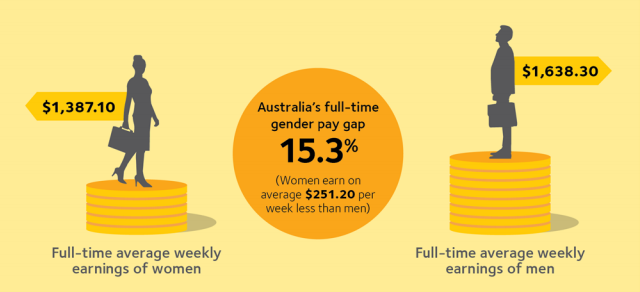
Gender inequality manifests itself in a range of ways including economic opportunities. Currently in Australia the national gender pay gap is 15.3%.

[1] The full-time total remuneration gender pay gap based on the Workplace Gender Equality Agency (WGEA) data is 23.1%, meaning men working full-time earn nearly $27,000 a year more than women working full-time. Data collected by the Australian Bureau of Statistics and WGEA highlights the “gender pay gap favouring full-time working men over full-time working women in every industry and occupational category in Australia”.[2]


There are several causes of the gender pay gap. They are rooted in gender inequality, one manifestation of which is discrimination and bias in hiring and pay decisions. The existence of male and female-dominated professions and industries that attract higher wages for men and lower for women is in itself rooted in rigid gender stereotypes and binaries. A nuanced analysis is required to understand why women are more likely on average to choose caring roles instead of careers in STEM, and this analysis cannot be done without acknowledging the impacts of gender stereotypes and prescribed roles and expectations on women. The gendered division of labour results in women’s disproportionate share of unpaid caring and domestic work and thus constitutes another cause of the gender pay gap. In Australia, mothers on average spend more than twice as many hours (8 hours and 33 minutes) each week looking after children aged under 15, compared to fathers (3 hours and 55 minutes).[3] Furthermore, Australian women account for 92 per cent of primary carers for children with disabilities, 70 per cent of primary carers for parents and 52 per cent of primary carers for partners.[4]


Given that women are more engaged in domestic and care work, the lack of workplace flexibility to accommodate caring and other responsibilities, especially in senior roles, is another cause of the gender pay gap. Finally, women’s greater time out of the workforce impacts on career progression and opportunities. 


WGEA reports that the gender pay gap starts from the time women enter the workforce. The gender pay gap immensely impacts women’s lifetime economic security. The gender pay gap and subsequent lack of economic security contributes to the feminisation of poverty. In 2016, 13.8% of all women in Australia were living in poverty.[5] Women’s higher rate of poverty results from poorer employment opportunities, women’s over-representation in lower level positions, the gendered wage gap, women’s increased likelihood of performing unpaid caring roles and as a result women’s lower financial security in retirement.[6] In 2012, 38.7% of elderly single women compared to 33.8% of elderly single men were living in poverty.[7]


The gender pay gap also results in women having less superannuation when they retire. The median super balance for a woman in the 55-64 age group was $80,000 compared to $150,000 for men. This represents a super gender gap of 47%.[8] As a result, as argued above, women are more likely to experience poverty in their retirement years and be far more reliant on the Age Pension.[9]


Fear of lacking income especially in later life is a real and major concern for many women. In 2015 economicSecurity4Women produced a Lifelong Economic Wellbeing for Women in Australia report. It concluded that women of all ages are not confident that they will have sufficient funds to live with respect and dignity in later life. A number of respondents felt that they would have to defer retirement indefinitely. 


There is a need to improve financial literacy for women, enable pathways to education and future employment that do not discriminate on gender, and address the gender pay gap by creating equal opportunities for all.   


Resources:  

economicSecurity4Women https://www.security4women.org.au/  

Workplace Gender Equality Agency https://www.wgea.gov.au/

References cited:  

[1] https://www.wgea.gov.au/addressing-pay-equity/what-gender-pay-gap  

[2] Ibid.

[3] Australian Bureau of Statistics, 4125.0 – Gender Indicators, Australia, Jan 2012: Caring for Children (February 2012). 

[4] Australian Bureau of Statistics, 4153.0-How Australians Use Their Time, 2006 (February 2008). 

[5] This is higher than the poverty rate of Australian men, which was 12.8 per cent. See Australian Council of Social Service (2016) Poverty in Australia: 2016, p. 32, available at: http://www.acoss.org.au/wp-content/uploads/2016/10/Poverty-in-Australia-2016.pdf  

[6] Australian Council of Social Service (2014) Poverty in Australia: 2014, p. 17, Available at http://www.acoss.org.au/images/uploads/ACOSS_Poverty_in_Australia_2014.pdf  

[7] Wilkins, R (2015), The Household, Income and Labour Dynamics in Australia Survey: Selected findings from Waves 1-12. Melbourne Institute of Applied Economic and Social Research, viewed 21 September 2016, available: https://www.melbourneinstitute.com/downloads/hilda/Stat_Report/statreport_2015.pdf  

[8] Australian Institute of Superannuation Trustees, Women in Super (2016) Women’s Super Summit 2016 

[9] R Tanton, Y Vidyattama, J McNamara, Q Ngu Vu & A Harding, Old Single and Poor: Using Microsimulation and Microdata to Analyse Poverty and the Impact of Policy Change Among Older Australians (2008) p 15. 


Day 7 Violence against Women and HIV Transmission

December 1st is World AIDS Day, when we raise awareness across the world about the issues surrounding HIV and AIDS. It is a day for people to show their support for people living with HIV and to commemorate people who have died.  


Today, we want to raise awareness about the connection between HIV/AIDS and violence against women. Research from countries most affected by HIV transmission established a clear and undeniable link between HIV infection and violence against women. This involves multiple pathways with the root causes lying in gender inequality.  


Rigid gender stereotypes about masculinity, gender roles and norms may lead to unsafe and/or non-consensual sex. Lack of gender equality and dominant social expectations prevent women from joint, safe and free negotiations of condom use. Unsafe sexual practices deny women the full enjoyment of their sexual and reproductive rights, and thus increase the risks of unplanned pregnancies and HIV and STI transmission.  


 Often, HIV transmission is the result of sexual and gender-based violence. In conflict situations, where rape is used as a weapon of war, the risks of HIV transmission are also high. 


In addition, several studies from different parts of the world have indicated that up to one third of adolescent girls reported that their first sexual experience was coerced.

[1]  


 Furthermore, the World Health Organisation states that “HIV can also be a risk factor for violence since disclosure can put women at risk of violence by their partners, family or community members”.[2] 


Economic factors exacerbate risks and put women in a vulnerable position. Women who are engaging in sex work or survival sex are at high risk both of being subjected to violence and of HIV transmission.  


Programmes and policies should address the underlying social and economic issues, structural factors, gender inequalities and harmful gender norms and apply a human rights focus. At the same time, there is a need to develop services, such as comprehensive post rape care that responds to the physical and psychological health needs of the violence survivor, and testing and counselling services that address violence.[3] A lot of work needs to be done to remove stigma and discrimination against people living with HIV/AIDS. 


 Resources: 


References cited:

[1] http://www.hivpolicy.org/Library/HPP001388.pdf  

[2] http://www.who.int/reproductivehealth/topics/violence/hiv/en/  

[3] http://www.who.int/reproductivehealth/topics/violence/hiv/en/  


Day 6 Spotlight on violence against the LGBTIQ community

Little research has been done into family violence in LGBTIQ relationships, yet anecdotal evidence suggests high rates. The family violence experiences of LGBTIQ people and the barriers they face in obtaining services are distinct from those of other victims/survivors of family violence.

[1] LGBTIQ people may also experience distinct forms of family violence, including threats to ‘out’ them.[2] Family violence in the context of LGBTIQ people is commonly perceived as violence inflicted by intimate partners, ex-partners or previous heterosexual partners. Such a perception overlooks the fact that violence can be inflicted by siblings, parents and other relatives too.[3] 


The existing evidence supports the following picture that LGBTIQ couples experience the same, similar or even higher levels of family violence, domestic violence, and intimate partner violence as heterosexual couples.[4] What is currently known is as follows:  

  • in a national study 32.7% of LGBTIQ Australians reported having been in a relationship where their partner was abusive (same-sex or opposite sex partner).[5] One third of this group reported having been physically injured, but only 20% had reported this to police;  
  • in a Victorian study, one third of LGBTIQ respondents had been in a relationship where they were subjected to abuse by their partner: 78% of the abuse was psychological and 58% involved physical abuse or being hit. Lesbian women were more likely to report an abusive same sex relationship than gay men (41% v. 28%);[6]  
  • transgender people may experience significantly higher levels of emotional, sexual or physical abuse from a partner or ex-partner.[7] In addition, they are at a higher risk of violence from their parents[8] due to entrenched homophobia and transphobia.[9]   

It is important to adopt an intersectional lens when talking about family violence in LGBTIQ communities. Different layers of identities and experiences as well as social positions affect people in different ways.  For instance, for older people, there may be a heightened risk of homophobic-related family violence, particularly as they become more dependant. Other factors compound general homophobia or transphobia to both put LGBTIQ people at greater risk of family violence and decrease access to supportive services. These intersections include:   

  • LGBTIQ people who are from culturally and linguistically diverse and/or religious backgrounds may be in settings that uphold rigid gender roles and conservative views about sexuality, while also facing racism and xenophobia;  
  • LGBTIQ people living with a disability (21% of LGBTIQ people) may have more barriers to access services which in their turn may be less inclusive towards both sexuality, gender identity and/or disability.  

In addition, the LGBTIQ population’s disproportionate, life-long exposure to physical and verbal violence, sexual violence and discrimination can exacerbate people’s vulnerability to, and the impact of, family violence by:  

  • contributing to the cumulative impact of violence on people’s psychological and physical health and social isolation;  
  •  making it more difficult for LGBTIQ people to both recognise and leave abusive relationships involving partners, parents and other family members;  
  • giving people cause to fear and mistrust services, including health and community services, police and the legal system.  

In terms of specialised services for both victims/survivors and perpetrators of family violence there are significant gaps. Service issues for LGBTIQ people who experience family violence include:  

  • Exclusion of transgender women from support services for victims, including refuges and support groups;  
  • Lack of support for gay, bisexual and transgender men;  
  • Lack of support for lesbian/bi women and transgender women.   

Service issues for LGBTIQ people who have been violent include: 

  • Lack of culturally safe, behaviour change options for gay, bisexual or transgender men who have been violent towards their current/ex partners; and  
  • No program options for lesbian, bisexual or transgender women who have been violent towards their current/ex partners.[10] 

The level of awareness of LGBTIQ experiences and needs is limited among police, in the courts, among service providers and in the community generally. As a result, LGBTIQ people can feel invisible in the family violence system.[11] 


There is now stablished evidence that family violence is the leading cause of homelessness in Australia[12], and reasons for LGBTIQ people homelessness follow the same pattern. Young LGBTIQ people are at higher risk of homelessness than their peers: Victorian research suggests that same sex attracted young people are disproportionately more homeless than opposite attracted young people.[13]  LGBTIQ young people often become homeless because of family conflict due to their gender, sexuality, and/or intersex variations. Sydney-based organisation Twenty10 estimates that 70% of homeless young people overall leave home to escape family violence and relationship breakdowns.  


GALFA LGBTI Homelessness Research Project[14] concludes from the collected data that LGBTI young people who have experienced homelessness are at higher risk than their cisgendered heterosexual counterparts of bullying at school, poorer mental health, experiences of trauma and childhood abuse, substance abuse issues, survival sex, STIs and HIV, multiple experiences and longer periods of homelessness.  


Systemic and comprehensive changes on the levels of policy, law and community attitudes are required to reduce violence against LGBTIQ people more broadly and family violence in particular. Governments should provide sustainable and adequate funding for the development of LGBTIQ-specific resources, programs and targeted community education campaigns and identification of research priorities and effective prevention strategies.  Other much-needed reforms include: service providers to adopt inclusive practices; better data collection that includes sex, sexual orientation and gender identity; and training on LGBTIQ for all services and agencies.  


Resources:  

  • ACON: www.acon.org.au 
  • ACON’s DFV in LGBTIQ relationships ‘Say It Out Loud’: sayitoutloud.org.au 
  • Another Closet (2015)
    The LGBTIQ Domestic Violence Interagency has produced a resource titled Another Closet for LGBTIQ people who may be experiencing domestic or family violence. It also has information for people supporting an LGBTIQ friend or family member who is experiencing abuse, contains information on what domestic violence is, what to do if you are experiencing abuse, tips for making a safety plan, information for how to support a friend or family member and the details for some referral services in NSW.
    www.anothercloset.com.au 
  • One Size Does Not Fit All (2011)
    ACON’s gap analysis of NSW domestic violence support services in relation to gay, lesbian, bisexual, transgender and intersex communities’ needs.
    One Size Does Not Fit All 
  • Calling It What It Really is (2015)
    A report into lesbian, gay, bisexual, transgender, gender diverse, intersex and queer experiences of domestic and family violence
    Click here to download 
  • Bring Violence Out Of The Closet
    Bring Violence Out of the Closet is a print resource was produced by the NSW Police to assist the LGBTI community to report domestic and family violence. It provides an outline of what to expect when you make a report to the police, clarifies key roles and offers details of referrals for additional support. 
  • LGBTI Domestic Violence Toolkit
    The LGBTI Domestic Violence Toolkit is a resource for agencies and service providers supporting LGBTI victims of domestic violence and their families. 


 References cited: 

[1] See: safe steps Family Violence Response Centre and No To Violence (2015) Joint submission into the Royal Commission into Family Violence: Family Violence and LGBTIQQ Communities; Drummond Street Services and the Victorian AIDS Council (2015) Joint submission into the Royal Commission into Family Violence: Family Violence and LGBTIQQ Communities.  

[2] State of Victoria, Royal Commission into Family Violence: Summary and recommendations, Parl Paper No 132 (2014–16).  

[3] Dr Philomena Horsley (2015) Family Violence and The LGBTIQ Community Submission to The Victorian Royal Commission Into Family Violence On behalf of Gay and Lesbian Health Victoria, Australian Research Centre in Sex, Health & Society, La Trobe University, Melbourne   

[4] Chan, C. 2005, Domestic Violence in Gay and Lesbian Relationships, Australian Domestic and Family Violence Clearinghouse  

[5] Pitts, M, Smith, A, Mitchell, A, Patel, S 2006 Private Lives: A report on the health and wellbeing of GLBTI Australians. Gay and Lesbian Health Victoria and the Australian Research Centre in Sex, Health and Society, La Trobe University, Melbourne  

[6] Leonard, W., Mitchell, A., Patel, S., Fox, C. 2008, Coming forward: The under-reporting of heterosexist violence and same sex partner abuse in Victoria, Gay and Lesbian Health Victoria, La Trobe University, Melbourne  

[7] Scottish Transgender Alliance, 2010 Out of sight, out of mind? Transgender people’s experiences of domestic abuse, Scotland  

[8] Victorian Royal Commission into Family Violence, Report and Recommendations (2016) vol 5, 144, 143 citing Marian Pitts et all, Private lives: a report on the health and wellbeing of GLBTIQ Australians (Australian Research Centre in Sex, Health and Society, La Trobe University, 2006), 51-52.  

[9] Dr Philomena Horsley (2015) Family Violence and The LGBTIQ Community Submission to The Victorian Royal Commission Into Family Violence On behalf of Gay and Lesbian Health Victoria, Australian Research Centre in Sex, Health & Society, La Trobe University, Melbourne  

[10] Dr Philomena Horsley (2015) Family Violence and The LGBTIQ Community Submission to The Victorian Royal Commission Into Family Violence On behalf of Gay and Lesbian Health Victoria, Australian Research Centre in Sex, Health & Society, La Trobe University, Melbourne  

[11] State of Victoria, Royal Commission into Family Violence: Summary and recommendations, Parl Paper No 132 (2014–16).  

[12] Spinney A 2012. Home and safe? Policy and practice innovations to prevent women and children who have experienced domestic and family violence from becoming homeless. Final report no. 196. Melbourne: Australian Housing and Urban Research Institute. 

[13] Rossiter, B, Mallett, S, Myers, P, Rosenthal, D 2003 Living Well? Homeless young people in Melbourne, Parity, 16(2), 13-14 

[14] GALFA LGBTI Homelessness Research Project (2017) Stage 1 Report LGBTI Homelessness: Preliminary findings on risks, service needs and use. Available at http://www.lgbtihomeless.com/wp-content/uploads/2017/01/LGBTI-Homelessness-Stage-1-Report-Preliminary-findings-on-risks-service-needs-and-use.pdf  


Day 5 Spotlight on Violence against Women Human Rights Defenders

In 1998, a landmark Declaration on Human Rights Defenders was adopted by the UN General Assembly, providing recognition to people who work to protect and promote human rights. While in every region human rights defenders become subjected to violence, women human rights defenders are often targeted not only for their “activism but also because of their gender and their activities are repeatedly delegitimized and denigrated”.

[1]


With the recognition of the gendered dimension of human rights work, in 2013 the UN General Assembly adopted a Resolution 18 focusing solely on women human rights defenders.[2] The resolution provides a comprehensive and nuanced understanding of the “structural and systemic discrimination and violence they face and calls upon states to create a safe and enabling environment for them”.[3]


Amnesty International states that “women human rights defenders face various forms of gender-based violence in addition to the attacks other human rights defenders might face, including sexual violence, and threats, harassment and defamation campaigns linked to their status as women”.[4]  Often, women human rights defenders work in traditional settings and challenge traditional norms, thus becoming more vulnerable to gender-based violence and attacks. Women are also often subjected to family and community rejection because of the perceived fear from the latter that women’s human rights work threatens their culture, tradition or values.


Women who are adopting intersectional approaches in their human rights work and who are working with Indigenous communities, LBGTIQ communities or others experience double if not triple discrimination. Amnesty International states that “LGBTI defenders experience intersectional discrimination, both for their work as human rights defenders and because they experience transphobic or homophobic discrimination because they are or are perceived as being LGBTI”.[5]


Women are often subjected to sexual harassment during official negotiations or advocacy meetings, including by being objectified and disregarded as experts. Consider these two recent examples from UN climate negotiations.


Women working on the issues of sexual and reproductive rights, gender equality, family and domestic violence are also vulnerable to abuse and threats, including technology-facilitated abuse. For women in regional and rural areas, the risks are increased due to the fact that they are normally known to both victim/survivors and perpetrators. Women also become targets for trolling and cyberbullying online for promoting of equality and rights of women and girls.


It is important to recognise the specific challenges this group of defenders face, in order to strengthen protection mechanisms and other responses to their specific concerns at both local and international levels.


Today on the International Day of Human Rights Defenders, we are celebrating the courage and commitment of women who dedicate their lives to achieve justice and equality for all.


 Resources:  


References cited:

[1] Amnesty International (2017) Human Rights Defenders under threat: shrinking space for civil society.  

[2] https://www.awid.org/news-and-analysis/first-resolution-protecting-women-human-rights-defenders-adopted-un-amid-strong  

[3] Amnesty International (2015) Their lives on the line: Women human rights defenders under attack in Afghanistan.  

[4] Amnesty International (2017) Human Rights Defenders under threat: shrinking space for civil society. 

[5] Ibid. 


Day 4 The Unique Role of Specialist Women’s Services in Ending Violence against Women

One of the core priorities of AWAVA is to promote the unique role of special women’s services in ending violence against women. Building on feminist and social justice approaches, the impact and effectiveness of specialist women’s services is underpinned by a set of good practice principles that are supported by international research and evidence-based practice.  


These principles should underpin the delivery and coordination of all essential services responding to women and children subjected to violence. Get your copy online or in print (contact us for a free copy to be posted to you).  


Resources: 

Go to Top